
If you want the closest match to Buffer's simplicity at a lower cost, start with SocialPilot or Publer. If you post mostly to Instagram and want stronger visual planning, Later or Sked Social fit better. If your team has outgrown scheduling and needs real analytics or listening, Sprout Social or Metricool are the upgrade.
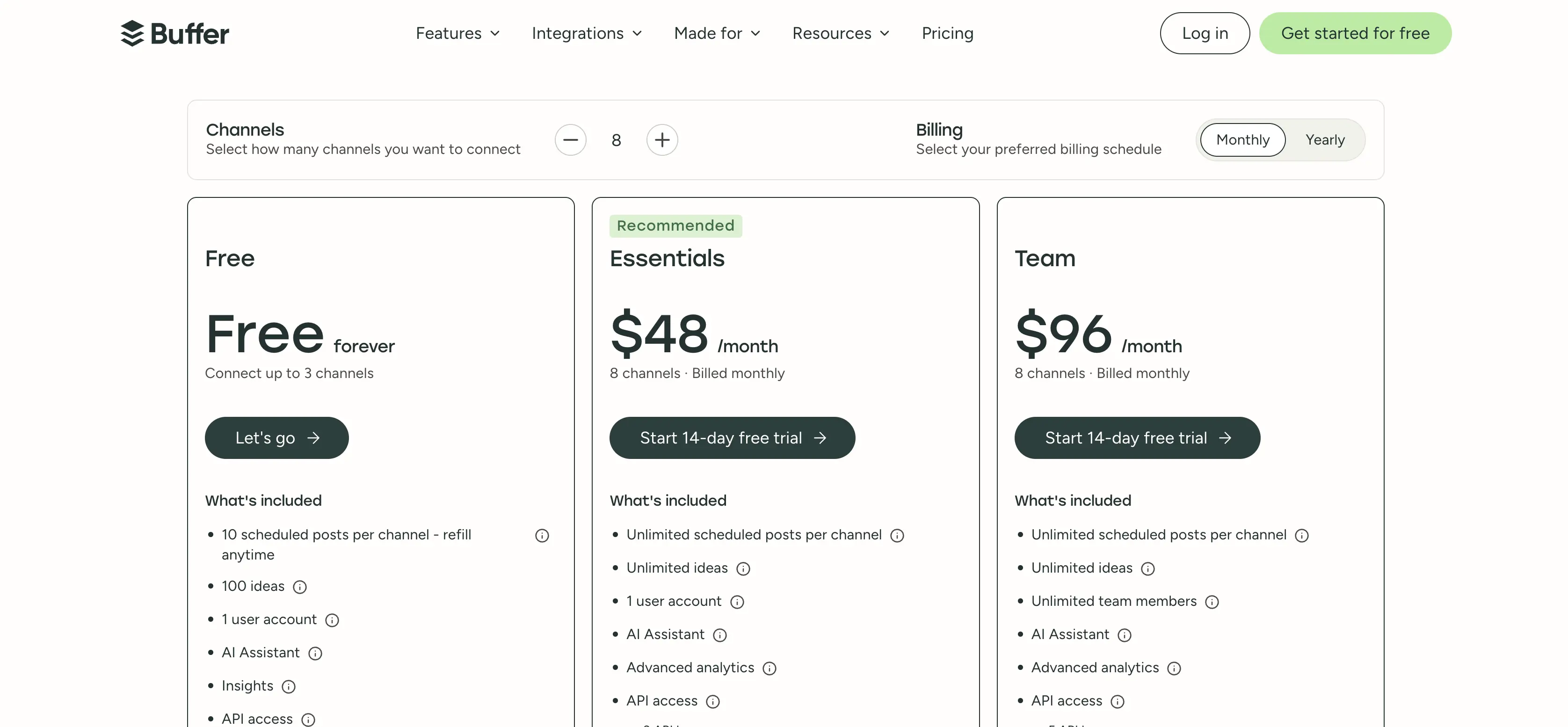
I connected 8 channels across three schedulers this month and tracked exactly what each one billed me, down to the cent. Buffer's own math surprised me. The Essentials plan charges $5 a month per channel for your first 10 channels, then drops to $3.33 once you cross channel 11. Most articles comparing Buffer alternatives just say "per-channel pricing adds up." Almost none of them run the actual tiered math, and fewer still mention the line buried in Buffer's own Help Center, which states the free plan "includes a lifetime limit of eight unique channel connections." Disconnect and reconnect all you want. Once you've touched 8 different accounts, the free plan is done with you.
That's the gap this guide fills. Below are 15 real alternatives to Buffer, grouped by what you're actually trying to fix: cost, visuals, team approval, content recycling, analytics, or AI-generated content. Every price below is pulled from each tool's own pricing page or a source that verified against it, current as of this write-up.
Why people go looking for a Buffer alternative
Buffer is not a bad tool. It's a clean, reliable scheduler with one of the few actually usable free plans in the category. The reasons people leave usually come down to three things. First, the per channel billing model rewards a narrow setup and punishes anyone managing more than a handful of accounts, especially agencies onboarding new clients regularly. Second, the free plan's channel cap (3 active, 8 lifetime) forces an upgrade decision earlier than most competitors. Third, Buffer's AI Assistant only rewrites and drafts text. It doesn't generate images, video, or carousels, so if you want an AI social media tool that also creates the visual, you'll be pairing Buffer with something else anyway.
None of that makes Buffer wrong for everyone. If you post to 3 to 5 channels and want a plain scheduler with clean analytics, it's still one of the better value options on the market. It's also worth checking where the crowd actually lands: G2's Buffer competitors page currently ranks HubSpot Marketing Hub as the top-rated overall alternative, sitting at roughly 4.4 stars across more than 14,000 reviewers, well ahead of most niche schedulers on raw review volume. This list is for the people who've hit one of the three walls above.
Cheaper, Simpler Switches (closest to what Buffer already does)
SocialPilot
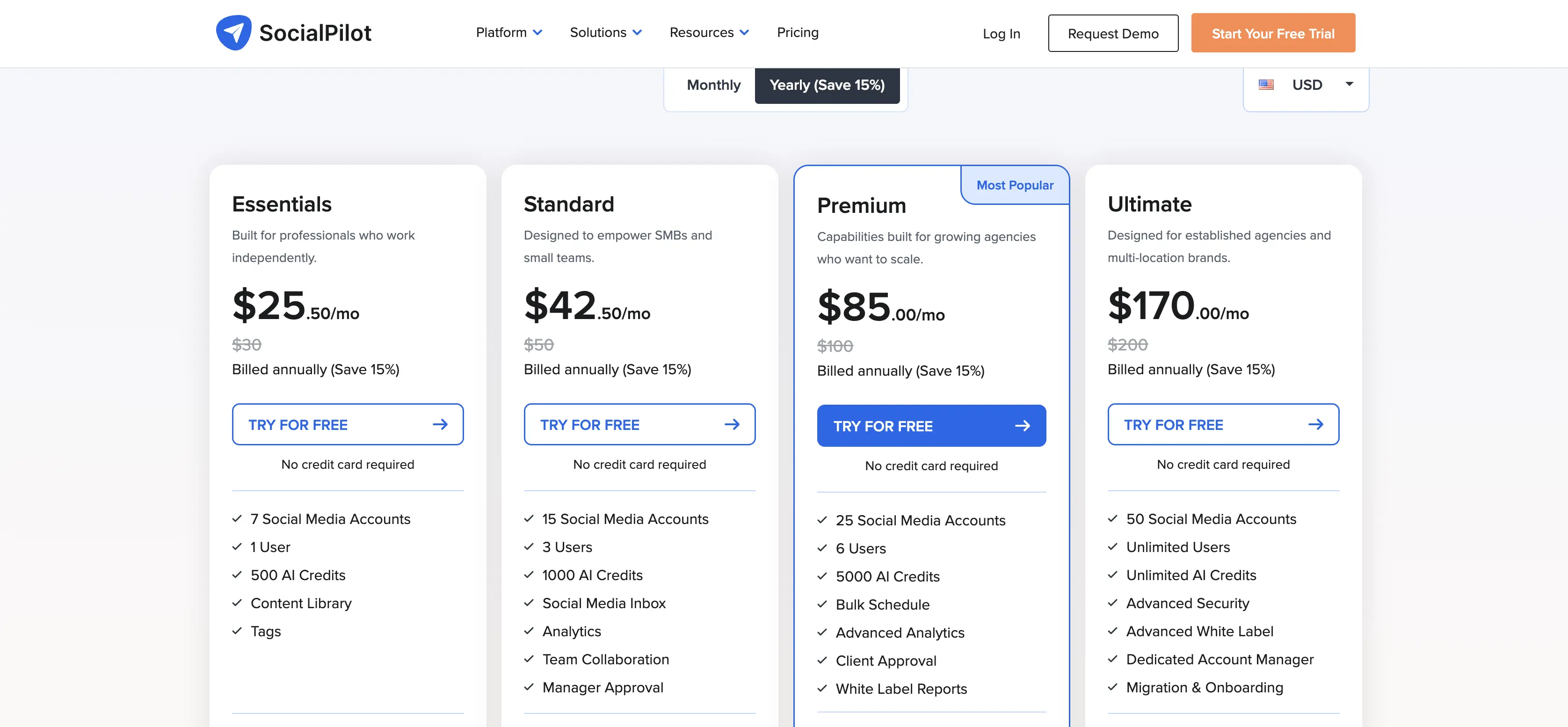
SocialPilot is the most direct swap if price is your main complaint. The Essentials plan runs about $20 a month flat for 7 social accounts, and the Premium tier stretches to 35 accounts with unlimited users. For an agency running 10 or more client channels, that flat structure beats Buffer's per-channel bill by a wide margin once you cross Buffer's own volume discount threshold.
Publer
Publer Undercuts almost everyone on price. It has a real free plan, and its Professional tier starts around $4 to $5 per social account per month on annual billing, similar territory to Buffer's Essentials rate but without the 3 channel free cap. It's a solid pick if you just want Buffer's simplicity minus the early upgrade pressure.
Social Champ
Social Champ runs two pricing models side by side: pay-per-profile from about $4 to $5 a month, or flat bundles for teams that want a predictable bill. It includes a free forever plan for 3 accounts, matching Buffer's free tier, but without Buffer's lifetime 8-connection ceiling.
Best for Visual First and Instagram Heavy Accounts
Later
Later built its reputation on the visual content calendar, and it shows the moment you open the grid view. The Starter plan runs $18.75 a month on annual billing for one social set, which covers Instagram, TikTok, Facebook, and a handful of other channels together as a bundle rather than billing each one separately.
If the social set bundle is the part that doesn't fit, our Later alternatives roundup prices the tools that bill per channel instead.
Vista Social
Vista Social pairs a visual planner with unusually strong review scores. Entry pricing sits around $79 a month, higher than Later, but it bundles social listening as an add-on and a review management inbox that Later doesn't offer at the same tier.
Sked Social
Sked Social leans hardest into Instagram specific features: first comment hashtags, auto publishing to Reels, and a visual grid preview. The Launch plan starts at $59 a month for 3 accounts with unlimited team seats, though extra accounts add $8 to $12 a month each, so the bill climbs fast for anyone past a single brand.
Best for Team Approval and Client Workflows
Planable
Planable exists for one reason: making content review painless. Every post shows a live preview of exactly how it'll look on each platform before it goes out, and feedback stays attached to the post instead of scattered across email threads. The free plan is limited, and paid plans start around $39 per user per month.
Planable's approval flow is also the closest match to what ContentCal offered before Adobe retired it, which is why it leads our ContentCal alternatives roundup.
Agorapulse
Agorapulse puts the unified inbox at the center instead of the calendar. If your team spends as much time replying to comments and DMs as scheduling posts, this is the stronger fit. Pricing starts at $69-$79 per user per month, depending on the plan, and as of early 2026, it no longer offers a free tier.
Sendible
Sendible is built around agencies juggling multiple clients, with a Client Connect feature that lets clients approve posts without ever creating a login. The Creator plan starts around $25 to $29 a month for one user and 6 accounts.
Best for Content Strategy and Recycling Evergreen Posts
SocialBee
SocialBee organizes content into categories with different posting frequencies and automatically recycles evergreen posts so your queue never runs dry. The Bootstrap plan starts at $29 a month, and it has no free tier, only a 14-day trial.
CoSchedule
CoSchedule ties social scheduling to an actual editorial calendar, which matters if your team also plans blog posts and email campaigns alongside social. The free Calendar plan covers 1 user and 1 profile, and the Social Calendar plan costs $19 per user per month on annual billing.
Best for Analytics, Listening, and Larger Teams
Metricool
Metricool offers one of the most generous free plans in the category, including analytics most competitors lock behind a paywall. The Starter plan runs from about $20 a month on annual billing for 5 brands, making it a strong pick for anyone who wants Buffer level simplicity with deeper reporting attached.
Sprout Social
Sprout Social is the enterprise grade jump. Standard pricing runs around $199 per seat per month, which is a real step up from Buffer, but it includes social listening, competitive benchmarking, and reporting depth that neither Buffer nor most of this list attempt to match.
Hootsuite
Hootsuite sits in similar territory. The Professional plan runs $99 a month for a single user, and Team jumps to $249 a month, both well above Buffer's entry pricing, but Hootsuite's breadth across listening, ads, and app integrations is built for a different scale of operation entirely. If Hootsuite's own pricing feels just as steep, our Hootsuite alternatives roundup covers cheaper options on both sides of that gap.
Best for AI-generated content instead of AI-written Captions
Blotato
Blotato flips the AI question Buffer can't answer. Where Buffer's AI Assistant only rewrites text, Blotato's $29-a-month Starter plan includes AI image generation, AI video generation, and unlimited AI writing across 20 connected accounts on one flat price. If the reason you're comparing Buffer alternatives is that you want the AI to make the content, not just edit your draft, this is the tool built around exactly that gap.
The Channel-Pricing Math Nobody Runs
Here's the number that changes the decision for anyone above 10 channels. Buffer's Essentials plan charges $5 a channel a month for your first 10 channels on annual billing, which is $50 a month at 10 channels. Add 10 more channels and, instead of doubling to $100, the bill only rises to about $83 a month, because channels 11 through 25 drop to $3.33 each. That volume discount softens the pain most competitor roundups warn you about, more than people expect. Where flat rate tools like SocialPilot or Blotato still win is below that 10 channel mark, where Buffer's rate hasn't dropped yet, and a flat monthly fee is already cheaper per account.
Buffer Alternatives Comparison
Tool | Starting price | Free plan | Best for |
|---|---|---|---|
SocialPilot | ~$20/mo (7 accounts) | 14-day trial only | Agencies wanting flat pricing |
Publer | ~$4 to $5/account/mo | Yes | Cheapest direct Buffer swap |
Social Champ | ~$4 to $5/account/mo | Yes (3 accounts) | Flexible pricing models |
Later | $18.75/mo (1 social set) | 14-day trial only | Instagram and visual planning |
Vista Social | ~$79/mo | Limited | Visual planning plus listening |
Sked Social | $59/mo (3 accounts) | No | Instagram-first agencies |
Planable | ~$39/user/mo | Limited | Client and team approvals |
Agorapulse | ~$69 to $79/mo/user | No (as of 2026) | Inbox-heavy teams |
Sendible | ~$25 to $29/mo | No | Multi-client agencies |
SocialBee | $29/mo | No | Evergreen content recycling |
CoSchedule | $19/mo/user | Yes (limited) | Social plus editorial calendar |
Metricool | ~$20/mo (5 brands) | Yes | Free-plan analytics depth |
Sprout Social | ~$199/seat/mo | No | Enterprise listening and reporting |
Hootsuite | $99/mo (1 user) | No | Large teams needing breadth |
Blotato | $29/mo (20 accounts) | No | AI-generated images and video |
How to Pick the Right Buffer Alternatives
If your main complaint is price and you manage under 10 channels, start with SocialPilot or Publer, since both beat Buffer's per-channel rate before the volume discount kicks in.
If you're posting mostly to Instagram and TikTok and want a visual-first calendar, Later or Sked Social will feel more natural than Buffer's list view.
If your team spends more time replying to comments than scheduling new posts, Agorapulse's inbox will save more time than any scheduler feature Buffer offers.
If you're an agency juggling client approvals, Sendible's no-login client review or Planable's live post previews solve a problem Buffer doesn't touch at all.
If you want the AI to generate the actual content instead of only rewriting your draft, Blotato is the only tool on this list built around that gap.
FAQ: Buffer Alternatives
Is there a free Buffer alternative?
Yes. Publer, Social Champ, Metricool, and CoSchedule all offer real free plans, and unlike Buffer's, none of them cap your account at a lifetime total of 8 channel connections.
What's the cheapest Buffer alternative for agencies?
SocialPilot's flat-rate model is the cheapest option for agencies managing more than 5 to 6 client accounts, since its Essentials plan covers 7 accounts for about $20 a month total, not per account.
Are there Buffer alternatives with better AI features?
Yes. Blotato includes AI image and video generation on its entry plan, something Buffer's text-only AI Assistant doesn't attempt at any tier.
Which Buffer alternative is best for teams that need approvals?
Planable and Sendible are both built around review workflows. Planable shows a live preview of each post before publishing, while Sendible lets clients approve posts without a login.
Do any Buffer alternatives include social listening?
Sprout Social, Hootsuite, and Vista Social all include some form of listening or competitive tracking, a feature Buffer doesn't offer at any plan level.
Is Buffer cheaper than Hootsuite and Sprout Social?
Yes, by a wide margin at low channel counts. Buffer's Essentials plan starts at $5 a channel, while Hootsuite starts at $99 a month and Sprout Social around $199 a seat, though both include analytics depth Buffer doesn't match.
Conclusion for Buffer Alternatives
None of these 15 tools are a straight upgrade over Buffer in every category. They each fix a specific thing Buffer doesn't do well: flat pricing past a certain channel count, deeper visual planning, real team approvals, evergreen recycling, listening, or AI that actually creates content instead of just rewriting it. Match the tool to the specific wall you hit, not the highest star rating on a review site, and the switch will actually solve the problem that sent you looking in the first place.