

Notion is the strongest all-around pick if your team already leans on AI and wants docs plus databases in one place. Docmost is the best free option if you can self-host and want a near drop-in Confluence importer. Nuclino is the pick for a small team that just wants a fast, simple wiki with no learning curve.
An Ask HN thread titled "What's a modern alternative to Confluence for small dev teams?" collected real answers from working engineers in September 2025, and Confluence barely came up. I spent two weeks checking whether the thread had a point: pulling official pricing pages, testing import flows, and running one calculation almost nobody publishes: what Confluence actually costs once a team needs single sign-on. Confluence is Atlassian's wiki and knowledge management tool, the usual companion to Jira for project docs and onboarding guides.
Short version: Confluence's sticker price and its real price are two different numbers, and that gap is the reason most of the alternatives below get picked.
Where Confluence starts to strain
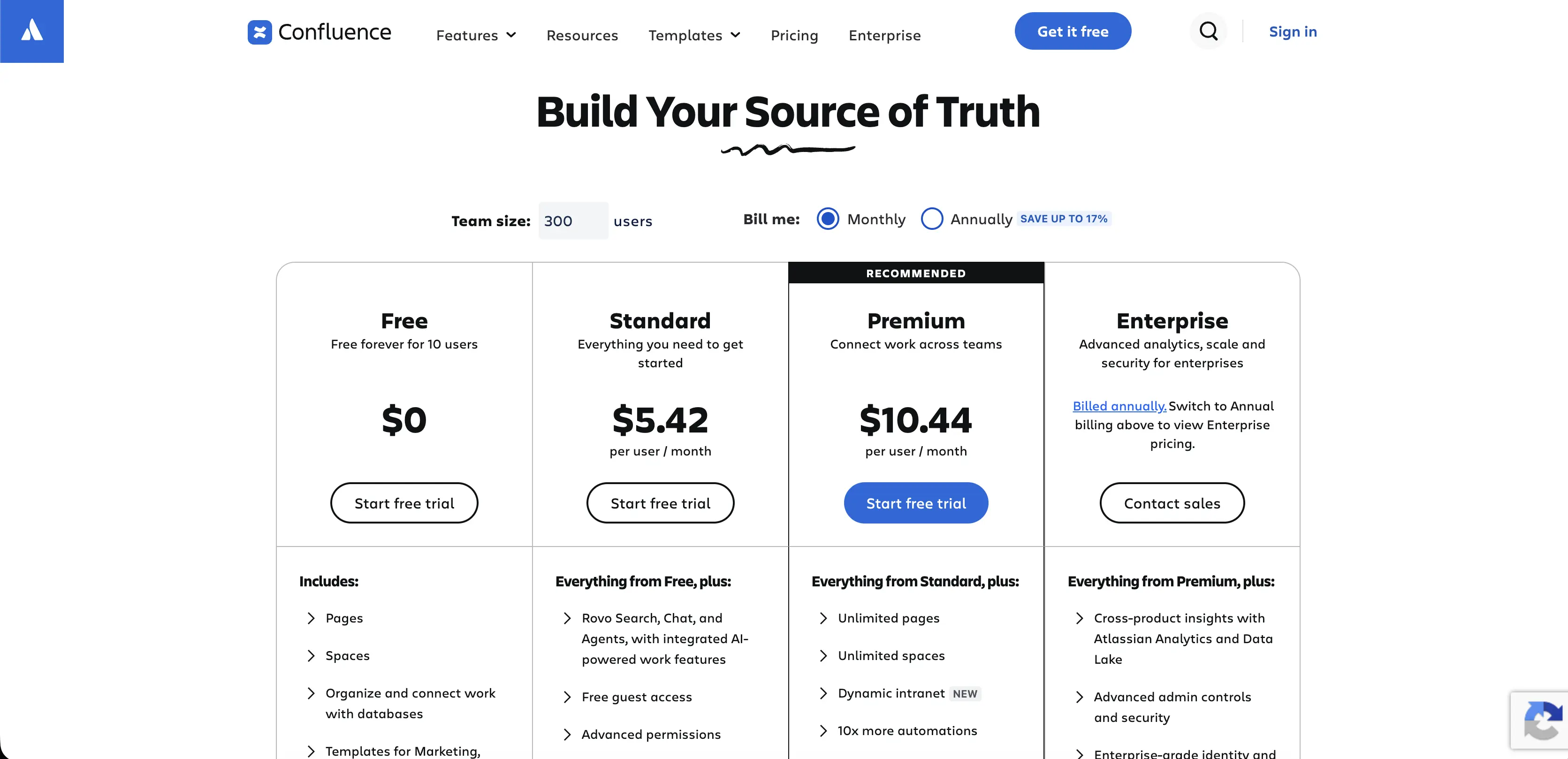
Confluence's Free plan covers up to 10 users with 2GB of storage, fine for a pilot and not much else. Standard runs about $5.16 to $5.42 per user per month on annual billing, and Premium runs about $10.44 per user per month with unlimited storage and a 99.9% uptime SLA. Server support ended years ago, so teams that wanted to stay off the cloud got pushed onto Data Center, a self-hosted license starting around $28,000 a year for 500 users, before infrastructure.
What's less visible is how the sticker price and the real price diverge the moment a team adds one feature almost every growing company needs: single sign-on.
The SSO math nobody puts on the pricing page. Standard and Premium Confluence plans do not include SAML SSO. You buy it separately as Atlassian Guard Standard, priced at roughly $4.20 per user per month and billed across every managed account in your Atlassian organization, not just Confluence seats. Run the number for a 25-person team on Standard: 25 users at $5.42 a month comes to $135.50 a month, or $1,626 a year. Add Guard Standard for SSO, and that's another $105 a month, or $1,260 a year.
Total: $2,886 a year, about 78% more than the number the pricing calculator shows before you've added anything.
 Guard Standard is bundled at no extra cost only on Enterprise, which is sold through a sales call rather than a self-serve checkout.
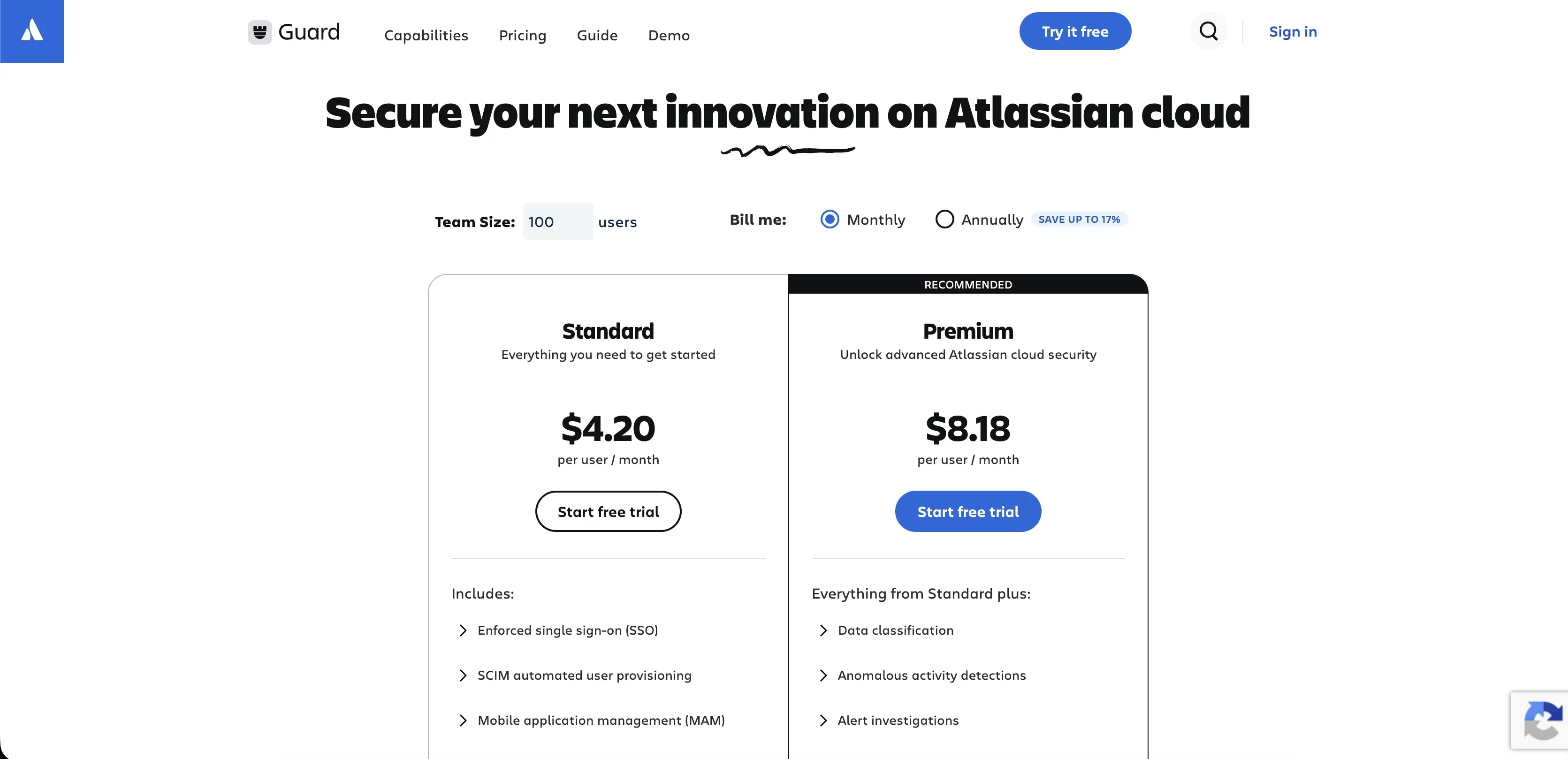 That single number is a big part of why several tools below look cheaper than they first appear: some of them bundle SSO into a mid-tier plan instead of billing it as a separate product.
Confluence Alternatives: If you want a Wiki and Project Tracking in one tool
Notion is an all-in-one workspace combining pages, wikis, and databases in one block-based editor. Free covers individual use; Plus runs $10/user/month annually; Business runs $20/user/month annually and bundles full Notion AI, SAML SSO, and private teamspaces into one price, the exact add-on Confluence bills separately through Guard. Notion ships a one-click Confluence importer for teams making this move.
ClickUp is a project management platform with Docs built in natively, not bolted on. Free Forever works for solo use; Unlimited runs $7/user/month annually; Business runs $12/user/month annually and adds Google SSO, unlimited automations, and workload management. A hybrid team currently paying for Jira, Confluence, and a separate time tracker can fold all three into one ClickUp bill.
Coda pairs documents with database objects, so a page can hold a live task tracker instead of plain text. The free plan is generous: unlimited docs with 50 objects per doc, and Team removes that cap entirely at around $10/user/month. The catch is a real learning curve: Coda rewards teams willing to learn its formula system and frustrates anyone expecting Notion-level simplicity on day one.
Read Also: Quip alternatives in 2026 (Low Cost, Better Mobility)
monday.com is a visual work management tool with a Docs feature for embedding live data inside written pages. Free covers 2 seats and 3 boards; Basic runs $9/seat/month annually; Standard runs $12/seat/month annually and adds automations. Paid tiers carry a 3-seat minimum, worth knowing if you hoped to pilot with one person first.
Basecamp breaks from every per-seat tool on this list. Plus is $15/user/month, but Pro Unlimited is a flat $299 a month billed annually for as many users as a company adds. A 25-person team on Pro Unlimited pays $3,588 a year regardless of headcount, close to what that team would pay for bare Confluence Standard with SSO turned on, and that flat fee covers the whole company.
Confluence Alternatives: If you just want a better dedicated wiki
Slite is an AI-powered internal wiki built for company-wide knowledge sharing. Standard runs $8/user/month; Premium runs $12.50/user/month and adds priority support and API access; Enterprise is custom and adds audit logs and SSO. Slite's agent flags stale pages on its own, the single most common complaint people have about aging Confluence spaces.
Nuclino is a lightweight, visual wiki with a graph view alongside the usual list and board views. Starter runs $6/user/month, Business runs $10/user/month, and a free tier exists for small teams testing it out. It has no Enterprise tier at all, so a large org will eventually outgrow it, but for a team under 50 it's the cheapest real wiki here.
Tettra answers questions inside Slack by pulling from your knowledge base and past conversations. Basic starts around $4 to $5/user/month with a 10-user minimum; Scaling runs about $10/user/month; Professional is custom, roughly $7,200 a year with a 50-user minimum. It's built for Slack-centric teams and does little for anyone outside that workflow.
Guru verifies knowledge cards on a schedule so answers don't silently go stale, and ships a browser extension that surfaces answers inside whatever app someone's already using. Self-serve pricing is $25/seat/month with a 10-seat minimum, so the real floor is $250 a month even for a 5-person team. It's an internal tool only: every person who needs an answer needs a paid seat.
GitBook is a developer-focused documentation publisher with native Git sync and OpenAPI support. The free tier covers one user; Premium starts around $65 to $79 per site monthly plus $12 to $15/user; Ultimate runs up to $249 to $299 per site plus $15/user. The site fee is the catch: a team publishing docs for three products pays that charge three times before adding a single extra seat.
Document360 builds AI-powered, customer-facing knowledge bases with multilingual content support. It discontinued its free tier in November 2024 and now sells entirely through a sales call, so there's no published self-serve rate to compare against Confluence's list price.
Confluence Alternatives: If you want to own your data and skip per-seat billing
Docmost is an open-source, self-hosted wiki released under the AGPL-3.0 license, built specifically as a Confluence and Notion alternative with real-time collaborative editing, nested spaces, and built-in diagramming. The core is free to self-host; managed and paid self-hosted tiers with SSO and advanced permissions start around $3.50 to $5/user/month.
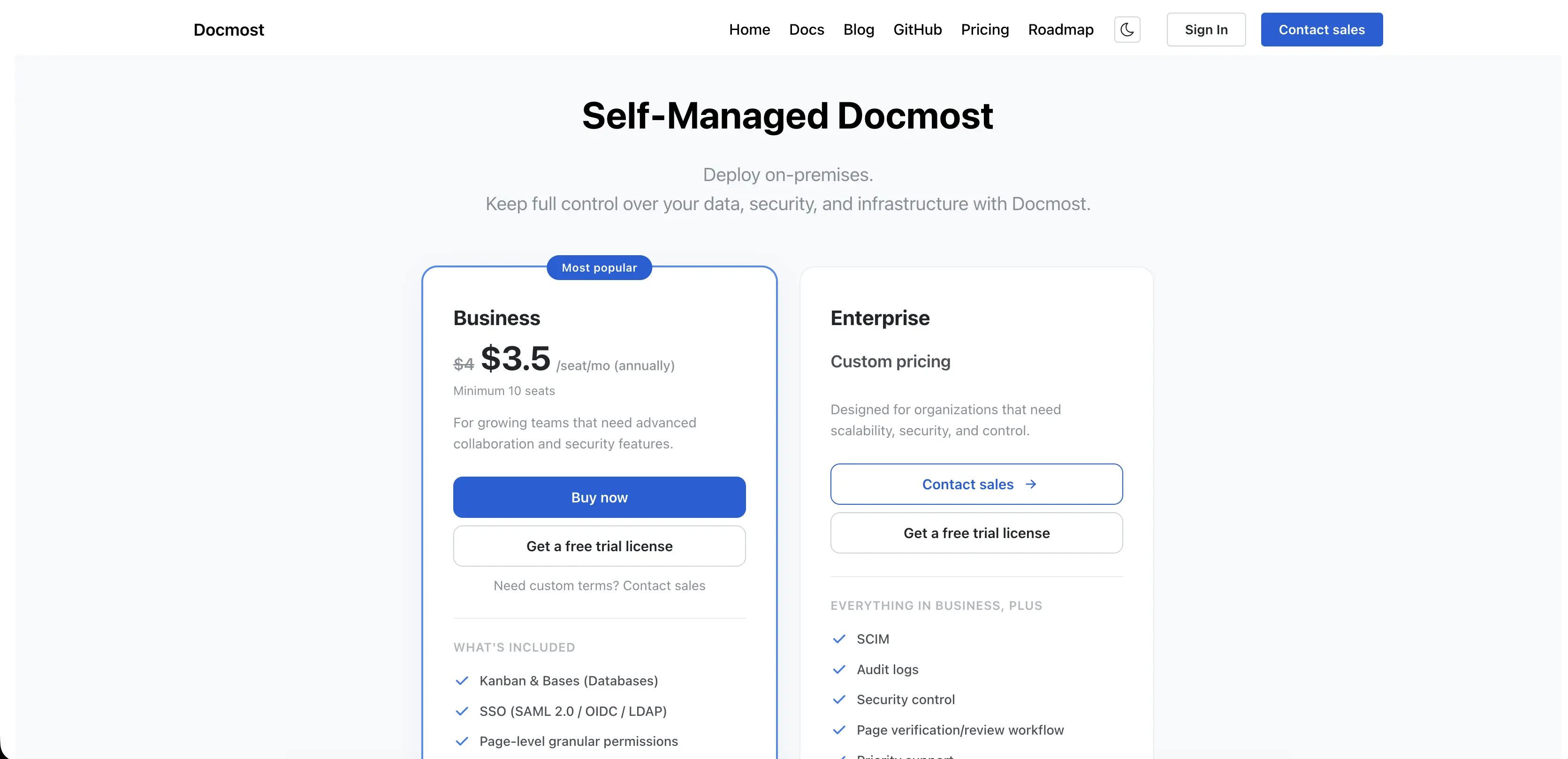 Docmost ships a direct Confluence importer, and founder Philip Okugbe confirmed the feature the day it shipped, writing on X: "Docmost v0.21 comes with the ability to import pages from both Confluence and Notion" (source).
Outline is a source-available team wiki (BSL 1.1 license) with a real-time editor and full-text search, built for teams who want a Notion-style experience without sending internal documents to a third party. Self-hosting costs whatever a small VPS runs, often $10 to $20 a month flat regardless of headcount; Outline Cloud runs closer to $10/user/month for teams that would rather skip managing a server.
BookStack is a fully open-source wiki (MIT license) organized into shelves, books, chapters, and pages instead of a flat page tree. It's free to self-host with no paid tier at all, and it shows up in nearly every r/selfhosted thread asking for a Confluence replacement because setup is a single afternoon of work.
Read Also: 10 Best Jira Alternatives in 2026 (Without the seat-tier pricing games)
Wiki.js is a Node.js based open source wiki that stores every page as a Git commit. It's free to self-host, and it gives engineering teams that already think in commits and pull requests full version history with no extra plugin.
Confluence Alternatives Quick specs
Notion: from $10/user/mo (Plus), free tier available, no self-hosting
ClickUp: from $7/user/mo (Unlimited), free tier available, no self-hosting
Coda: from $10/user/mo (Team), generous free tier, no self-hosting
monday.com: from $9/seat/mo (Basic), free tier available, no self-hosting, 3-seat minimum
Basecamp: $15/user/mo or $299/mo flat unlimited, limited free tier, no self-hosting
Slite: from $8/user/mo (Standard), no free tier, no self-hosting
Nuclino: from $6/user/mo (Starter), free tier available, no self-hosting
Tettra: from about $4 to $5/user/mo (Basic, 10-user minimum), no free tier, no self-hosting
Guru: $25/seat/mo (10-seat minimum), no free tier, no self-hosting
GitBook: from $65 to $79/site/mo plus $12 to $15/user/mo, free tier for 1 user, no self-hosting
Document360: sales-led pricing only, no free tier, no self-hosting
Docmost: free to self-host, paid tiers from about $3.50 to $5/user/mo, self-hosting native
Outline: free to self-host, Outline Cloud around $10/user/mo, self-hosting native
BookStack: free, self-hosting only, no paid tier
Wiki.js: free, self-hosting only, no paid tier
Picking the right Confluence Alternatives
If your team is small and budget-conscious, Nuclino or BookStack cover the basics for close to nothing. If compliance or data residency rules out any cloud tool, Docmost gets you closest to Confluence's feature set without the per-seat bill, and it's the one tool here built to import Confluence content directly. Teams still deep in the Atlassian ecosystem, running Jira daily and relying on tight two-way linking between issues and pages, will often find migrating away costs more in workflow disruption than it saves in license fees, so weigh that before switching on price alone.
Teams that want an AI layer across docs, tasks, and search tend to land on Notion or ClickUp, since both bundle SSO into a mid-tier plan instead of charging for it separately. Teams that mainly need a customer-facing or developer-facing knowledge base, rather than an internal wiki, should look at GitBook or Document360 instead.
FAQ
Is there a free Confluence alternative?
Yes. Nuclino, ClickUp, Coda, and Notion all have usable free tiers, and BookStack, Wiki.js, and self-hosted Docmost are free indefinitely if you can run your own server.
What is the cheapest Confluence alternative?
For a self-hosted team, BookStack and Wiki.js cost nothing beyond server hosting. For a cloud tool, Nuclino at $6/user/month undercuts Confluence Standard's roughly $5.42 once you factor in that Confluence bills SSO separately.
Is there a self-hosted Confluence alternative?
Docmost, Outline, BookStack, and Wiki.js are all self-hostable. Docmost is the closest match feature for feature, and the only one of the four with a built-in Confluence importer.
Which Confluence alternative works best for small teams?
Nuclino and Slite both target teams under 50 with simple setup and no sales process. Basecamp's flat $299 monthly rate gets more attractive the closer a team gets to 20 people.
What is the best Confluence alternative for teams still using Jira?
ClickUp and Notion offer the most direct replacement for Confluence's page-and-space structure, though neither matches Jira's native two-way issue linking as tightly as Confluence itself.
Can I import my existing Confluence pages into a new tool?
Notion and Docmost both ship dedicated Confluence importers as of 2026. Most other tools here support a general Markdown or HTML import instead, usually meaning some manual cleanup of macros and attachments.
What do people on Hacker News actually recommend over Confluence?
The most common answers in the Ask HN thread on small dev team alternatives were Notion, GitBook, and self-hosted options like Outline, with several commenters noting the right pick depends more on whether a team wants AI search than on price alone.
My picks for Confluence Alternatives
Notion for a team that wants one workspace instead of five. Docmost for a team that wants to self-host and already has a Confluence export sitting in a folder somewhere. Nuclino for a team of ten that just wants a wiki, not a platform. Basecamp for a team of 20 or more that would rather pay one flat bill than watch a per-seat number climb every quarter.