
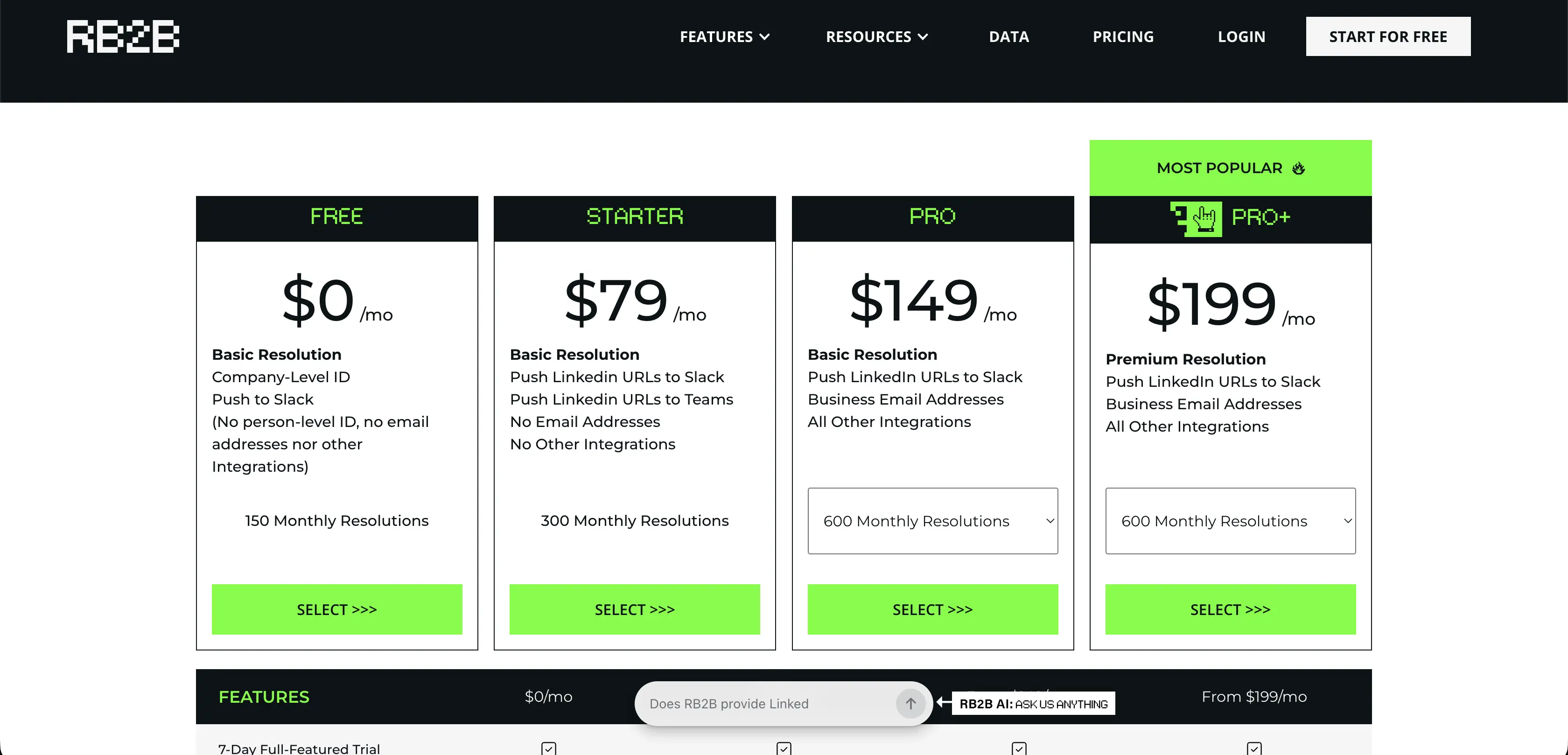
RB2B gets you to person level identification for $79 a month, with a real free tier to test first. Leadinfo prices by exact company volume instead of a flat seat count, which suits European teams that want phone support.
HubSpot Breeze Intelligence costs nothing extra if you already pay for a HubSpot Hub, since plain enrichment doesn't touch your credit balance. Price by volume, not seats.
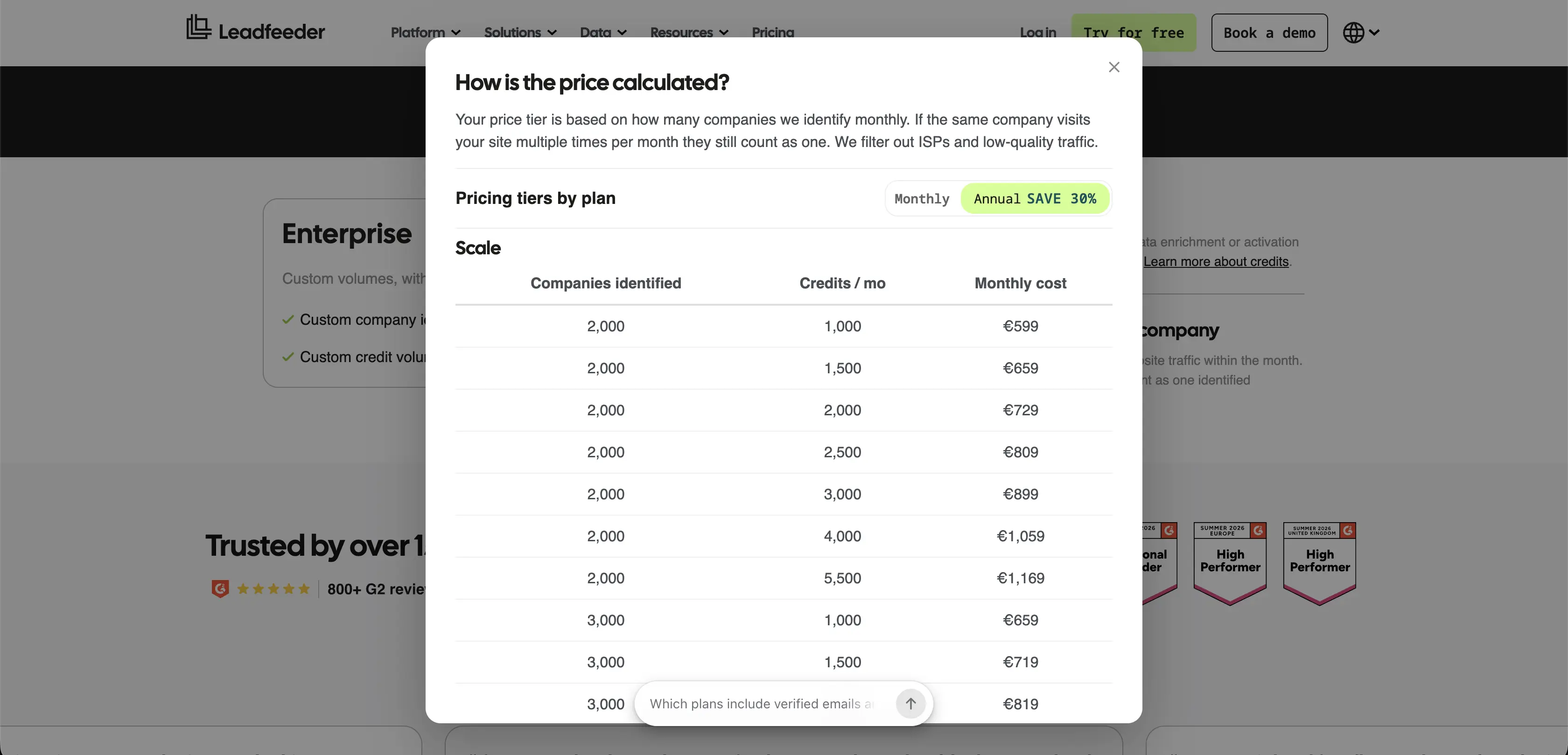
Leadfeeder pricing starts at 79 euros a month on the Discover plan, covering up to 1,000 identified companies, and it climbs on its own once your traffic outgrows the tier you signed up for.
Twelve of the best Leadfeeder alternatives are priced against that same volume below, not against Leadfeeder's smallest, cheapest tier.
Leadfeeder's bill depends on identified companies rather than seats, and that single detail decides whether switching actually saves money or just moves the same problem to a different vendor.
Why people go looking for a Leadfeeder alternative
Leadfeeder reviews on Capterra, 135 of them averaging 4.2 out of 5, split cleanly in two.
The five star reviews praise easy setup and a clear activity feed, so the software itself still works for a lot of people.
The one star reviews cluster around two things instead: company matches that turn out to belong to the wrong business, and thin contact data once you actually try to reach someone.
A cancellation process that needs 30 days notice, buried in the contract rather than a button in the account, comes up again and again too. That pattern repeats a lot.
The company behind the product has changed shape twice in four years. Leadfeeder merged with Echobot in 2022 and traded its name for Dealfront.
In March 2026 it dropped Dealfront and went back to being Leadfeeder. A few of the roundups you'll find elsewhere still describe Leadfeeder as folded into Dealfront, which runs the rebrand backwards.
"We proved the value of the product first, then asked for money later," founder Pekka Koskinen told SalesTechStar about Leadfeeder's early years, when the tool ran free for twelve months to build an audience before any plan carried a price.
That free year is gone. What's left is a company whose invoice depends on a number the account holder doesn't control, identified companies, which is exactly what the rest of this guide prices the alternatives against.
The 12 Leadfeeder Alternatives
RB2B
Free plan (150 resolutions a month), paid from $79 a month.
RB2B is a website visitor identification tool built around naming the actual person browsing your site, not just their employer.
The free plan sends company level matches to Slack; paid tiers add named individuals and business email addresses.
Coverage leans toward US traffic, so international visitors identify less reliably.
Snitcher
From $49 a month for up to 50 companies identified.
Snitcher is a company identification tool that includes every integration and unlimited team seats on every paid plan, so the price only moves with your traffic volume, never your headcount.
Contact level enrichment sits on top of company matches as an add on rather than the core product.
Leadinfo
From 69 euros a month for up to 50 companies, scaling in bands up to 5,000 plus.
Leadinfo identifies the companies visiting your site and layers in phone support, over 70 native integrations, and mobile numbers on its Pro plan.
Pricing runs on a slider tied to exact company volume rather than one flat plan, so the jump from 50 to 100 companies is a real, visible price change rather than a rounding error.
Albacross
From 59 euros a month billed annually, covering up to 50 companies.
Albacross pairs company identification with intent data, flagging accounts researching your category before they land on your site at all.
Its Professional tier adds LinkedIn Ads integration for teams running paid campaigns, and its highest plan goes custom and annual only, aimed at organizations running structured account based marketing programs across several regions.
HubSpot Breeze Intelligence
Included with a HubSpot Hub subscription; plain enrichment doesn't use credits.
Breeze Intelligence is HubSpot's built in enrichment layer, adding company and contact detail straight onto CRM records.
HubSpot folded its old standalone credit packs into one shared HubSpot Credits system back in 2025, and basic enrichment now runs free under any paid Hub tier.
Heavier features, like ongoing intent monitoring, still draw from that shared credit pool.
ZoomInfo
Pricing not public; every plan is quote based after a demo.
ZoomInfo is a contact and company database built for large sales teams that want prospecting, intent data, and website visitor signals in one system.
The cost of that breadth is a sales process with no listed price anywhere on the site, so budgeting means booking a call first.
Warmly
From $10,000 a year, billed quarterly or annually with no monthly option.
Warmly bundles visitor deanonymization with an AI chat agent that can greet and qualify a named visitor while they're still on the page.
It's priced for a revenue team with a real budget rather than a solo marketer testing the category, and every tier starts in five figures a year.
Cognism
Pricing not public; sold in seat based packages after a sales call.
Cognism is a European focused contact database that leans on verified phone and email data and GDPR compliance as its main pitch.
Credits are shared across prospecting, enrichment, and API use once purchased, but the per seat price itself sits behind a sales conversation.
Lusha
Free plan with 40 credits a month; paid tiers are custom. Lusha is a browser extension first contact finder, revealing a verified email for one credit or a phone number for five.
The free tier is generous enough to check match accuracy before committing, though the paid Scale plan's exact price isn't listed and needs a sales conversation for teams over five seats.
Hunter.io
Free plan with 50 credits a month; paid from $49 a month for 2,000 credits.
Hunter.io is a contact discovery tool built around finding and verifying email addresses by domain, then running outreach sequences straight from the same connected account without needing a separate tool.
That's a different job than the visitor identification tools above solve, but several competitor roundups group it in anyway, so it's still worth pricing out here too.
UpLead
From $99 a month for 170 credits, or $74 a month billed annually.
UpLead sells verified contact data on a pay-as-you-go credit model, adding technographic filters and buyer intent data on its Plus tier.
Extra credits cost 50 to 60 cents each beyond the monthly allowance, which matters if your usage swings month to month.
Lead Forensics
Pricing not public; the company states cost depends on your traffic volume.
Lead Forensics identifies companies visiting your site and is built for larger sales teams that want unlimited user seats included as standard.
If you're comparing Leadfeeder vs Lead Forensics specifically, that's the real difference: Leadfeeder caps users by plan; Lead Forensics doesn't. Like ZoomInfo and Cognism, the actual number only shows up after a sales conversation.
What each tool actually costs once you pass 1,000 identified companies a month
Starting prices hide where each tool lands once your traffic grows.
At around 1,000 companies identified a month, roughly a real mid size site's volume, Leadinfo's Scale plan runs 309 euros, Snitcher runs $229, and Leadfeeder's own Discover plan tops out near that same 309 euro mark before forcing an upgrade into Activate, which starts at 369 euros and climbs to 729.
Albacross doesn't publish a figure this high. Its highest plan goes custom above 500 companies, so there's no listed number to compare past that point.
RB2B prices by contact resolutions rather than raw company counts, so it isn't a direct line for line comparison, but its heaviest listed tier covers up to 2,500,000 resolutions for $199 a month, more headroom than most sites this size will use.
None of the alternatives lead with this comparison themselves. Nobody names the real one. Every one of them opens with a small number instead, 50 companies, $49, 69 euros, that only tells you what the tool costs when you're barely using it.
Why a Leadfeeder bill keeps climbing after you sign up
Leadfeeder's plans upgrade themselves. Each plan covers a range of identified companies, and once your traffic crosses into the next band, the account moves up at the start of the next billing period with no approval step in between.
Two smaller details make that jump land harder than it looks.
First, Leadfeeder counts a company once per physical location, so a business with offices in two cities counts as two identified companies even though it's a single customer.
Second, companies past your plan's cap simply stop appearing until the next cycle starts, so a busy month can hide the exact leads you're paying to see.
Annual plans only allow a tier change once a year. Nothing else moves midyear. Both annual and monthly plans renew automatically unless you cancel first.
Switching without losing a month of data
None of the alternatives above import history from a Leadfeeder account, so switching means running the new tool in parallel for a full cycle before cancelling the old one.
Leadfeeder's own cancellation terms split by billing type: annual plans need 30 days notice before the renewal date, monthly plans need notice before the next billing date, and both renew on their own if you miss the window.
Set a calendar reminder for that date before you start testing a replacement, not after you've already found one you like.
Visitor Queue no longer exists as a separate product
Several roundups still price Visitor Queue on its own, listing it somewhere between $31 and $49 a month. Its website no longer agrees.
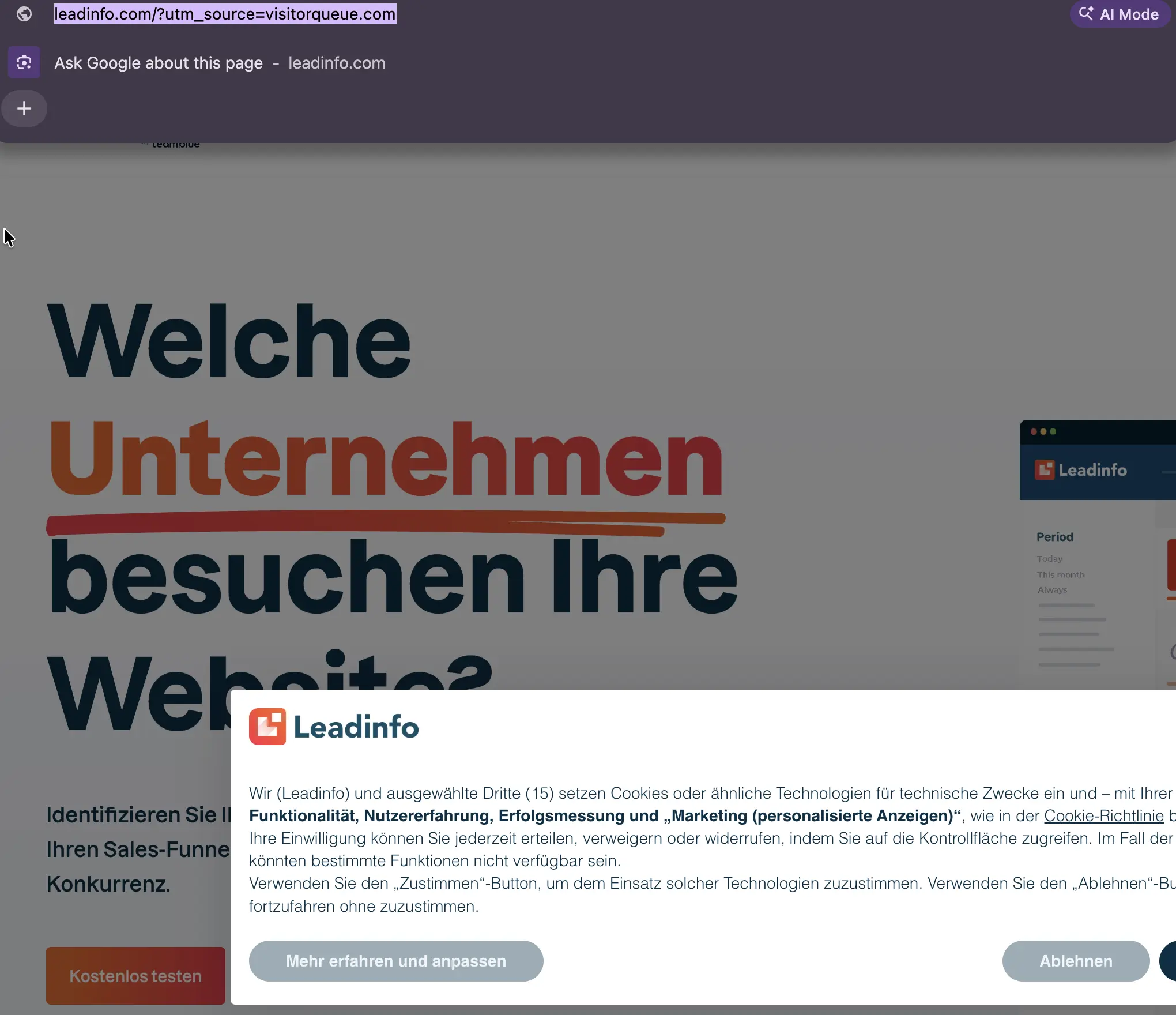
Visiting visitorqueue.com's pricing page now redirects straight to Leadinfo's marketing site, carrying a utm_source parameter pointing back to Visitor Queue, which confirms the redirect is intentional rather than a broken link.
Leadinfo bought Visitor Queue in January 2026. By the point this was checked, that acquisition had gone further than a name change on an about page: the product's own pricing page doesn't exist anymore.
Anyone comparing Visitor Queue's old standalone pricing against the tools above is comparing against a page that no longer loads.
How 12 Leadfeeder competitors compare on price
Tool | Starting price | What it identifies | Best for |
|---|---|---|---|
RB2B | Free, then $79/mo | Named individuals | Person level ID on a budget |
Snitcher | $49/mo | Companies, contacts as an add on | No per seat fees |
Leadinfo | 69 euros/mo | Companies, mobile numbers on Pro | European teams, phone support |
Albacross | 59 euros/mo annual | Companies, intent data | Account based programs |
HubSpot Breeze Intelligence | Free with a Hub plan | Companies and contacts | Teams already on HubSpot |
ZoomInfo | Quote only | Companies and contacts | Large sales orgs |
Warmly | $10,000/yr | Companies and contacts, AI chat | Revenue teams with budget |
Cognism | Quote only | Verified contacts | European compliance focus |
Lusha | Free, then custom | Verified contacts | Solo reps on a budget |
Hunter.io | Free, then $49/mo | Email addresses | Outreach with email finding |
UpLead | $99/mo | Verified contacts | Pay as you go data |
Lead Forensics | Quote only | Companies | Enterprise, unlimited seats |
Which Leadfeeder alternative fits your situation
You want to know who, not just which company. RB2B and HubSpot Breeze Intelligence both surface named individuals rather than stopping at a company name, and RB2B's free tier is the cheapest way to check whether person level matching works on your traffic before paying for it.
You're already paying for HubSpot. Breeze Intelligence rides on your existing Hub subscription, and plain company and contact enrichment doesn't touch your credit balance, so the marginal cost of turning it on is close to nothing.
Your team is in Europe. Leadinfo and Albacross both lead with GDPR language, European data hosting, and phone support in European hours, areas where Leadfeeder and the US built alternatives say less.
You need a managed rollout, not a self serve signup. ZoomInfo, Cognism, and Lead Forensics all gate pricing behind a sales call, which is a fair trade if your team wants a dedicated contact running onboarding rather than a form to fill in.
You're typing "leadfeeder free alternative" into Google. RB2B, Lusha, and Hunter.io all have real free tiers, not trials that expire, so you can check match quality against your own traffic before spending anything.
You need contacts to reach out to, not visitors to react to. A different job entirely. Our Apollo.io alternatives guide and RocketReach alternatives guide both cover contact discovery tools built for outbound work, rather than identifying who's already on your site.
FAQs
Why are teams leaving Leadfeeder in 2026?
Mainly cost and matching. The complaints behind this search cluster around bills that grow with company volume rather than seats, matches that name the wrong business, and a cancellation process that needs 30 days notice rather than a cancel button in the account.
Is Leadfeeder the same company as Dealfront?
Yes, and they've swapped names twice. Leadfeeder merged with Echobot in 2022 and became Dealfront, then dropped the Dealfront name and went back to Leadfeeder in March 2026. Pricing and the product itself carried over through both changes.
Which alternatives identify the actual person, not just the company?
RB2B and HubSpot Breeze Intelligence both surface named individuals when a match succeeds. Snitcher and Leadinfo add contact level detail as an upgrade rather than the default. Most of the rest of the list, including Leadfeeder itself, mainly identifies the company.
What happened to Visitor Queue?
Leadinfo bought it in January 2026, and Visitor Queue's website now redirects straight to Leadinfo's own site. It no longer has a working pricing page of its own at all, so any comparison you find using its old standalone pricing figures is simply out of date now.
Do these tools comply with GDPR?
Leadinfo, Albacross, and Cognism lead with GDPR compliance and European data hosting as a main selling point. Coverage still varies by tool. US built tools like RB2B, ZoomInfo, and Hunter.io state general compliance but aim their marketing at US and Canadian coverage first.
Can I run two visitor identification tools at the same time?
Yes. Nothing about how these tools work stops it, since most install as a separate script tag or integration. The real cost is paying for two overlapping bills at once, so it only makes sense during a short side by side test before you cancel one.
Where the numbers land
Every price named here came from that tool's pricing page, verified on 24 September 2026.
RB2B and Lusha are the cheapest way to test person level matching without committing to anything.
Leadinfo is the clearest on what real traffic volume will actually cost, since its pricing scales in named steps instead of a vague range.
If your team already pays for HubSpot, Breeze Intelligence is close to a free add on rather than a new line item.
Leadfeeder still works. The reviews back that up. What it comes with is an invoice tied to a number you don't control, and that's worth knowing before the next renewal date, not after it.
That's the short version of where the top Leadfeeder alternatives for 2026 land once you price them against real traffic instead of a starting number.