

Quick answer: If you want the fastest guided migration off Chargebee, Recurly is the strongest overall pick. If you sell internationally and want someone else to own VAT and sales tax, Paddle is built for exactly that. If you would rather own your billing code and skip revenue-based fees entirely, Lago's open source core is free forever.
I hit Chargebee's overage fee twice in one quarter before I started looking seriously at alternatives. The first time I figured it was a fluke. The second time I sat down and worked out exactly where the plan stopped making sense, and that math is what sent me shopping.
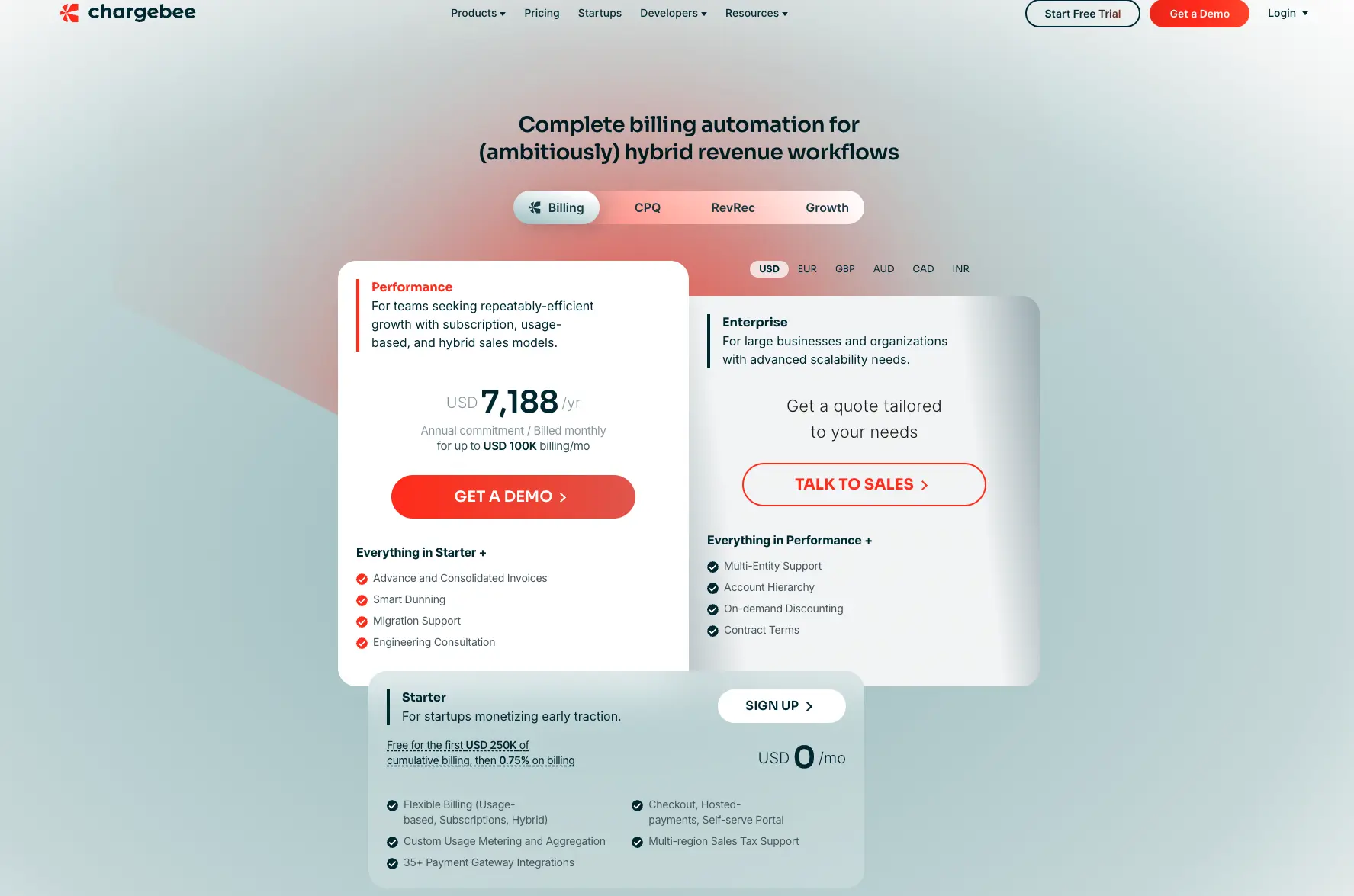 Chargebee is a subscription billing platform. It handles recurring invoicing, dunning (the automated process of retrying failed card payments), and revenue recognition for SaaS and AI companies. According to Chargebee's own pricing page, the free Starter plan covers your first $250,000 in cumulative billing, then charges 0.75% on everything after that. The Performance plan costs $7,188 a year, covers up to $100,000 in monthly billing, and charges the same 0.75% on any excess.
Here is the calculation that others have not run: Performance's flat $599 a month only pays for itself once your overage on Starter would cost more than that. Do the math ($599 divided by 0.75%), and the break-even point is $79,867 in monthly billing, not the $100,000 monthly cap most reviews quote. Below that number, staying on Starter and eating the overage is cheaper than upgrading, assuming you do not need Performance's smart dunning or migration support.
Why teams start shopping for Chargebee Alternatives
Four complaints keep coming up again and again when you dig into reviews and forum threads. The overage fee lands as a surprise, often months after you cross the threshold, since Chargebee does not flag it mid-cycle. The interface gets dense fast, and simple tasks like editing a plan or an add-on take longer than they should. Support slows down noticeably once you are past the free tier and your billing problems are affecting live customers. And several finance-heavy features, like RevRec or Retention, sit behind add-on pricing that is not listed anywhere on the main pricing page.
On an Ask HN thread about switching away from Chargebee, one founder explained he was looking at Paddle specifically to hand off VAT handling, since Chargebee requires you to manage tax yourself even though it orchestrates the payment gateways. That split is worth understanding before you pick a replacement: some alternatives replace Chargebee's job one for one, others take on tax and payment processing too.
The 12 best Chargebee Alternatives, Ranked by Overall Strength
1. Recurly
Price: $249/month + 0.9% of billing volume on Starter (your first $40,000 each month is included free); All-Access runs under 1% of billing volume for teams doing $1M+ annually, per Recurly's pricing page.
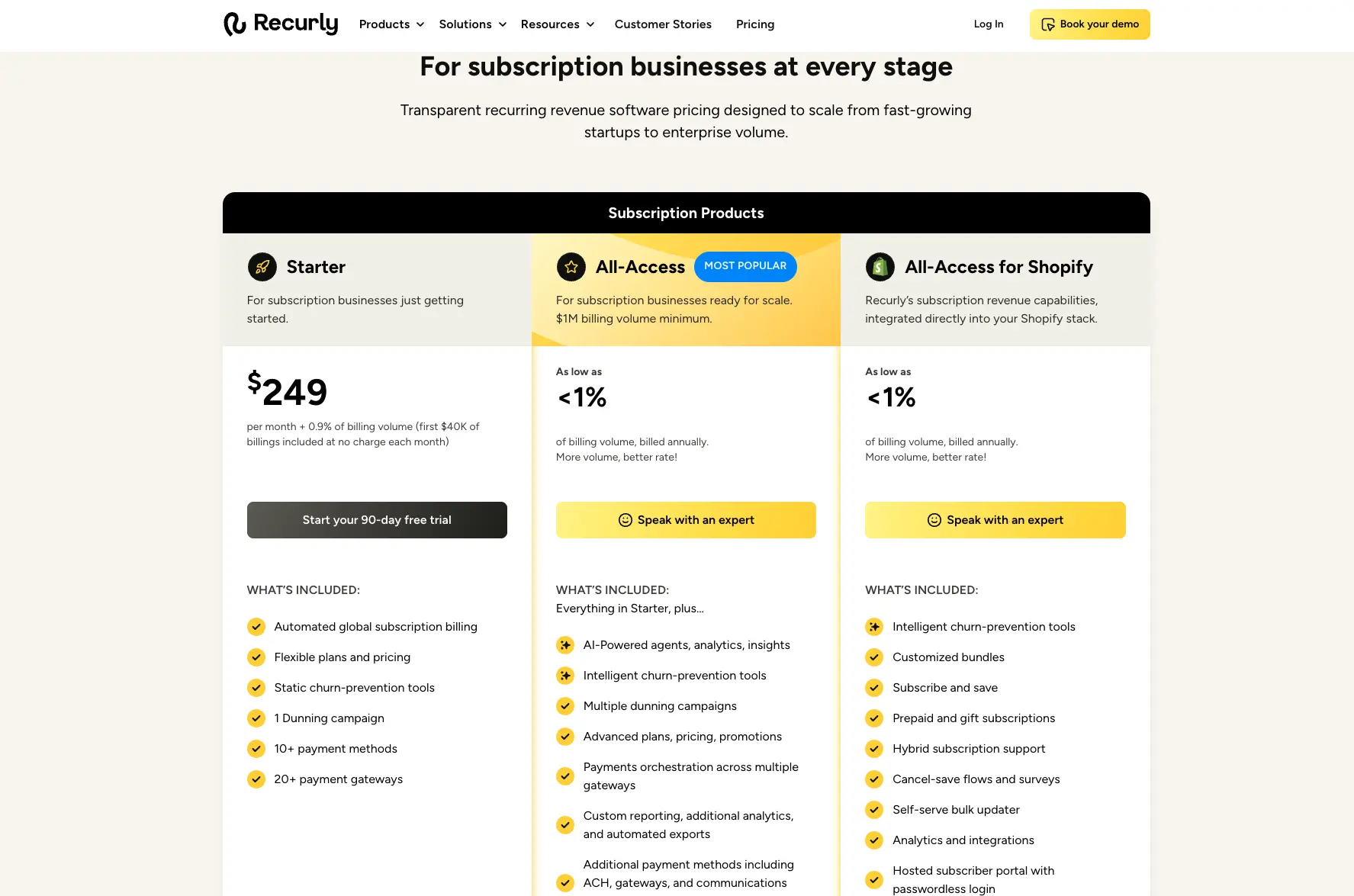
Recurly is a subscription billing platform built around churn recovery and dunning. It is the closest one-to-one swap for Chargebee's core billing job, and Recurly runs a 90-day free trial specifically so you can test a real migration before committing. Where it pulls ahead of Chargebee is dunning: multiple automated retry campaigns are included on the entry plan instead of gated behind an upgrade.
2. Paddle
Price: 5% + 50 cents per checkout transaction, all inclusive, no monthly fee, according to Paddle's pricing page.
Paddle is a merchant of record (MoR), meaning it becomes the legal seller on every transaction and takes on your sales tax and VAT liability directly. That single fee replaces Chargebee's platform cost, your separate payment gateway fees, and whatever you would otherwise pay a tax tool like Avalara. Tailwind Labs' CEO Adam Wathan has said the tax compliance alone made switching worth it for his team. The catch is that Paddle appears as the merchant on your customers' statements, not your brand.
3. Maxio
Price: Build plan is a free 30-day sandbox; Grow and Scale require a sales quote.
Maxio, formerly Chargify, targets B2B SaaS finance teams specifically. It bundles subscription billing with revenue recognition and financial reporting in one system, which is a separate add-on with Chargebee. Reviewers consistently rate its billing management and support highly, though a few note the learning curve is steeper than Chargebee's for simple use cases.
4. Stripe Billing
Price: 0.7% of billing volume, on top of standard Stripe payment processing (2.9% + 30 cents per card charge), confirmed on Stripe's Billing pricing page.
If you are already running payments through Stripe, Billing lives in the same dashboard and the same webhooks. Stripe merged its old Starter and Scale tiers into a single 0.7% rate in mid-2024, so if you are comparing against an older 0.5% figure quoted elsewhere, that rate no longer applies. This is the pick for teams with engineers who would rather write code against a mature API than configure a separate vendor's UI.
Read Also: 18 Best Pipedrive Alternatives in 2026 (true cost, add-ons included)
5. Zoho Billing
Price: Standard $39/month (billed annually), Premium $79/month (billed annually), Enterprise custom with a 0.2% fee past $500,000 in monthly US revenue.
Zoho Billing is the budget pick. It caps invoices at 100,000 a year and revenue at $1 million on the Standard and Premium plans, but for a small team that is rarely a real limit. "The entire process is now completely automated," said Jayash Kesri, CEO of Muse GRAVITY, after moving off Chargebee and Stripe.
6. Lago
Price: Free forever for the self-hosted open source core; Premium (cloud or self-hosted) is usage-based and custom quoted, per Lago's pricing page.
Lago is an open source billing engine, meaning the code is public and you can run it yourself instead of trusting a vendor's closed system. It is payment agnostic, so it sits on top of Stripe, Adyen, or GoCardless rather than replacing them. This is the pick for engineering teams that want to own their billing logic and avoid revenue-based fees for good.
7. Zuora
Price: Custom only, no public tiers.
Zuora is built for large, multi-entity enterprises running complex global billing across many currencies and legal entities. It is the platform G2 reviewers name most often as the overall alternative to Chargebee, though it is overkill and expensive for anything smaller than mid-market.
8. FastSpring
Price: Quote based, revenue share model, no published rate card.
Like Paddle, FastSpring is a merchant of record, but it has been doing this since 2005 and leans toward desktop software and game studios rather than pure SaaS. Checkout customization is stronger than Paddle's, though the admin dashboard shows its age.
9. Younium
Price: Custom, quote based.
Younium focuses on B2B SaaS with sales-led, contract-heavy revenue: multi-year deals, amendments, and renewals that do not fit neatly into a self-serve subscription model.
10. TrueRev
Price: See the TrueRev pricing page.
TrueRev is a revenue management and billing platform for B2B SaaS companies that use QuickBooks Online. It puts contract-based billing, revenue recognition, deferred revenue, renewals, journal entries, and SaaS metrics such as ARR and MRR in one workflow.
It suits sales assisted SaaS companies that have outgrown spreadsheet heavy finance work but want to keep QuickBooks Online as their accounting system.
You can see how it lines up against Chargebee in the TrueRev vs Chargebee comparison.
11. Orb
Price: Custom, quote based.
Orb is usage-based billing infrastructure built for AI and API companies charging by tokens, compute, or calls rather than seats. If your pricing model looks nothing like a traditional subscription, this is worth a look before you force it into Chargebee's subscription-first structure.
12. Ordway
Price: Custom, quote based.
Ordway pairs subscription billing with revenue automation for finance teams that want both in one system rather than treating RevRec as a bolt-on module.
13. Sage Intacct
Price: Custom, quote based.
Sage Intacct is accounting first. Subscription billing sits inside a full ERP rather than standing alone, which suits companies that want one system of record instead of stitching billing data into their accounting software after the fact.
Chargebee Alternatives Compared
Tool | Starting price | Best for | Free trial or plan |
|---|---|---|---|
Recurly | $249/mo + 0.9% | Fast one-to-one migration | 90-day trial |
Paddle | 5% + 50 cents/transaction | Global tax handled for you | Free to start |
Maxio | Free sandbox, then custom | B2B SaaS finance ops | 30-day sandbox |
Stripe Billing | 0.7% of volume | Teams already on Stripe | Pay as you go |
Zoho Billing | $39/mo | Small teams, flat pricing | 14-day trial |
Lago | Free (open source) | Engineering-led teams | Free forever |
Zuora | Custom | Large multi-entity enterprise | Demo only |
FastSpring | Custom | Desktop software and games | Demo only |
Younium | Custom | Contract-heavy B2B SaaS | Demo only |
TrueRev | $299/mo, billed yearly | Sales-assisted SaaS on QuickBooks Online | 14-day trial |
Orb | Custom | Usage and AI billing | Demo only |
Ordway | Custom | Finance-led revenue automation | Demo only |
Sage Intacct | Custom | Billing inside full ERP | Demo only |
How to Pick Chargebee Alternatives
If you are mostly happy with Chargebee and just want to stop the overage surprise, start with Recurly. It is the closest feature match and the migration path is the shortest.
If tax compliance is your actual pain point rather than the billing software itself, skip straight to Paddle or FastSpring. Neither will feel like a lateral move since both take on liability Chargebee never touched.
If your team can maintain infrastructure and you want to never think about a revenue-based fee again, Lago is worth the setup time.
If your billing is actually complex, meaning multiple entities, currencies, or sales-led contracts with amendments, do not force a self-serve tool to do that job. Zuora, Younium, or Ordway are built for it specifically.
Where Chargebee still wins
It is worth being fair here. Chargebee's 60-plus native integrations and 35-plus payment gateways are still broader than most of what is on this list, and its 2025 Gartner Magic Quadrant Leader placement was not handed out for nothing. Teams with truly complex catalog needs (multiple products, multiple currencies, dozens of add-ons) often find the migration cost is not worth it until the overage math gets bad enough to force the question.
FAQ for Chargebee Alternatives
What is the cheapest Chargebee alternative?
Lago is free if you self-host the open source core. Among paid tools, Zoho Billing starts lowest at $39/month, though Stripe Billing can cost less at very low volume since there is no monthly fee.
Is there a free Chargebee alternative?
Yes. Lago's self-hosted open source version is free forever, and Stripe Billing has no monthly fee at all, just a percentage of what you actually bill.
Which Chargebee alternative is best for startups?
Recurly or Zoho Billing. Recurly gives you a 90-day trial to test a real migration, and Zoho Billing's flat pricing is easier to forecast when your revenue is still unpredictable.
Chargebee vs Stripe Billing: which is better?
Stripe Billing wins if you are already processing payments through Stripe and want one dashboard. Chargebee wins if you need deeper dunning, revenue recognition, or multi-gateway orchestration out of the box.
Is there an open source Chargebee alternative?
Yes, Lago. It is self-hostable for free, payment agnostic, and built API-first for teams that want full control over their billing code.
My Experience
Chargebee still does its core job well. The overage fee just is not disclosed loudly enough, and once you have hit it twice, it is worth spending an afternoon running your own numbers against Recurly, Paddle, or whichever tool on this list matches your actual pain point rather than defaulting to whatever ranks first on someone else's list.