
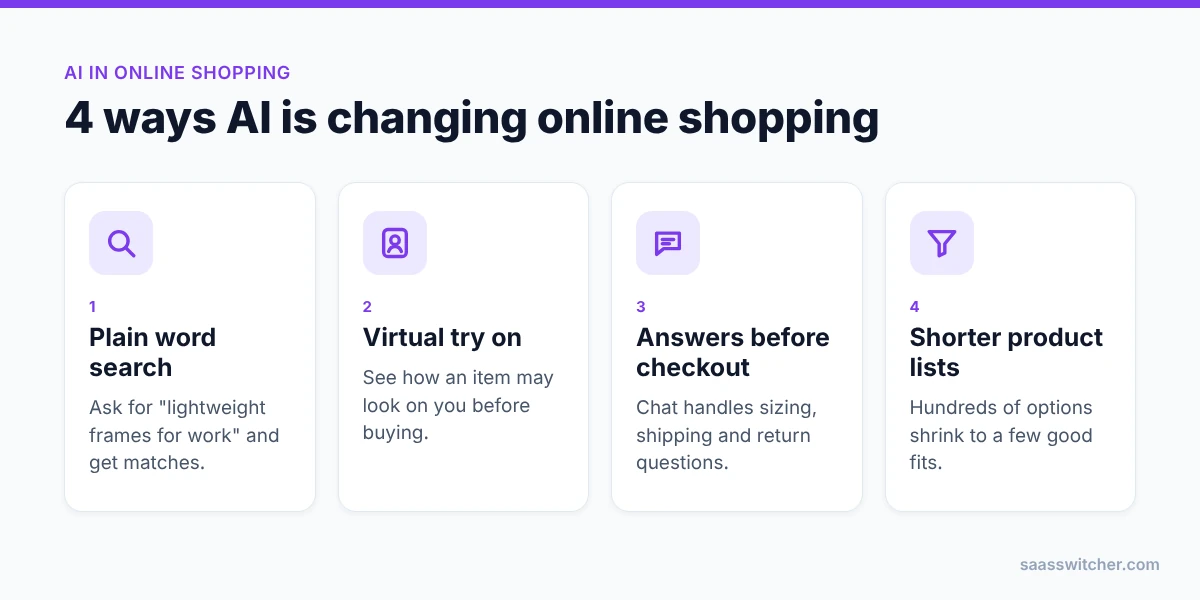
AI changes online shopping in four ways: shoppers search in plain words, see how a product may look on them, get answers before checkout, and face a short list instead of hundreds of products.
Each change runs on a software tool, and each tool has its own price and limits. A store that checks those limits first avoids surprises after sign-up.
Access to products was never the hard part of online retail. Choice was. A customer searching for glasses, clothing, electronics, skincare, or home products can face hundreds or thousands of options, and AI tools aim to cut that list down.
Search now understands plain requests
Traditional ecommerce search runs on keywords and filters. A shopper types a phrase, picks a category, sets a price range, and works through the results. The customer does the work.
AI search works from ordinary sentences, so a shopper can ask for lightweight frames for work or comfortable travel shoes for long walking days and get picks that fit several needs at once.
Comparing gets quicker too, because AI tools can summarize how two products differ and point out which details matter for a given use.
Specifications, compatibility details, and prices still need a check against reliable sources.
Visual tools cut the guessing
Some people still prefer physical stores because they can see and try products first, and e-commerce has answered with better photos, video, 360-degree views, and augmented reality.
AI can make these visual tools more useful by reading images, spotting product traits, and finding similar items.
Google shows the way. Its virtual try-on lets a shopper tap a try-it-on icon on a shirt, pants, skirt, or dress listing, upload a full-length photo, and see how the item looks on them.
Google announced it on 20 May 2025 as a Search Labs rollout in the U.S. It also described an AI Mode for shopping that runs several searches at once and narrows products as the shopper refines the request.
Trying a product in person still gives the final word on fit. Try-on speeds early choices.
Smart eyewear changes what people shop for
AI shapes the products on the shelf as well as the way people find them. Eyewear was once split into prescription glasses and sunglasses.
Today it also includes connected glasses with cameras, audio, voice controls, and AI-enabled functions in familiar frame designs.
Fashion and technology now overlap. A shopper may find a product through its looks, its features, or a celebrity collaboration.
Options such as Kylie Jenner Meta glasses illustrate how smart eyewear can sit at the intersection of style, personal technology, and online product discovery.
LensCrafters lists three Meta styles, Adventurer, Fury, and Starfire, and shows four steps for adding prescription lenses, from choosing a frame to picking lens type and treatments.
Buyers can try the glasses in store or pick up an online order there.
Stores that sell online and in store need one stock count. See which of the seven store systems list online selling in our wine retail POS software guide.
A shopper may first see a product on social media, look up the technology through search, compare retailers and read specifications, and only then choose where to buy.
So product pages need clear specifications, prescription options, battery life, and privacy details.
Online eyewear shows how far ecommerce has come
Buying glasses online was hard. Shoppers had to judge prescription details, frame sizes, lens options, style, and fit without visiting a store.
Modern eyewear sites eased this with detailed filters, product images, measurements, prescription guidance, virtual tools, and clearer customization options.
The result is shopping for glasses online made simple, a process that took far more effort years ago.
The same lesson applies across ecommerce. When a retailer knows which questions stop customers from buying, technology can answer those questions directly, and AI helps by spotting patterns in customer behavior and offering more relevant help at the moment of choice.
However, improving the shopping experience also requires strong organic visibility.
Working with an experienced ecommerce SEO agency can help retailers optimise product and collection pages, improve technical SEO, and develop content strategies that attract customers actively searching for their products.
Support and recommendations start earlier
AI chat answers questions about sizing, shipping, compatibility, availability, and return policies while a customer is still deciding, and it can pass harder cases to a human representative. People stay reachable.
Recommendations improved too. Early systems showed dozens of similar items, while newer ones weigh browsing patterns, purchase history, and actions during one visit, so a person who buys a suitcase sees packing organizers or a travel adapter and not ten more suitcases.
Personalization runs on information, so shoppers should know what a store collects and why, and an AI assistant should not ask for more personal data than it needs.
Fewer options beat more options
Choice overload pushes shoppers to delay a purchase or leave a site. AI narrows the options by preference.
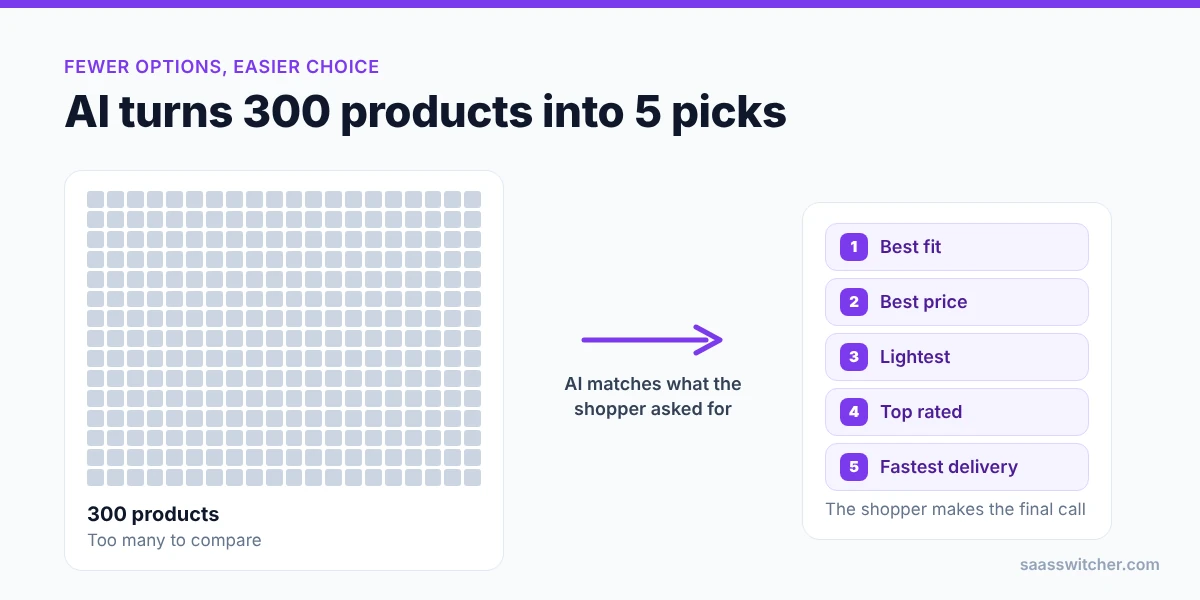
Instead of showing 300 possible products, a system can help a customer find five that meet the most important needs, and the shopper still makes the final call.
Taste stays personal.
Which software does each job
Each shift above depends on a software tool, and each tool has its own price and limits, so the table below shows which job each type of tool covers.
Shopping job | Software to look at |
|---|---|
Finding products | Search and recommendation tools |
Answering questions during a visit | Chat assistants |
Handling orders and returns | Help desk software |
Sending relevant messages | Email platforms for ecommerce |
Stores that want to compare options can start with guides to email platforms built for ecommerce brands, help desk software and website chat tools, and each one compares tools in its category.
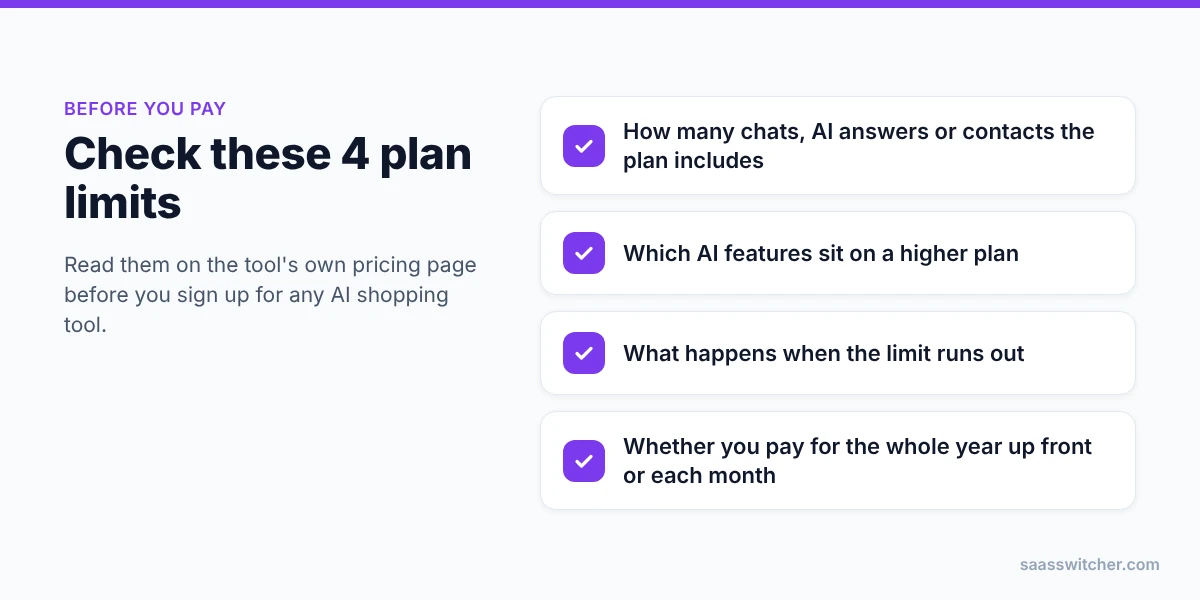
Before paying for any of them, read the plan page for four things:
How many chats, AI answers, or contacts the plan includes.
Which AI features sit on a higher plan.
What happens when the limit runs out.
Questions about AI shopping tools
Does AI replace human support in online stores?
No. AI answers repeat questions fast and sends harder cases to a person, so shoppers keep a clear way to reach a human when a case needs judgment or flexibility.
Can shoppers trust every AI product recommendation?
Not without a check. Specifications, compatibility details, prices, and retailer policies need reliable sources, and the AI saves the time spent reaching them.
How does AI reduce choice overload?
It cuts a large catalog to a short list that fits the shopper's stated needs. A catalog of 300 products can shrink to five, and the shopper still makes the final call.
Where to start
Store owners can start at the point where shoppers leave, such as a search that returns too many results or sizing questions that nobody answers on the page.
Pick one tool for that gap, check its price and limits, and add the next tool only after the first one proves useful.