

MailerLite is the best Mailchimp alternative for most small businesses, Kit is the best free option for creators, and Brevo is the cheapest way to email a large list you don't message often. All three cost less than Mailchimp at every list size I checked.
I went into this test with a budget, not a feature checklist. I spent $34 in one month across three entry plans: Mailchimp Essentials at $13, MailerLite Comfort at $12, and Moosend Pro at $9. Then I tracked what each dollar actually bought in contacts, monthly sends, and automation steps. The gap was bigger than the sticker prices suggest. Mailchimp's $13 plan bought me 500 contacts, with a cap of 5,000 emails per month. Moosend's $9 bought the same 500 contacts with no send cap at all.
Why so many people are leaving Mailchimp this year
Mailchimp is an email marketing platform, meaning software that stores your contact list and sends campaigns and automated emails to it. It's still a capable product. The problem is the direction of its pricing.
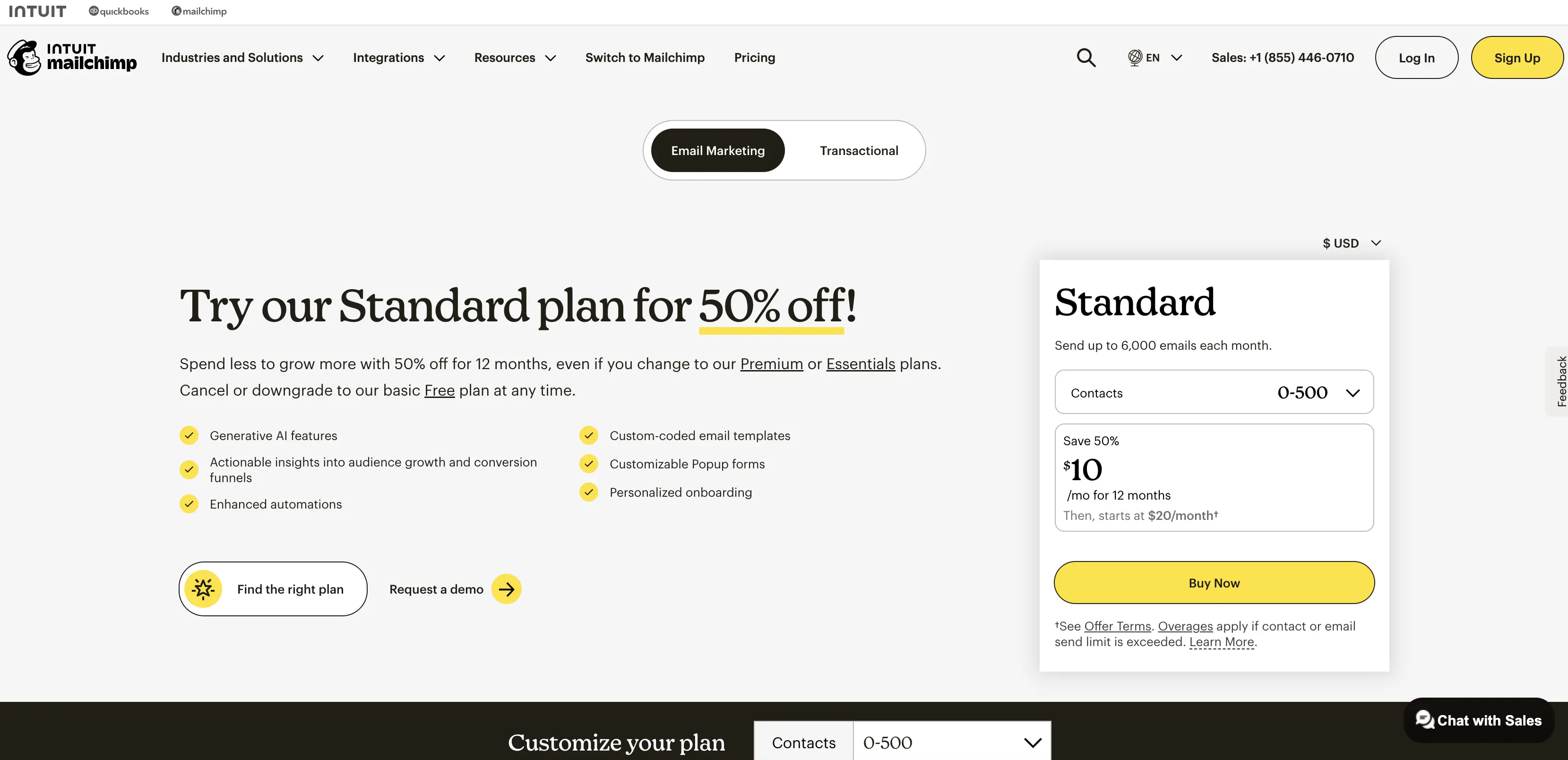
In January 2026, Mailchimp cut its free plan from 500 contacts and 1,000 sends down to 250 contacts and 500 sends per month, with a daily cap of 250 emails. Paid plans start at $13 per month for 500 contacts on Essentials, and every plan carries a send ceiling tied to your contact count. Mailchimp's own help docs put it plainly for the Standard plan: "The monthly send limit is 12 times your contact limit" (source). Essentials gets 10 times, Premium gets 15 times. You also keep paying for unsubscribed contacts unless you archive them by hand.
Users have noticed. On G2, Intuit Mailchimp holds a 4.3 star rating across more than 18,300 verified reviews, and pricing complaints show up again and again in the recent ones (G2 reviews page). The praise clusters around ease of use. The criticism clusters around cost.
The free plan math nobody runs
Mailchimp's free plan gives you 250 contacts and 500 sends a month. Divide one by the other, and you get exactly 2. That means a full free plan list can receive at most two complete campaigns per month. A weekly newsletter is mathematically impossible on Mailchimp's free tier once your list is full. The 250-per-day cap adds a second squeeze: each full-list send uses an entire day's allowance.
Compare that with the free tiers I verified this week. EmailOctopus allows 2,500 subscribers and 10,000 emails a month, which works out to four full-list campaigns at maximum list size. Kit allows 10,000 subscribers with unlimited sends. Even MailerLite, which cut its own free plan to 250 subscribers and 2,500 emails on June 16, 2026, still allows ten full-list sends a month at the cap. Mailchimp's two-campaign ceiling is the tightest of any major tool in this roundup.
The 12 Mailchimp Alternatives, Explained In Detail
I ranked these by overall strength for a typical small business or solo operator switching away from Mailchimp. Your best pick depends on your list size and how often you send, so check the decision guide after the list.
1. MailerLite
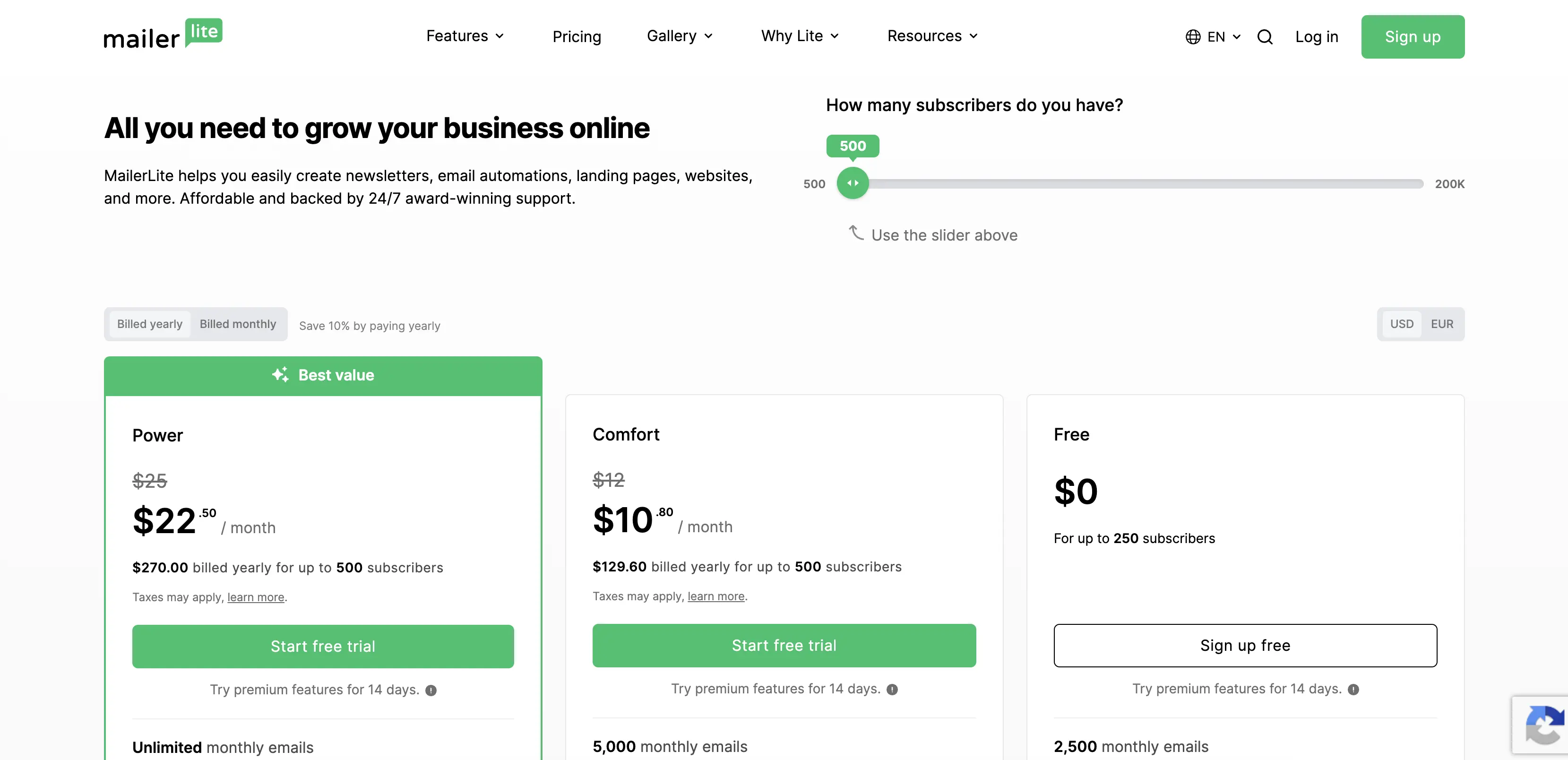
MailerLite is an email marketing tool built around a clean drag and drop editor, automation, and landing pages. Its Comfort plan costs $12 per month for 500 subscribers and 5,000 emails, with 3 user seats and 24/7 email support included. That's one dollar less than Mailchimp Essentials for a friendlier editor and a far better landing page builder. Know one thing before you sign up: MailerLite repriced on June 16, 2026, and its free plan now covers 250 subscribers and 2,500 emails per 30 days (MailerLite billing docs). Many roundups still quote the old 500 subscriber figure. It's gone. If the reprice puts you off, we've also compared the best MailerLite alternatives separately.
2. Brevo
Brevo is an email and SMS platform that charges by send volume instead of list size. You can store a huge contact database and only pay for the emails you actually send. If you hold 20,000 contacts and email a segment once a month, Brevo will cost a fraction of any contact-based plan. It also folds in a basic CRM, live chat, and WhatsApp campaigns. The editor feels a step behind MailerLite, and deliverability setup takes more care, but for large quiet lists nothing here beats the billing model.
3. Kit
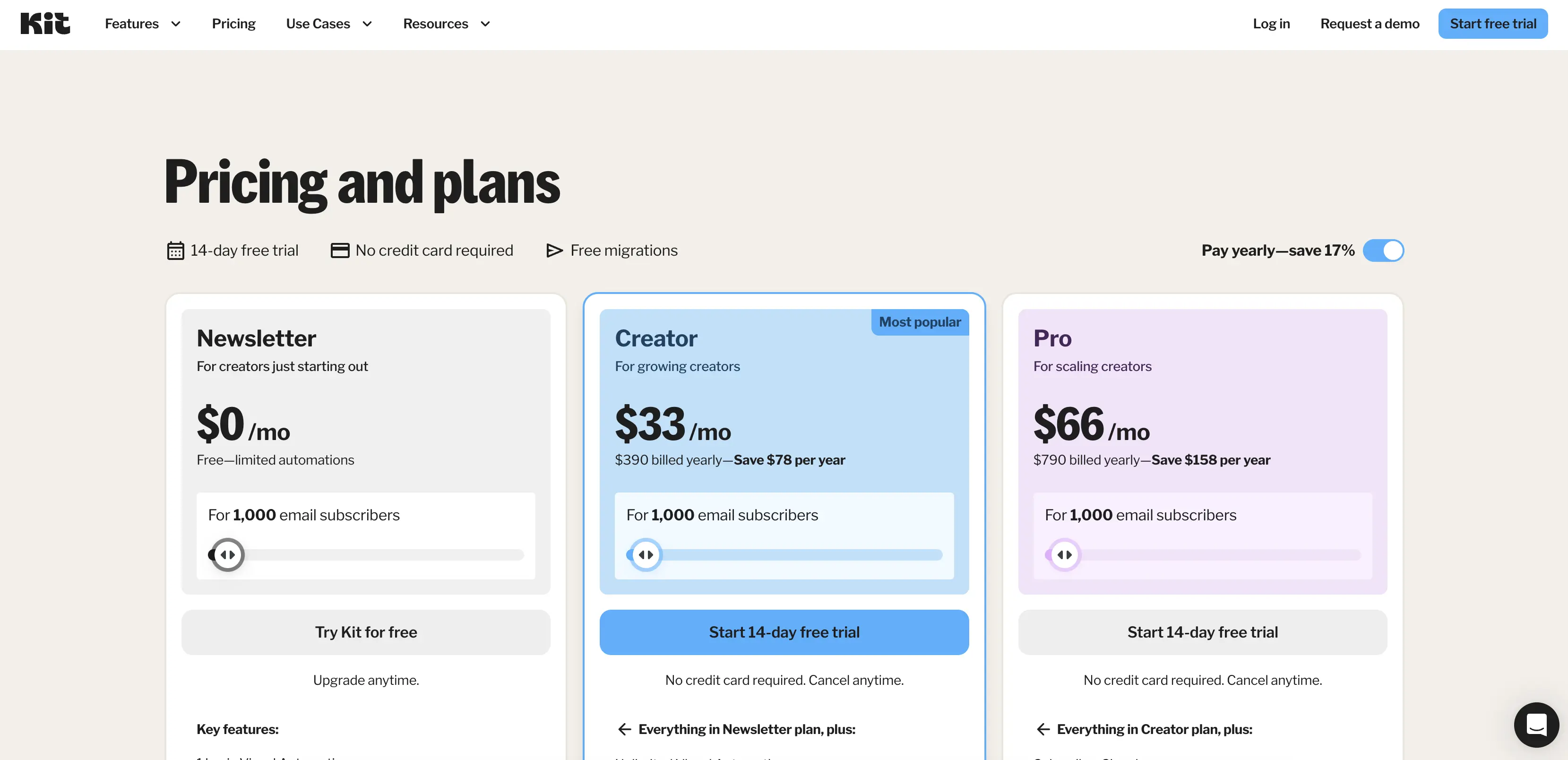
Kit, formerly ConvertKit, is an email platform made for creators, writers, and course sellers. Its free plan reaches 10,000 subscribers with unlimited sends, the most generous free ceiling in this entire list, though you're held to a single automation sequence until you upgrade. Paid plans add visual automations and integrations with Gumroad, Teachable, and similar creator tools. If you sell your own products to an audience you built, start here.
4. Moosend
Moosend is a budget email marketing tool with a strong automation builder. Pro starts at $9 per month for 500 contacts with unlimited email sends, landing pages, and transactional email included. If transactional sending is your main need rather than a bonus, our SendGrid alternatives guide is the better starting point. It was the cheapest paid plan in my $34 test and the only one of the three that never showed me a send counter. The template library is smaller than Mailchimp's, which mattered less than I expected once I'd saved two layouts of my own.
5. EmailOctopus
EmailOctopus is a stripped down email tool that wins on price. The free plan covers 2,500 subscribers and 10,000 emails per month, ten times Mailchimp's free contact limit. Paid plans stay cheap as your list grows because the feature set stays lean: campaigns, simple automation, forms, and not much else. Perfect if you mostly send newsletters and don't want to pay for tools you'll never open.
6. GetResponse
GetResponse is an all-in-one marketing platform with email, autoresponders, webinars, and a website builder. Its mid-tier plan undercuts Mailchimp Standard at most list sizes and includes 1.2 million monthly sends at the 100,000 contact level. The interface carries more menus than a beginner needs. Teams that will actually use webinars or conversion funnels get real value; pure newsletter senders should look higher up this list.
7. ActiveCampaign
ActiveCampaign is a marketing automation platform for businesses that have outgrown simple campaigns. Its automation builder handles branching workflows, lead scoring, and deep segmentation that Mailchimp's Customer Journeys can't match. It costs more than most tools here and takes longer to learn. Pick it when automation is the reason you're leaving, not price. And if you try it and find it too heavy, our guide to ActiveCampaign alternatives covers the lighter options.
8. Omnisend
Omnisend is an ecommerce marketing platform built for Shopify, WooCommerce, and BigCommerce stores. Pre-built cart abandonment and browse abandonment flows work within minutes of connecting a store, and SMS lives in the same workflow builder as email. If your revenue comes from an online store, Omnisend replaces Mailchimp's ecommerce features with better ones.
9. AWeber
AWeber is one of the oldest email marketing services still running, and its Plus plan comes with unlimited emails, unlimited subscribers per price band, and unlimited users. It undercuts Mailchimp Standard while removing the send ceiling entirely. The templates look dated next to newer tools. The deliverability record and the phone support are why long-time small businesses stay.
10. Constant Contact
Constant Contact is an email and event marketing tool aimed at small local businesses and nonprofits. It bundles event registration, social posting, and email in one place, and the learning curve is about as flat as this category gets. Automation is thinner than MailerLite or Moosend at a similar price, so it ranks here on value rather than features.
11. Sender
Sender is a lesser known email tool with one of the most generous free plans available: 2,500 subscribers at no cost. Paid plans stay low as you grow, and the basics all work: campaigns, automation, forms, segmentation. Brand recognition and third-party integrations are where it trails the bigger names.
12. Benchmark Email
Benchmark Email is a simple email marketing service with a free plan covering 500 contacts and 2,500 sends per month, double Mailchimp's free contact limit and five times its send allowance. Live chat and email support answer around the clock, even on free accounts. Advanced automation is not the point here. Easy sending with a human on the other end of support is.
Mailchimp Alternatives Comparison
Tool | Free plan ceiling | Cheapest paid plan | Send limit on entry plan |
|---|---|---|---|
Mailchimp | 250 contacts, 500 sends/mo | $13/mo (500 contacts) | 5,000/mo |
MailerLite | 250 subs, 2,500 sends/mo | $12/mo (500 subs) | 5,000/mo |
Brevo | Daily send cap, unlimited contacts | Send-volume based | Based on volume bought |
Kit | 10,000 subs, unlimited sends | Paid adds automation | Unlimited |
Moosend | Trial only | $9/mo (500 contacts) | Unlimited |
EmailOctopus | 2,500 subs, 10,000 sends/mo | Low, scales by subs | Generous |
Benchmark Email | 500 contacts, 2,500 sends/mo | Low entry tier | Capped by plan |
How to Pick Your Alternative
Start with your list size and your sending habit, in that order. If your list is under 10,000 and you run a newsletter or sell your own products, Kit's free plan removes the cost question entirely while you grow. If you're a small business that wants the closest like-for-like Mailchimp swap with a nicer editor, MailerLite Comfort at $12 does everything Essentials does and undercuts it by a dollar.
Big list, low volume is a different problem. A 20,000 contact database that gets one segmented email a month will bleed money on any contact-based plan, Mailchimp's most of all. Brevo's send-based billing was built for exactly that usage pattern. Store owners should skip the general tools and go straight to Omnisend, since abandoned cart flows will pay for the subscription on their own. And if what pushed you out of Mailchimp was hitting the ceiling of Customer Journeys, price shop last and test ActiveCampaign's automation builder first, because that's the one thing nothing cheaper on this list fully replaces.
FAQs for Mailchimp Alternatives
Is there a free alternative to Mailchimp?
Yes. Kit is free up to 10,000 subscribers with unlimited sends, and EmailOctopus is free up to 2,500 subscribers with 10,000 emails a month. Both free plans allow more contacts than Mailchimp's paid Essentials entry tier includes.
What is the cheapest Mailchimp alternative?
Moosend, at $9 per month for 500 contacts with unlimited sends. Mailchimp charges $13 for the same 500 contacts and caps you at 5,000 emails a month on Essentials.
Which Mailchimp alternative is best for small businesses?
MailerLite. Its $12 Comfort plan matches Mailchimp Essentials on contacts, matches it on the 5,000 send allowance, and adds a better landing page builder plus 24/7 email support.
Is there an open source Mailchimp alternative?
Yes. Listmonk is a self-hosted, open source newsletter and mailing list manager written in Go. You run it on your own server, so there's no per-contact fee, though you'll need to connect a separate sending service and handle setup yourself.
Which Mailchimp alternative works best for ecommerce stores?
Omnisend. It connects to Shopify, WooCommerce, and BigCommerce, ships with pre-built cart abandonment flows, and puts SMS in the same automation builder as email.
Do any alternatives work better for nonprofits?
MailerLite offers a 30% nonprofit discount, double Mailchimp's 15%. Combined with its lower base prices, a nonprofit with a 4,000 contact list will usually pay less than half of what Mailchimp charges.
Why is Mailchimp so expensive compared to alternatives?
Two reasons: prices scale with total stored contacts, including unsubscribed ones you haven't archived, and every plan carries a monthly send ceiling. Most rivals drop at least one of those two multipliers, and some drop both.
My picks for Mailchimp Alternatives
If you want the wider context for why leaving makes sense right now, I ranked all the major platforms in my email marketing software ranking for 2026, and Mailchimp landed near the bottom of it. The shrunken free plan and the send cap math did most of the damage there. That page is also the fastest way to see how the tools below stack up against each other, not just against Mailchimp.
For most people reading this, the honest answer is MailerLite, and the switch takes an afternoon. Creators with growing audiences should take Kit's 10,000 subscriber free plan and not look back. If your database is large and your sending is light, Brevo's billing model will save you more than any feature ever could. Whatever you choose, export your Mailchimp list first and archive the unsubscribes before your next billing date. You've probably been paying for them.