
Most "best email marketing software" lists rank tools by features. That's the wrong question. Every platform on this page can send a newsletter, build an automation, and segment a list. What separates them in 2026 is how they charge you: some bill by stored contacts, some by emails sent, and one bills you for every active profile whether you email them or not. Pick the wrong billing model for your list, and you'll pay double for the same output.
I run email for a few small sites, and last year I moved the same 2,100 subscriber newsletter through three of these platforms across consecutive billing cycles to see what actually changed. The list stayed identical. The invoices didn't. That test, plus pricing page checks on all 10 tools this month, is what this ranking is built on.
The three billing models, explained
Every email marketing platform bills one of three ways:
Contact based. You pay for how many people you store, whether you email them or not. Mailchimp and Constant Contact work this way. Both also cap your monthly sends at a multiple of your contact tier, so storage and volume are linked.
Send based. You pay for emails delivered, and stored contacts are cheap or unlimited. Brevo is the clearest example, with room for up to 100,000 contacts on its free plan while charging by send volume.
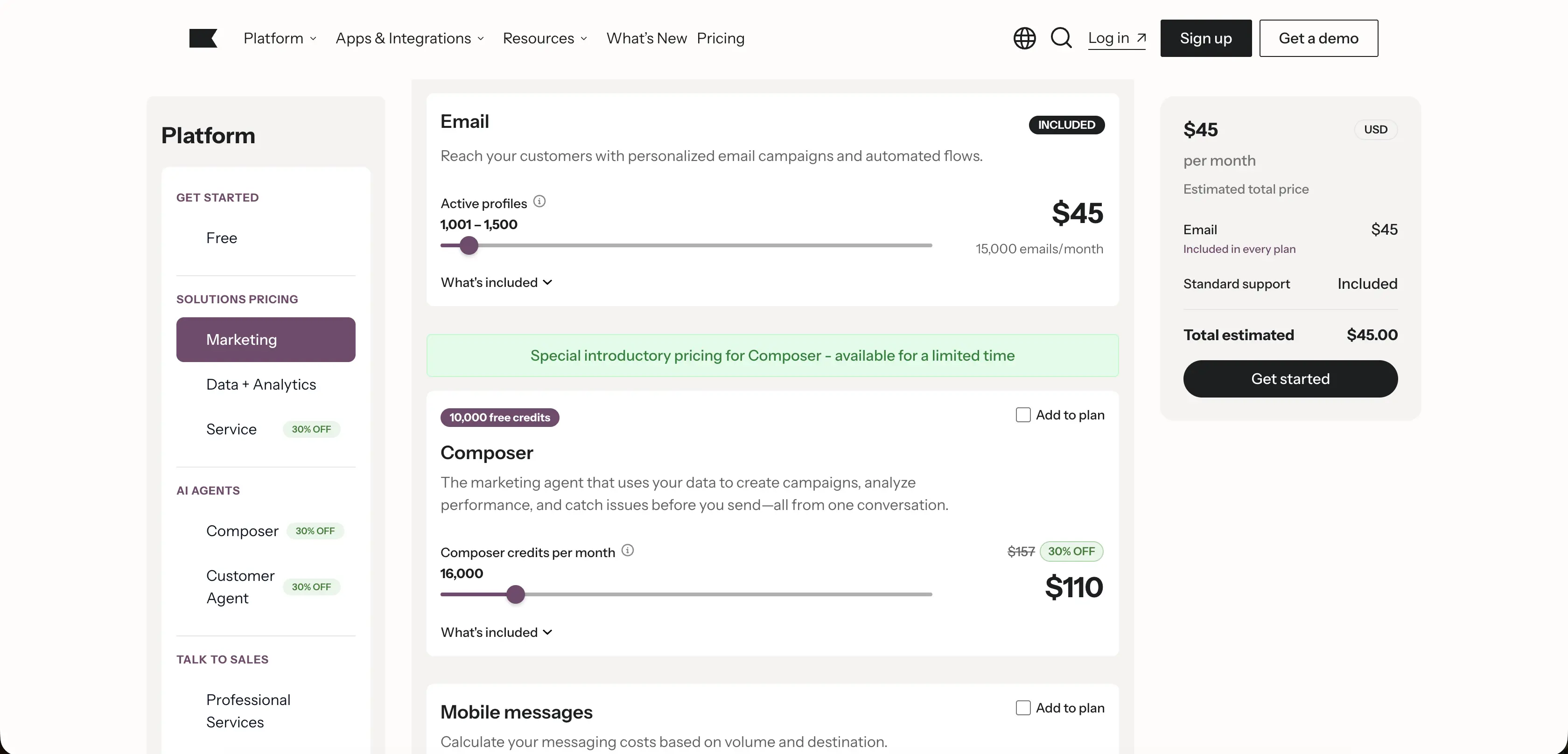
Active profile based. Klaviyo moved here in February 2025. You pay for every profile marked active in your account, including people you haven't emailed in months. On a 10,000 contact list where only 6,000 people ever open anything, you're still billed for all 10,000 until you manually suppress the rest.
Same list, three completely different invoices. Keep your own numbers in mind as you read: list size, monthly send volume, and how many of your contacts are actually engaged.
Before picking anything here, total what you already pay across every tool in the SaaS spend calculator.
The 10 Best Email Marketing Platforms for 2026
MailerLite
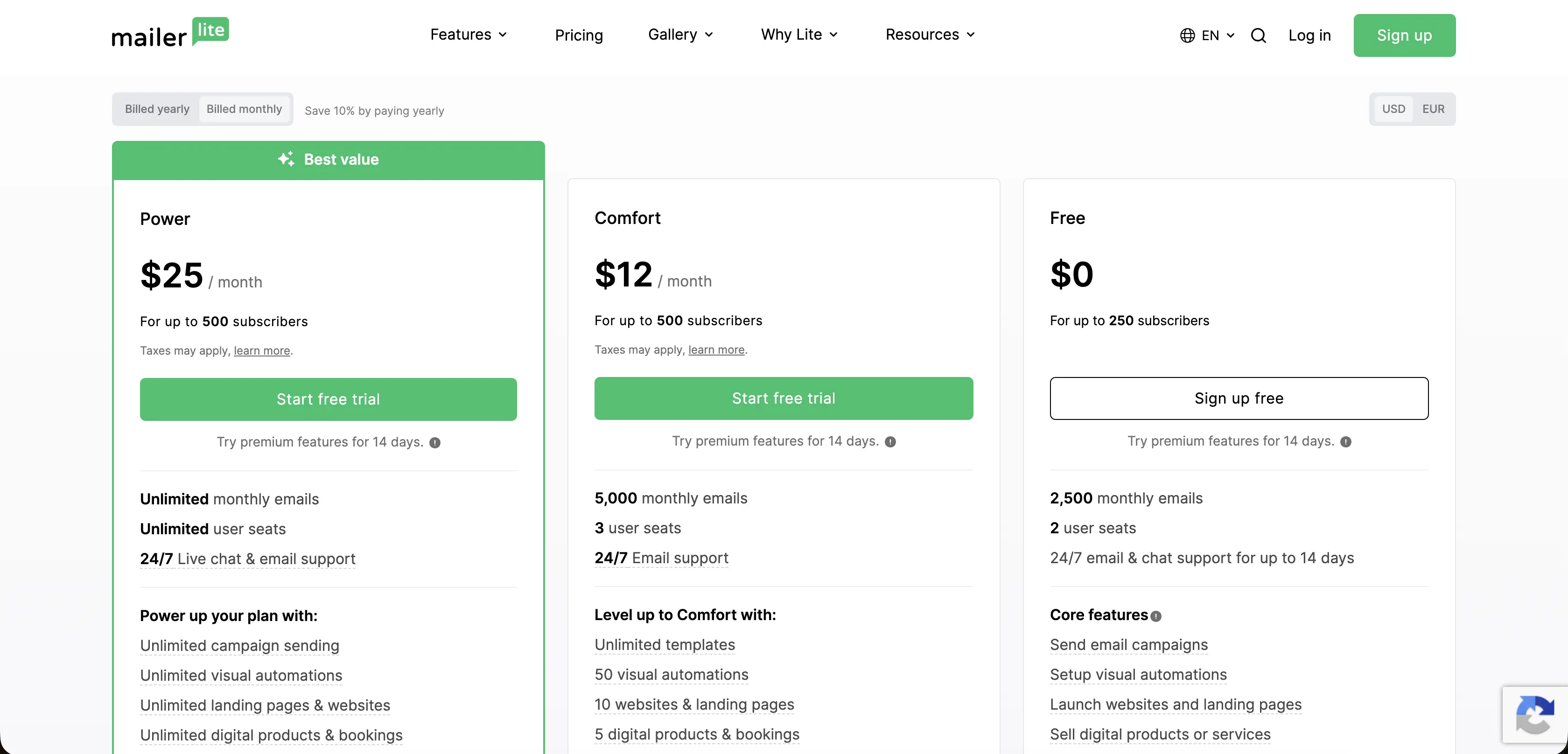
MailerLite takes the top spot for the same reason it keeps winning switcher traffic: the pricing stays simple, and the editor stays out of your way. One thing to know before you sign up: MailerLite repriced on June 16, 2026, and the free plan now covers 250 subscribers and 2,500 monthly sends. Plenty of older articles still quote the retired 1,000 subscriber free tier, so check the current MailerLite pricing page rather than a screenshot from 2024. In my three platform test it produced the cleanest campaign workflow of the group, and support answered a DNS question in under an hour on a paid plan. If you outgrow it or want to compare neighbors first, my MailerLite alternatives roundup covers 13 options.
Brevo
Brevo is the best pick when your list is big, but your send volume is modest. Because billing follows emails sent rather than contacts stored, a 40,000 contact list you email once a month costs a fraction of what contact based platforms charge for the same job. It also folds in SMS, WhatsApp, and transactional email, which normally means a second tool. Two cautions from my earlier research: enterprise extras get expensive fast, with SAML SSO priced at $324 a month on top of the $499 Professional plan, and the marketing automation on entry tiers is thinner than ActiveCampaign's. For the full picture of where it breaks down, see my Brevo alternatives breakdown.
ActiveCampaign
ActiveCampaign is still the automation benchmark. If your email program is really a web of behavior triggered sequences, lead scoring, and CRM handoffs, nothing else on this list matches its workflow builder. The cost is complexity: it took me noticeably longer to ship a first campaign here than on MailerLite, and contact based pricing climbs steeply past 10,000 contacts. It's ranked third because most small senders pay for depth they never use. Teams that do use it rarely leave. I've collected the escape routes in my ActiveCampaign alternatives guide for everyone else.
Klaviyo
For ecommerce stores on Shopify or WooCommerce, Klaviyo's revenue attribution and segmentation are the strongest in the category. Rank it first if you sell products; rank it here otherwise, because of the billing change above. Since February 2025 Klaviyo bills on all active profiles, not just the people you email, so an unpruned list quietly inflates the invoice every month. Drag the slider on Klaviyo's pricing page to your true total profile count, not your engaged count, before budgeting. Store owners weighing cheaper options should read my Klaviyo alternatives comparison first.
Omnisend is the value play for ecommerce. It covers the core Klaviyo use case, product feeds, abandoned cart flows, and SMS in the same workflows, at a lower price at every list size I checked. Reporting depth is a step behind Klaviyo and the template library is smaller, but for a store doing modest volume, the math favors Omnisend until revenue justifies the upgrade. It's the tool I recommend most often to store owners who ask me "Klaviyo quotes scared me, now what?"
Kit
Kit, formerly ConvertKit, is built for creators and newsletter writers rather than marketing teams. The free plan runs to 10,000 subscribers, with the catch that it covers broadcasts and a single basic automation rather than full sequences. Paid plans add the automation and the creator network for paid recommendations. If your product is the newsletter itself, Kit's plain text first approach and tagging model fit better than any general platform on this list.
Mailchimp
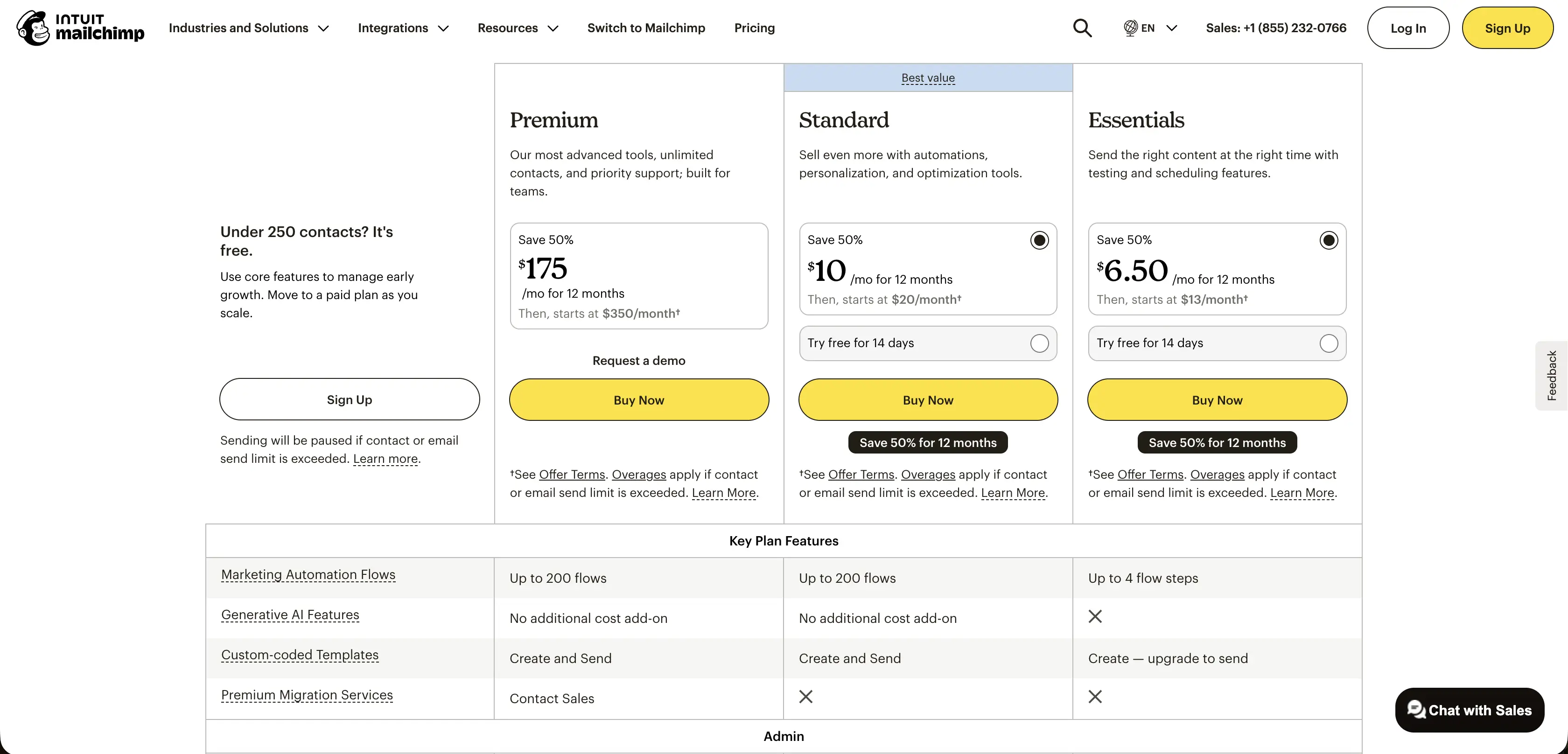
Mailchimp remains the most recognized name in email marketing, and in 2026 that recognition is most of what you're paying for. The free plan now stops at 250 contacts, and the monthly send limit sits at 12 times your contact limit, which means a free account gets exactly two full list campaigns a month. A weekly newsletter is impossible without paying. User sentiment reflects the squeeze: Mailchimp holds a 2.8 score across roughly 1,465 reviews on Trustpilot, with billing disputes and cancellation friction as the recurring themes. The editor is still excellent and the 300+ integrations matter if your stack depends on them. Everyone else should scan my Mailchimp alternatives list before renewing.
Constant Contact
Constant Contact earns its keep with nonprofits and local businesses that value phone support and event tools over automation depth. Watch the send allowance: your monthly cap is a multiple (10x, 12x, or 24x depending on plan) of the top of your contact tier, and overages bill automatically. One more thing most lists still miss: Constant Contact acquired Moosend in June 2025, so treat any article recommending Moosend as an independent alternative to it with suspicion. Full details in my Constant Contact alternatives roundup.
GetResponse
GetResponse is the bundle option. Email, landing pages, a website builder, and built in webinars sit under one subscription, and the webinar feature alone replaces a separate tool that costs as much as the whole plan. Email deliverability and automation are solid rather than exceptional. Choose it when the bundle matches your needs; skip it if you only want email, because focused tools above do that job better for less.
SendGrid
SendGrid is last on this list only because it's a different species. It's a developer grade sending infrastructure owned by Twilio, built for transactional email like receipts, password resets, and app notifications at serious volume. Its marketing campaigns product exists but trails every dedicated platform above on editor quality and automation. Rank it first if you're a developer who needs an API and volume pricing. If you came to it for newsletters, my SendGrid alternatives guide points to better fits.
Best Email Marketing Platforms: Quick Comparison
Tool | Billing model | Free plan | Best for |
|---|---|---|---|
MailerLite | Contact based | 250 subs, 2,500 sends | Simple newsletters on a budget |
Brevo | Send based | Up to 100,000 contacts stored | Big lists, low send volume |
ActiveCampaign | Contact based | Trial only | Deep automation and CRM |
Klaviyo | Active profiles | 250 profiles | Shopify and ecommerce revenue |
Omnisend | Contact based | 250 contacts | Ecommerce on a budget |
Kit | Subscriber based | 10,000 subs, broadcasts only | Creators and newsletters |
Mailchimp | Contact based | 250 contacts, 500 sends | Integration heavy stacks |
Constant Contact | Contact tier + send cap | Trial only | Nonprofits and local business |
GetResponse | Contact based | Limited free tier | Email plus webinars in one bill |
SendGrid | Send volume | 100 sends a day | Developers and transactional email |
Which email marketing software should you pick?
You run a small newsletter and want the least friction: MailerLite. Cheapest path from zero to a scheduled weekly send.
Your list is large, but you email rarely: Brevo. Send based billing is built for exactly this shape.
You sell products online: Klaviyo if the revenue supports it, Omnisend if you want 80% of the outcome for less. Prune inactive profiles before Klaviyo bills you for them.
Your email program is really an automation program: ActiveCampaign, and budget time to learn it.
The newsletter is the business: Kit.
You need receipts and password resets, not campaigns: SendGrid, and stop reading marketing roundups.
As one 2026 industry review put it, "what separates the good from the great in 2026 isn't templates or pricing." It's how the platform handles your data, automation, and deliverability. The billing model just decides how much you'll pay to find out
FAQ: Best Email Marketing Platforms
What is the best email marketing software for small businesses?
MailerLite is the best email marketing software for most small businesses in 2026. The free plan covers 250 subscribers and 2,500 monthly sends, paid tiers stay affordable as lists grow, and the editor requires no training. Brevo is the better pick when the list is large but sends are infrequent.
What is the cheapest way to start email marketing?
Kit offers the largest free ceiling, with room for 10,000 subscribers on broadcasts. For a small list with full features, MailerLite's free plan at 250 subscribers and 2,500 sends beats Mailchimp's, which caps at 250 contacts and 500 sends, only two full list campaigns a month.
Is Mailchimp still the best email marketing platform?
No. Mailchimp is still the most recognized email marketing platform, but its shrunken free plan, contact tier pricing, and a 2.8 Trustpilot score from around 1,465 reviews mean better value exists at nearly every list size. It remains a fair choice for teams locked into its integration ecosystem.
What's the difference between email marketing software and SendGrid?
Email marketing software like MailerLite or Klaviyo is built for campaigns, newsletters, and automations with a visual editor. SendGrid is sending infrastructure: an API developers use for transactional email such as receipts and password resets. Many companies run one of each, and they solve different problems.
Bottom line for Best Email Marketing Platforms
Ignore feature checklists and start with your numbers: how many contacts you store, how many emails you send a month, and what share of your list is actually engaged. Those three figures point to a billing model, and the billing model points at two or three tools instead of ten.
My default answers for 2026: MailerLite for newsletters, Brevo for big quiet lists, Klaviyo or Omnisend for stores, ActiveCampaign for automation heavy teams. Whichever you pick, recheck the pricing page before you enter a card.
Two of the platforms on this list changed their free plans in the last thirteen months, and old numbers are still everywhere.
Price is half the decision. Run the other half through the SaaS ROI calculator.