
HubSpot for a free CRM that actually scales. Zoho CRM for the most CRM per dollar at $14 a user. Pipedrive for the cleanest pipeline view with no bloat. Microsoft Dynamics 365 Sales for teams already living inside Microsoft 365. Freshsales for built in calling under $10 a user.
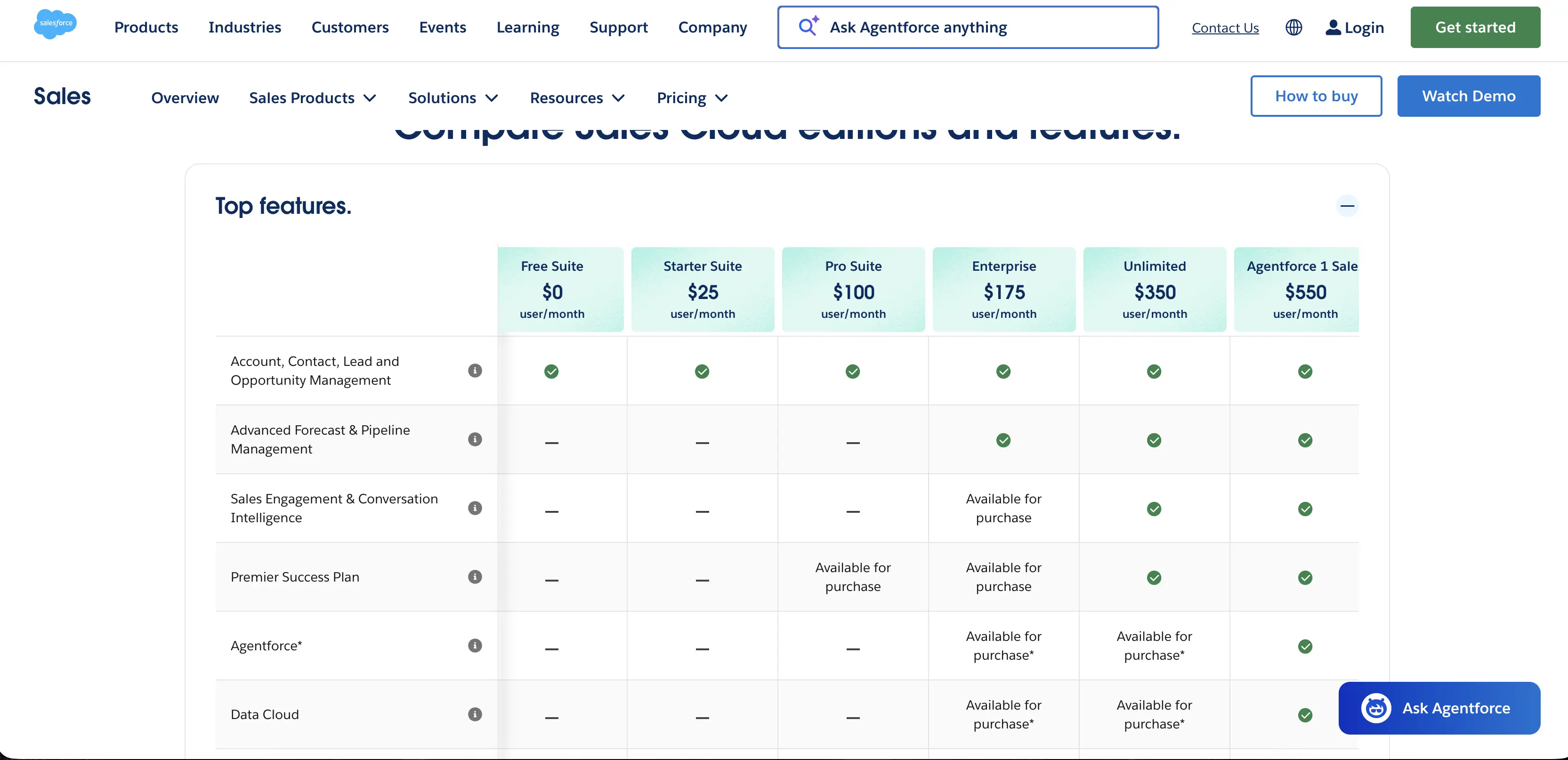
A client asked me to price out Salesforce for her six person outreach team this spring. Starter Suite looked reasonable at $25 a user a month. Then I found out Starter does not include workflow automation. The tier that does, Pro Suite, runs $100 a user. That is $600 a month before a single automated follow up sends.
A thread on Quora asking about low cost Salesforce alternatives had already flagged the same problem, with one answer calling Salesforce "very expensive" and noting new hires often need introductory training just to use it. I spent that same afternoon pricing fourteen other CRM platforms instead.
Salesforce is still the biggest name in customer relationship management software, and there are real reasons teams stay. But its pricing page hides a five step climb that most alternatives roundups never actually total up. Here is what I found, tool by tool, with real numbers pulled straight from each vendor's own pricing page.
Why teams go looking for a Salesforce alternative
The complaints repeat across review sites and forums: high per user pricing once you need automation, a steep learning curve for anyone without a dedicated admin, add ons that turn a $25 sticker price into a four figure monthly bill, and a setup process that often needs a certified partner to finish. None of that makes Salesforce bad software.
It makes it the wrong size for a lot of the businesses searching for a Salesforce alternative in the first place: solo founders, five to twenty person sales teams, and services businesses that need sales pipeline software without an IT department behind it.
The Five Price Jumps Nobody Adds Up
Salesforce's own Sales Cloud pricing page lists five tiers: Starter Suite at $25 a user a month, Pro Suite at $100, Enterprise at $175, Unlimited at $350, and Agentforce 1 Sales at $550. Read individually, each step looks like a normal upgrade. Added up, Pro Suite is four times the Starter price for the automation most teams assume is already included. Enterprise is nearly double Pro Suite. Agentforce 1 Sales, the tier with unmetered AI agents, costs twenty two times what Starter costs.
The AI positioning makes this sharper. Salesforce markets itself as the number one agentic AI CRM, but Agentforce itself is listed as "available for purchase" on Enterprise and Unlimited, not included by default. Salesforce's own pricing page settles the point directly: "Contact a sales representative for detailed pricing information." The AI CRM you are being sold does not have a public AI price.
For comparison, Zoho CRM's entire five tier climb runs from free to $52 a user. HubSpot's runs from free to roughly $150 a user on Sales Hub Enterprise. Neither one asks you to talk to a sales representative to find out what the top tier costs.
The 15 Salesforce Alternatives Compared
Tool | Starts at | Best for |
|---|---|---|
Freshsales | $9/user/mo | Built in calling under $10 a user |
Close CRM | $9/mo (Solo, 1 user) | Outbound teams that live on the phone |
monday CRM | $12/seat/mo | Teams already running monday.com boards |
Nutshell | $13/user/mo | Avoiding usage based pricing tricks |
Zoho CRM | $14/user/mo | Budget teams under ten people |
Pipedrive | $14/user/mo | The cleanest pipeline view, no bloat |
Zendesk Sell | $19/user/mo | Teams already on Zendesk for support |
HubSpot | $20/seat/mo | A free CRM that scales without switching later |
Copper | $23/user/mo | Teams working inside Google Workspace |
Insightly | $29/user/mo | Agencies tracking deals and delivery together |
Salesflare | $29/user/mo | Small B2B teams selling over email |
Vtiger | ~$30/user/mo | Retiring several separate tools at once |
Microsoft Dynamics 365 Sales | ~$65/user/mo | Businesses standardised on Microsoft 365 |
Keap | ~$249/mo (2 users) | Sales and marketing in one system |
Creatio | Quote only | Custom sales processes without developers |
All prices are annual billing rates as published by each vendor. Monthly billing typically runs 20 to 25 percent higher; check yours in the annual vs monthly calculator.
The 15 best Salesforce Alternatives, Ranked and Explained
1. HubSpot
HubSpot is a customer relationship management platform that bundles a free CRM with paid sales, marketing, and service tools on top. The free CRM covers contacts, deals, and companies for unlimited users with no time limit.
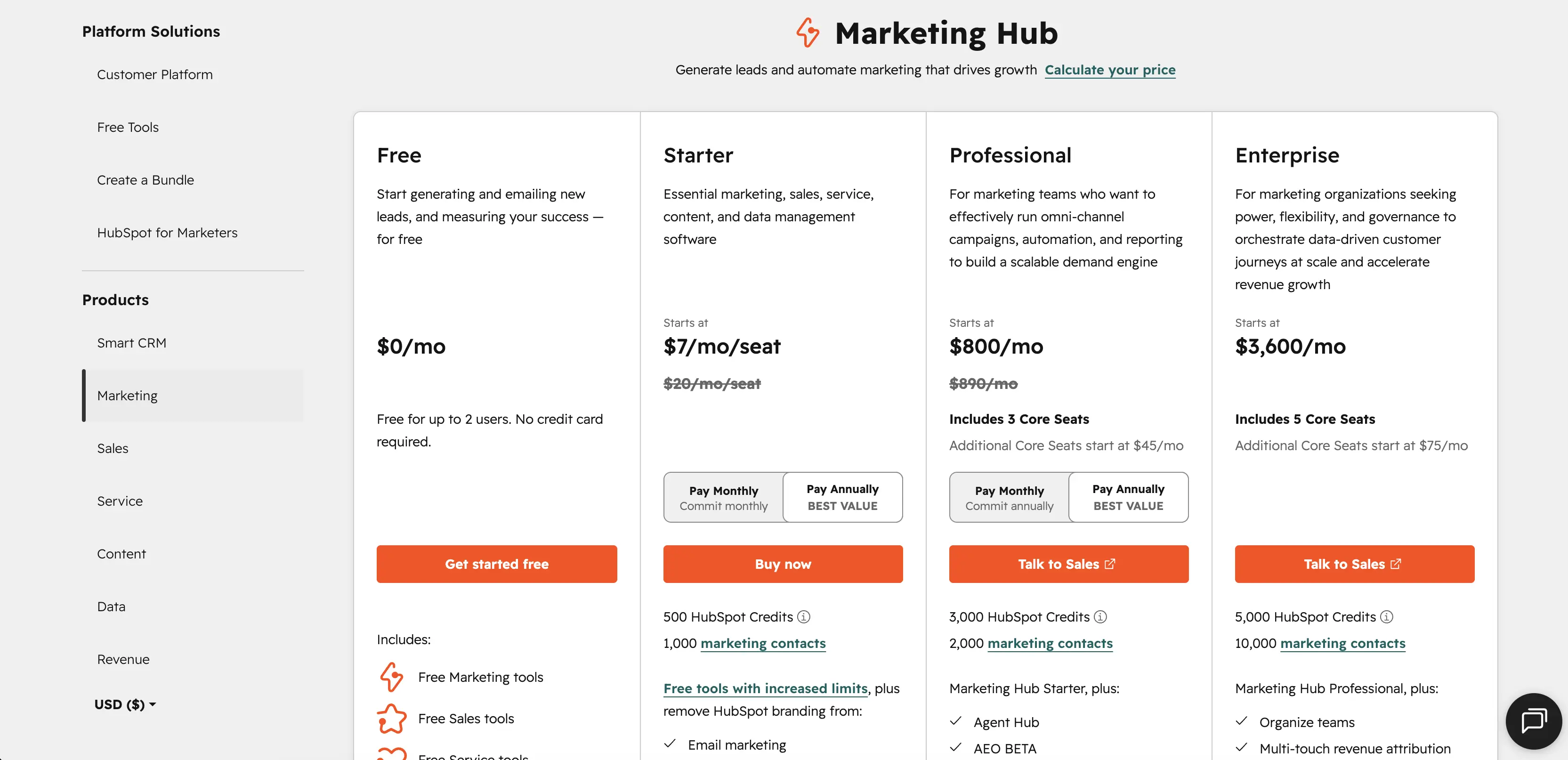
Sales Hub Starter runs about $20 a seat, Professional lands near $100 a seat, and Enterprise reaches roughly $150 a seat, all cheaper than the matching Salesforce tier. The catch is the onboarding fee most Professional and Enterprise buyers pay on top, often $3,000 or more in year one. If HubSpot itself does not fulfil your requirement, check out our HubSpot Alternatives covered in full detail with pricing.
Zoho CRM
Zoho CRM is a budget focused CRM built by Zoho, the same company behind Zoho Books and Zoho Mail. It offers a free plan for up to three users, then Standard at $14, Professional at $23, Enterprise at $40, and Ultimate at $52 a user a month, all billed annually.
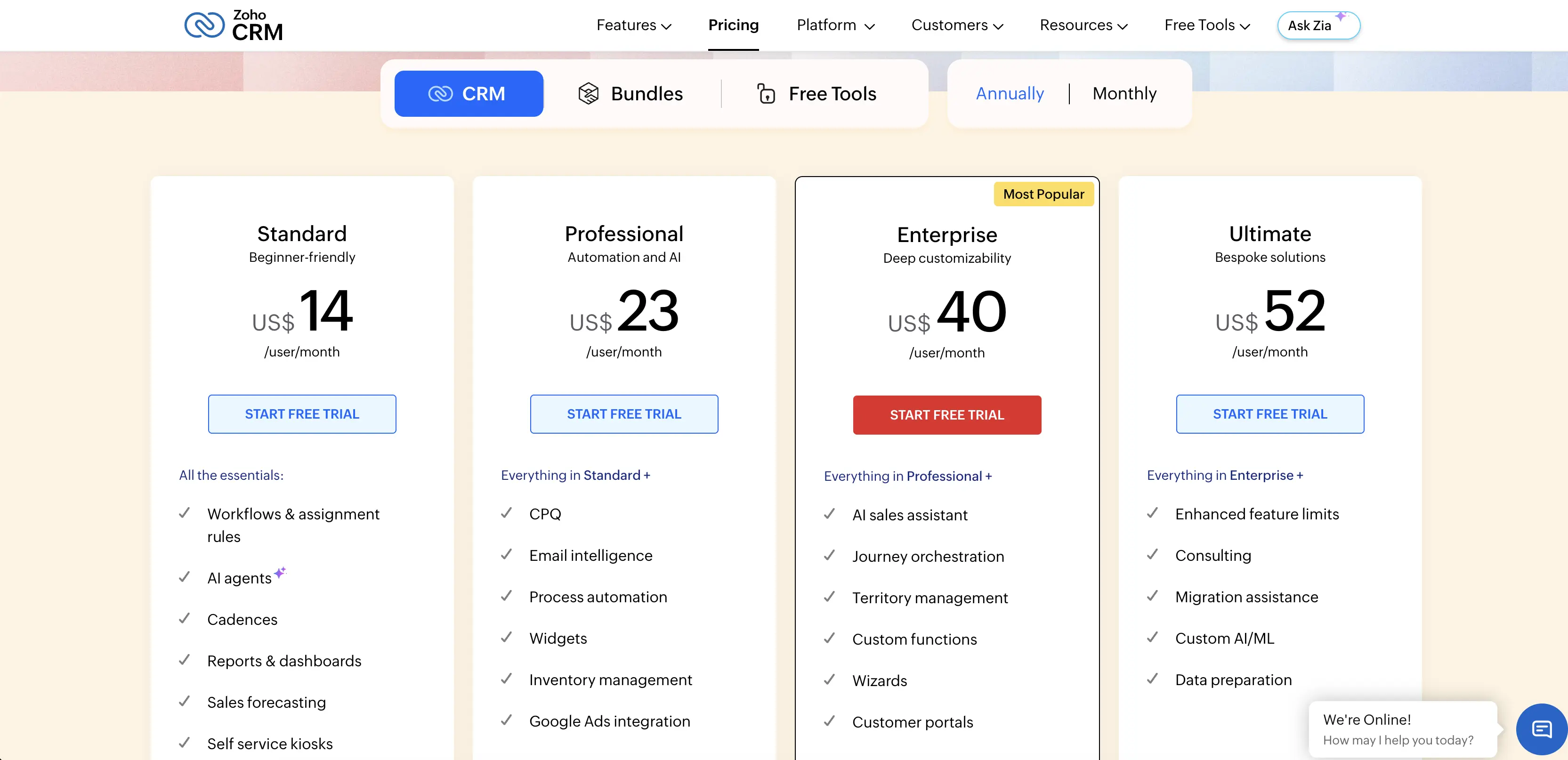
Zoho's Enterprise tier, at $40, sits below even Salesforce's Pro Suite, and it includes an AI assistant called Zia. The trade is a less polished interface than HubSpot or Salesforce.
Pipedrive
Pipedrive is sales pipeline software built around one visual view: your deals, moving through stages, with almost nothing else competing for attention. Pipedrive rebranded its plans in mid 2025: Lite at $14, Growth at $39, Premium at $59, and Ultimate at $79 a user a month, all annual pricing. If Pipedrive itself does not fit, the site's own Pipedrive alternatives roundup covers tools built the same way.
Microsoft Dynamics 365 Sales
Microsoft Dynamics 365 Sales is Microsoft's own CRM, built to sit inside the same login as Outlook, Teams, and Excel. Professional pricing runs close to $65 a user a month, with Enterprise editions pushing past $95 once forecasting and AI insights get added.
It makes the most sense for a business that has already standardized on Microsoft 365 and wants its CRM data to show up inside Outlook and Teams without a separate integration.
Monday CRM
Monday CRM is the sales specific product built on top of monday.com's visual work platform. Basic starts at $12 a seat a month, Standard at $17, and Pro at $28, all billed annually, though every plan carries a three seat minimum even for a solo user. Teams that already run projects on monday.com's boards get the CRM without learning a second interface.
Freshsales
Freshsales is Freshworks' sales CRM, and it is one of the only tools on this list with a built in phone dialer at every paid tier. Growth starts at $9 a user, Pro at $39, and Enterprise at $59 a month, with a free plan for up to three users. The lowest paid tier undercuts Salesforce's Starter Suite by more than half while still shipping automation Salesforce reserves for Pro Suite.
Zendesk Sell
Zendesk Sell is Zendesk's CRM, aimed squarely at sales teams that already run customer support through Zendesk. Team starts at $19 a user, Growth at $55, Professional at $115, and Enterprise at $169. The jump from Team to Growth alone is close to three times the price, so budget for Growth as the real starting point if your reps need custom fields or forecasting.
Close CRM
Close CRM is built for outbound, calling heavy sales teams: dialer, email, and SMS live inside one inbox with no separate phone tool required. Solo runs $9 a month for one user, Essentials $35, Growth $99, and Scale $139 a user, annual pricing throughout. Close's own reps say the platform gets teams calling within days, which matters if your Salesforce implementation is still stuck with a partner three months in.
Insightly
Insightly pairs CRM with project management, which makes it a fit for agencies and consultancies that need to track a deal and then deliver the resulting project in the same system. Plus starts at $29 a user, Professional at $49, and Enterprise at $99 a month. A separate marketing add on adds another $29 a user if you need email campaigns too.
Copper
Copper is a CRM built specifically for teams that live inside Gmail and the rest of Google Workspace, with deep two way sync instead of a bolted on integration. Basic runs about $23 a month, Professional $59, and Business $99 a user. Outside Google Workspace, Copper loses most of what makes it worth the price.
Keap
Keap bundles CRM, email marketing, and payment collection into one small business platform instead of separate modules. Pricing does not run per seat the way most of this list does. It starts around $249 a month for two users and 1,500 contacts, billed annually, or $299 a month on month to month billing. That structure suits a small business that wants one system for sales and marketing rather than a sales only tool.
Nutshell
Nutshell sells a straightforward, transparent pricing pitch: every plan includes unlimited contacts and unlimited storage, so a growing contact list never forces an upgrade on its own. Foundation starts at $13 a user, Growth at $25, Pro at $42, Business at $59, and Enterprise at $79 a month, annual pricing. It is a fit for teams that got burned by usage based pricing tricks on other platforms.
Vtiger
Vtiger bundles CRM with a help desk, project tracking, and light inventory tools inside one subscription instead of separate products. Its One Professional plan runs close to $30 a user a month, with a cheaper Single App license available for support only or sales only roles. It is worth a look for a small business that wants to retire three or four separate tools at once, not just replace one.
Salesflare
SalesFlare automates the data entry Salesforce leaves manual: it pulls contact details from email signatures, meeting invites, and social profiles instead of asking a rep to type them in. Growth starts at $29 a user, Pro at $49, and Enterprise at $99 a month. It is aimed narrowly at small B2B teams that sell over email and hate updating CRM fields by hand.
Creatio
Creatio is a no code CRM and workflow automation platform aimed at businesses that want to build and change their own sales processes without a developer. Unlike every other tool on this list, Creatio does not publish per seat pricing. Every quote is custom, which cuts against the transparent pricing theme of this whole roundup but can work in your favor if you are negotiating a large multi year deal.
Where Salesforce still wins
None of this makes Salesforce the wrong choice for every business. Its AppExchange marketplace lists thousands of prebuilt integrations that smaller CRM platforms simply do not have.
Multi cloud businesses that need sales, service, marketing, and commerce data to live natively in one system still get more out of Salesforce than out of stitching four separate tools together. And because so many admins are trained specifically on Salesforce, hiring for that skill set is easier than hiring for a CRM with a smaller user base.
Which Salesforce Alternatives actually fit
If your team is under ten people and mostly needs contacts, deals, and a pipeline, start with Zoho CRM or Freshsales, since both undercut Salesforce's Starter Suite while including automation Salesforce reserves for Pro Suite.
If you are inbound heavy and want a free CRM that scales without needing to switch tools again later, HubSpot is the safer long term bet even though its Professional tier costs more than Zoho's.
Teams already standardized on Microsoft 365 should look at Dynamics 365 Sales first, since the native Outlook and Teams integration is hard to replace.
Outbound, calling heavy teams get more from Close or Zendesk Sell than from a general CRM with a dialer bolted on.
A services business tracking both the sale and the delivery should look at Insightly or Vtiger before anything sales only.
Still comparing CRMs broadly rather than one Salesforce feature at a time: our best CRM software for small business roundup prices ten tools on annual versus monthly billing, several of which appear above.
FAQ: Salesforce Alternatives
What is the best Salesforce alternative for a small business?
For most small teams, Zoho CRM or Freshsales offer the closest match to Salesforce's features at a fraction of the per user cost, since both include automation at their entry paid tier instead of gating it behind a fourth tier the way Salesforce does.
Is there a free alternative to Salesforce?
Yes. HubSpot's CRM is free for unlimited users with no time limit, and Zoho CRM and Freshsales both offer free plans capped at three users, which covers most solo founders and very small teams.
What is the cheapest Salesforce alternative?
Close CRM's Solo plan and Freshsales' Growth plan both start under $10 a user a month, and Zoho CRM's Standard tier at $14 a user is the cheapest option among tools built for teams larger than three people.
What are Salesforce's biggest competitors?
HubSpot, Zoho CRM, Microsoft Dynamics 365 Sales, and Pipedrive are the four names that show up most often as direct Salesforce competitors, each pulling from a different part of Salesforce's customer base.
Can I move my data out of Salesforce without losing history?
Most CRM platforms on this list, including HubSpot, Zoho CRM, and Pipedrive, offer a guided or CSV based import built for Salesforce migrations, though custom objects and years of activity history usually need a data migration specialist to move cleanly.
Which Salesforce alternative fits a team already using Microsoft or Google?
Dynamics 365 Sales is the natural fit for a Microsoft 365 shop, since it shares a login with Outlook and Teams. Copper plays the same role for a Google Workspace team, syncing directly with Gmail and Calendar instead of bolting on an integration.
Is Salesforce worth the price for a growing team?
It depends on what growing needs. A team that needs Salesforce's AppExchange ecosystem or true multi cloud data sharing across sales, service, and marketing still gets real value for the price. A team that just needs a pipeline, contact records, and basic automation is very likely overpaying once it reaches Pro Suite.
My picks for Salesforce Alternatives
Fifteen tools, one honest conclusion: most businesses searching for a Salesforce alternative are not looking for a smaller Salesforce. They are looking for the specific two or three features they actually use, at a price that does not jump four times the moment automation gets turned on.
Start with Zoho CRM or Freshsales if budget drives the decision, HubSpot if you want the safest long term free to paid path, and Dynamics 365 Sales or Copper if your team already lives inside Microsoft or Google. Price out Salesforce's real tier, not just the $25 headline, before you compare it against any of the fourteen alternatives here.