TL;DR
Starter Suite and Pro Suite still run $25 and $100 a seat. Above that, Salesforce now sells Core, Advanced, and Max at $195, $395, and $550, and its own pricing pages have not caught up with each other yet.
Already on Enterprise or Unlimited? Your price has not moved yet, but expect an 8 to 10 percent bump at renewal unless you push back on it.
Add the Premier Success Plan to an Enterprise seat and the total costs more than Core, which already includes it.
I checked five of Salesforce's own pricing pages on the same afternoon this week. Three of them disagree about what a Salesforce Enterprise seat costs right now.
One of them does not mention Enterprise at all anymore.
If you have tried to get a straight answer on salesforce pricing lately and come away more confused, that is not you. That is the site.
What Salesforce actually charges, edition by edition
Salesforce sells its CRM in two shapes: two entry suites priced per seat, and a set of higher tiers that vary by which page you land on. Here is what is live right now, checked directly on each product's own page.
Edition | Price | Billing |
|---|---|---|
Starter Suite | $25 per user per month | Monthly or annual, transaction fees apply |
Pro Suite | $100 per user per month | Annual, contract required |
Sales Cloud Enterprise | $175 per user per month | Annual, contract required (still sold on the small business page) |
Core | $195 per user per month | Monthly or annual |
Advanced | $395 per user per month | Monthly or annual |
Max | $550 per user per month | Monthly or annual |
Marketing Cloud is different. Its Next Growth Edition runs $1,500 a month per org, not per seat, so it does not fit the same ladder at all.
Nonprofit Cloud has its own separate price list, covered further down.
What replaced Enterprise and Unlimited (and what did not)
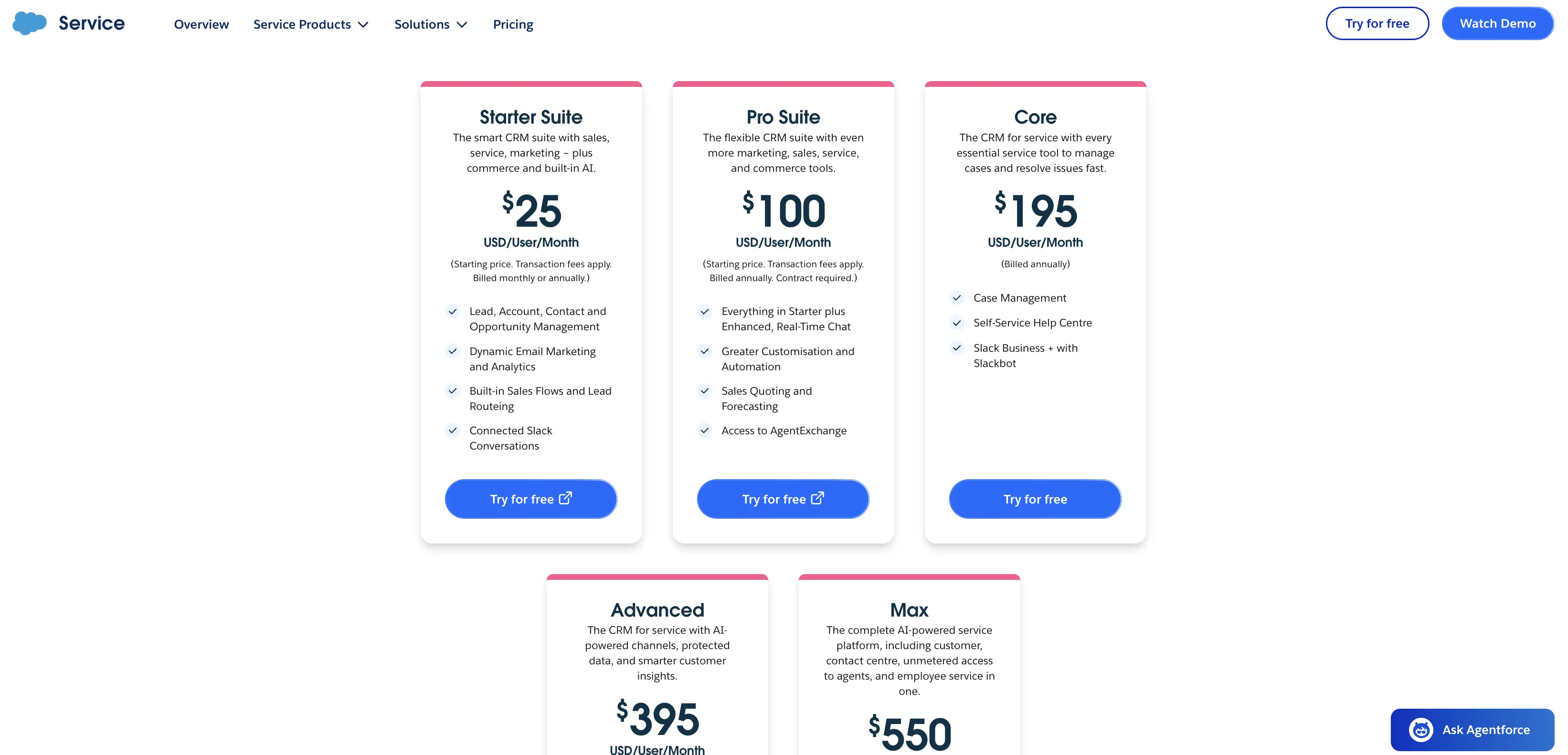
On 3 September 2026, Salesforce launched three new editions: Core, Advanced, and Max, priced at $195, $395, and $550 a seat.
Each one bundles Agentforce, Slack, embedded analytics, data security, and a Premier Success Plan, plus a Flex Credit allowance: 500,000 for Core, 1,000,000 for Advanced, and 2,750,000 for Max.
Max sits at the same price as the old Agentforce 1 edition, and current Agentforce 1 customers move to it at no extra cost.
Here is the part almost nobody covering this has checked: whether Enterprise and Unlimited are actually gone.
Salesforce Ben's own writeup on the launch says plainly that it is "possible" the new editions replace them, but calls that "not confirmed." I went and looked. Not confirmed. Not true, at least not yet. Salesforce's small business pricing page, checked today, still sells "Sales Cloud Enterprise" at $175 a seat with no mention of Core anywhere on it.
Salesforce's CRM pricing page mentions that Enterprise and Unlimited "exist" without pricing them. Only the Service Cloud pricing page shows the clean Core, Advanced, Max lineup with zero reference to Enterprise or Unlimited. Same company, same week, three different stories about the same product line.
Salesforce's own pricing pages do not agree with each other right now
This is worth its own section because it changes how you should shop, not just what you should know. If a rep, a partner site, or a search result tells you Enterprise "no longer exists," check which Salesforce page they are looking at before you believe it.
Three pages, checked the same day: the small business page prices Sales Cloud Enterprise at $175. 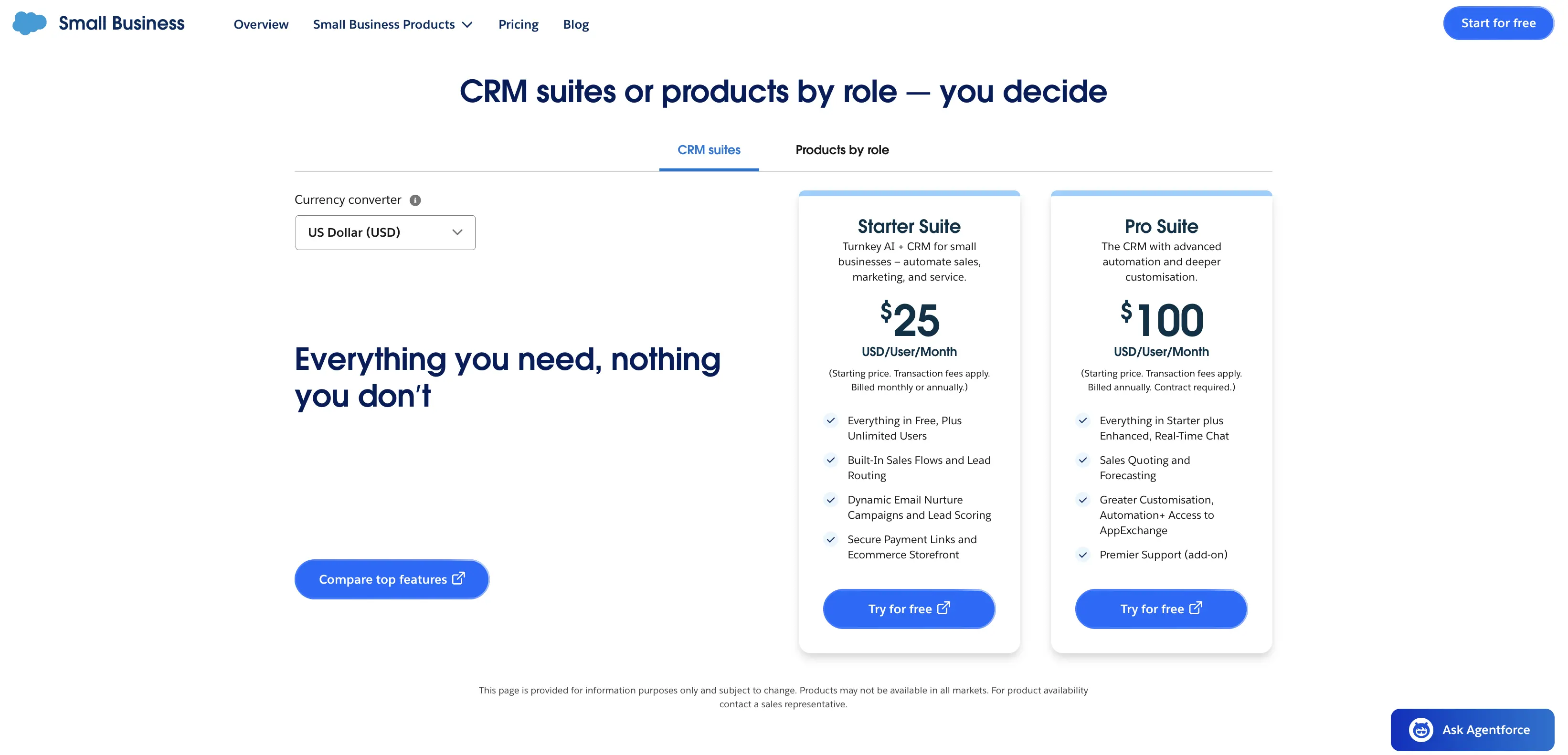
The Service Cloud page shows Core, Advanced, and Max with no Enterprise line at all.
The CRM pricing page splits the difference, naming Enterprise and Unlimited as real editions but declining to price them. None of the three pages links to either of the other two for clarification.
If you are budgeting for a seat right now, the honest answer is that the number depends on which door you walked through, and that is true today, not in some hypothetical edge case.
The bundle math nobody runs on a Core seat
Salesforce's Premier Success Plan, its paid support tier, costs 30 percent of your net license fees on its own. It comes free with Unlimited and Agentforce 1, but not with plain Enterprise.
Do the math. Core stops looking like a straightforward price increase.
An Enterprise seat is $175. Add Premier at 30 percent and you are paying $175 plus $52.50, for a total of $227.50 a month, and that is before Slack, Tableau Next, or any Agentforce credits, none of which Enterprise includes.
Core is $195 flat, with Premier, Slack, Tableau Next, and 500,000 Flex Credits already inside it. Priced this way, Core is $32.50 a seat cheaper than an Enterprise seat with the support plan most serious teams end up buying anyway.
Nobody selling either edition puts these two numbers next to each other, because doing so makes the "price increase" story a lot less simple.
What happens to your bill if you are already on Enterprise or Unlimited
If you signed your contract before 3 September, nothing changes automatically. Not yet. Salesforce's own announcement states that "existing customer pricing on legacy editions remains unchanged" for now. The number to watch is not today's invoice. It is the one at your next renewal.
Most Salesforce order forms include a clause letting Salesforce raise your contracted rate at each annual renewal, by 8 to 10 percent as a default, according to procurement advisory firm LOW/CODE.
That compounds fast: a seat signed at $130 in 2022 reaches $183.50 by 2026 on a straight 9 percent annual climb, a 41 percent increase with no new features added.
The same source says customers who negotiate ahead of the renewal date, ideally around 12 months out, can often get that annual bump down to 3 to 5 percent instead.
Separately, Salesforce has raised its published list prices outright before: a 6 percent increase took effect in 2025, with the company describing it at the time as reflecting "ongoing innovation and customer value."
A renewal uplift and a list price increase are not the same mechanism, and it is worth knowing which one just hit your invoice.
"They're trying to figure out what is the right pricing model for this," says Arun Chandrasekaran, a Distinguished VP Analyst at Gartner, quoted the same week Salesforce last raised list prices.
Agentforce credits, converted into something you can actually budget
Flex Credits are Salesforce's currency for Agentforce, its AI agent product, and the number on the pricing page means little on its own until you convert it into usage. Credits cost roughly $500 per 100,000. Cheap, until it isn't.
A standard AI agent action burns 20 credits, so about ten cents. A voice action burns 30 credits, about fifteen cents.
Run that against Core's included 500,000 credits and you get somewhere in the neighborhood of 25,000 standard actions a year before you are buying more.
Whether that is generous or tight depends entirely on how many conversations, cases, or workflows you actually plan to route through an agent, and almost none of the pages selling Core tell you that math up front.
The hidden costs that do not show up on the pricing page
The sticker price is rarely the whole bill. Budget for these too, before you sign anything:
Extra data storage runs about $125 a month per additional 500MB once you are past your included allowance, and extra file storage is billed separately at roughly $5 a month per gigabyte.
Implementation is not included at any tier. Depending on how customized your setup needs to be, that is a separate line item, often the single biggest cost in year one for a mid sized team.
Starter Suite carries transaction fees on top of the seat price, which Pro Suite and above do not.
Salesforce pricing by who is buying
Small businesses and solo teams: Starter Suite at $25 covers basic contact and deal tracking. Pro Suite at $100 adds automation and reporting most small teams eventually need, and is the edition Salesforce itself points small business shoppers toward.
Nonprofits: Nonprofit Cloud has its own price list entirely, separate from the commercial editions above: Enterprise at $60, Unlimited at $100, and the two Agentforce 1 tiers at $135 each, all per user per month.
Eligible nonprofits can also get 10 free licenses through the Power of Us program, which is worth checking before paying for anything.
Startups: there is no dedicated startup edition. None. Most startups land on Starter or Pro Suite and grow into Core once they need agent automation or multi department access.
Larger teams already comparing options: if the honest math above makes switching look better than paying for a new edition, Salesforce alternatives roundup breaks down 15 competing tools by price and use case, and the switch and save calculator will run the actual payback math on your own seat count.
How Salesforce pricing compares to HubSpot and Zoho
Salesforce is not alone here. Every major CRM's pricing page takes work to parse.
HubSpot's entry Starter tier lists two different numbers depending on whether you pay monthly or annually, and most pages covering it only print one.
Zoho CRM's paid tiers run noticeably below Salesforce at every comparable seat level, which is the main reason "salesforce vs hubspot pricing" and "salesforce vs zoho pricing" show up in search at all: buyers are not asking which tool has more features, they are asking which one they can actually afford to scale.
FAQ: Salesforce pricing
Can I still buy Salesforce Enterprise or Unlimited?
Yes, as of this check. Salesforce's small business page still sells Sales Cloud Enterprise at $175 a seat, even though its Service Cloud page shows only Core, Advanced, and Max. Which one you are offered may depend on which product line and which sales page you start from.
How much does Salesforce cost per user?
Starter Suite is $25, Pro Suite is $100, and the top three tiers are Core at $195, Advanced at $395, and Max at $550, all per user per month. Sales Cloud Enterprise, where still sold, is $175.
Is Salesforce worth it?
For teams that need the automation in Pro Suite and above, most reviewers say yes on capability. The recurring complaint, visible across hundreds of Trustpilot reviews, is less about the software and more about pricing transparency during the sales process.
Does Salesforce have a free trial?
Salesforce offers free trials on most editions, but no permanent free tier. Nonprofits get the closest thing to free, through 10 no cost licenses via the Power of Us program.
How much does Salesforce cost for a small business?
Starter Suite at $25 a seat or Pro Suite at $100 a seat covers most small business needs. Neither requires Core, Advanced, or Max.
What are the hidden costs of Salesforce?
Implementation, storage overage past your included allowance, Starter Suite's transaction fees, and the Premier Success Plan surcharge on any edition that does not already include it.
What to check before you sign
Salesforce's own pricing pages will tell you three different things about the same product this week. Do not trust just one. Check which edition a rep is actually quoting you against the live page for that specific cloud.
Check which edition a rep is actually quoting you against the live page for that specific cloud, run the Premier Success Plan math if you are anywhere near Enterprise, and ask directly what your renewal uplift clause says before you sign, not after.
Pricing verified 11 September 2026 from Salesforce's own pricing pages (sales, service, small business, CRM, and nonprofit) and the sources linked throughout.