Lemon.io works best if you're a startup watching every dollar. Braintrust works best if you want to see exactly where your money goes, since it charges talent nothing and adds a flat fee on top. Turing works best if you need an AI or machine learning specialist fast and don't mind a blended rate.
I put $2,240 through three of these platforms over six weeks, hiring a developer through each one for the same two-week WordPress migration task, then lined up what showed up on the invoice against what the identical scope would have cost through Toptal. The gap wasn't the hourly rate. It was everything billed around it: the deposit, the monthly access fee, and on a couple of platforms, a fee for hiring the same person directly later.
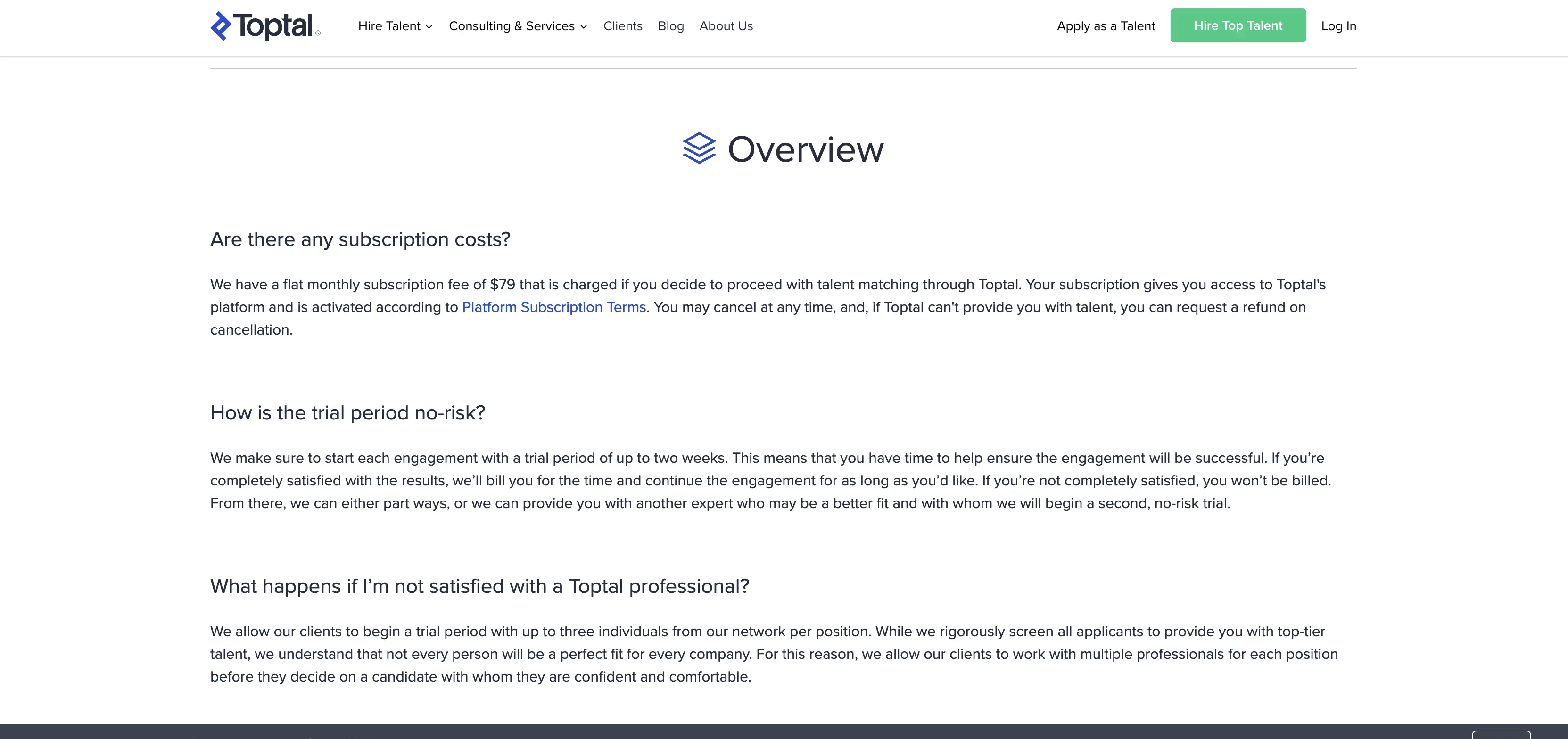 Toptal itself isn't cheap or slow. Its own FAQ confirms candidates arrive within 24 hours in almost all cases, and 90% of clients hire the first person they're introduced to. The problem isn't the matching. It's the $79 monthly subscription that runs whether or not you're actively hiring, the $500 refundable deposit that ties up cash before you've talked to anyone, and a blended hourly rate ($60 to $200+, sometimes $240+ for AI specialists) that hides the platform's markup inside one number.
Where the Toptal math stops working
Toptal's own Trustpilot page carries several thousand reviews, mostly positive, and the recurring praise is about match speed and talent quality, not price. Pricing frustration shows up elsewhere: on G2 and in independent cost breakdowns, where clients report being billed $110 to $120 an hour with no visibility into how much reaches the freelancer.
One member of Toptal's own talent network, quoted on Toptal's talent FAQ page, credits the platform because "they perfectly matched my client with my design profile." That's a real strength. It doesn't explain why a full-time hire at $110/hour runs about $17,600 a month before the subscription is added.
If you're hiring one specialist for a defined project, none of this may matter much. If you're staffing an ongoing role, the fee comparison below is worth fifteen minutes before you commit.
Read Also: 13 best Adverity Alternatives (with real pricing, no demo required)
The direct-hire tax nobody mentions
Every "Toptal alternatives" roundup compares hourly rates. Almost none compare what happens if you like a contractor enough to hire them permanently, and that number moves more than the hourly rate does.
Lemon.io: $14,000 flat, per its own placement fee policy.
Braintrust: 15% of the first year's base salary, if converted within six months.
Gun.io: 20% of the negotiated first-year salary.
Andela: $50,000 if you convert within the first 12 months, per its Master Services Agreement as reported in independent buyer cost breakdowns.
Toptal: no published conversion fee. Its FAQ mentions only the $79/month subscription, likely because most Toptal engagements stay hourly rather than converting to a direct hire.
If there's any chance a contractor becomes permanent, run this math before you pick a platform. A rate that looks $10/hour cheaper can cost far more the day you bring someone in-house.
1. Lemon.io
Best for: startups that want a flat monthly relationship instead of an access fee. Rate: $45 to $85/hour blended, 160-hour minimum per project.
Lemon.io is a curated marketplace that matches vetted developers to startups month-to-month, with no separate subscription fee outside the hourly rate. Its acceptance rate sits at 1.2%, and it commits to one to three candidate matches within 24 hours.
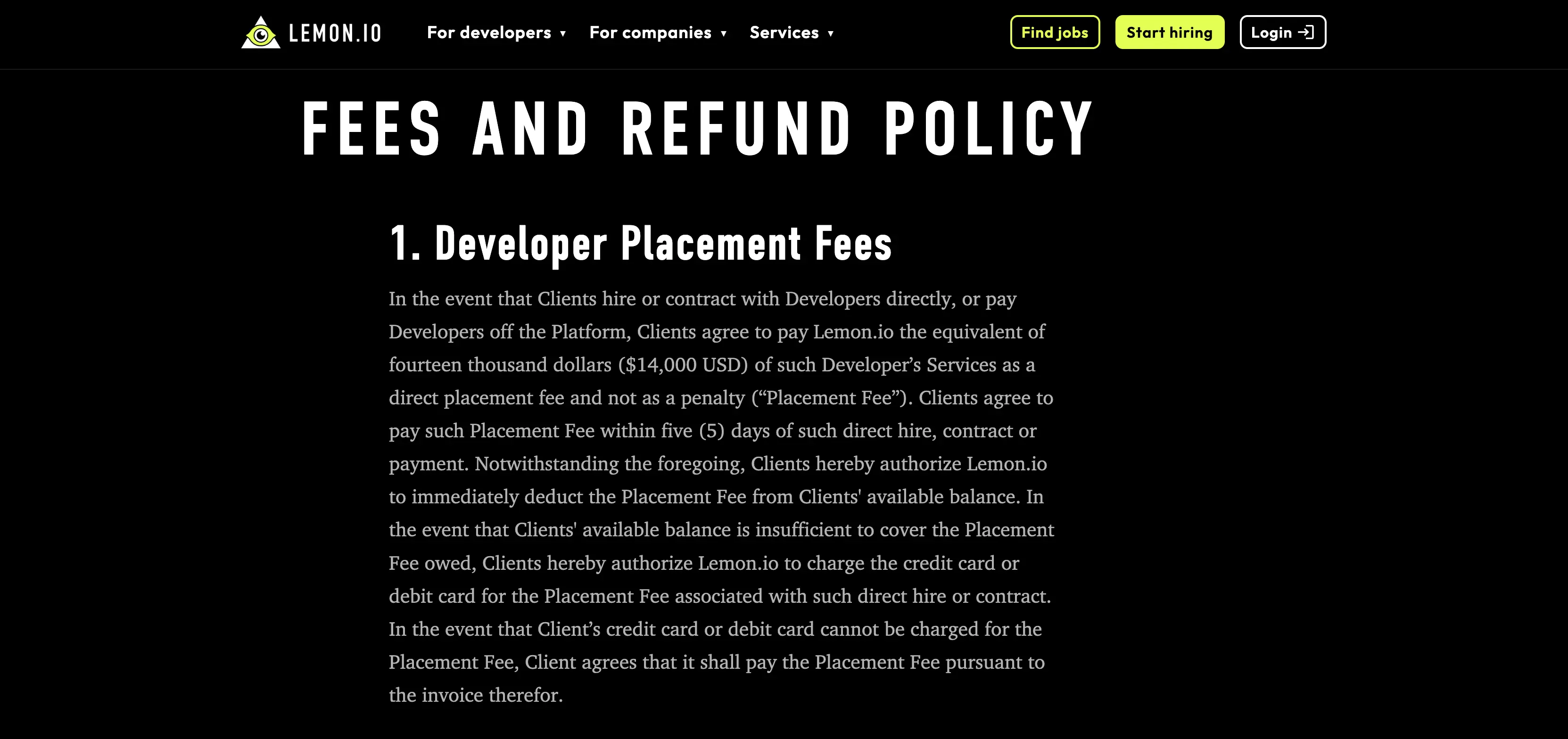 The catch: hire a matched developer directly, off the platform, and Lemon.io's own placement fee policy charges a flat $14,000 for that move.
2. Braintrust
Best for: companies that want to see exactly where the markup goes. Rate: talent sets its own price and keeps 100% of it; clients pay roughly 15% on top.
Braintrust flips the usual freelance-marketplace math. Instead of taking a cut from the developer's pay (Toptal's model, Turing's model, Gun.io's model), it charges the client a separate fee and lets talent keep their full rate. Its FAQ states developers on the platform earn close to $100/hour on average.
Convert a Braintrust contractor to a full-time hire within six months, and its policy applies a 15% fee on the first year's salary, not a flat number like Lemon.io's.
3. Turing
Best for: AI and machine learning hires where speed matters more than a published price. Rate: $60 to $200+/hour, blended.
Turing runs AI-driven matching across a global developer pool and offers a two-week free trial with no upfront cost, per its own hire-developers page. It doesn't publish a rate card. Third-party cost breakdowns put Turing's service margin at 50 to 55% of what the client pays, close to Toptal's own markup pattern, just wrapped in a faster, more AI-forward sales process.
4. Arc.dev
Best for: teams that want a smaller deposit and a quicker contractor match. Rate: $60 to $110/hour, $300 refundable deposit.
Arc.dev runs on an AI matching engine called HireAI across a pool of more than 450,000 candidates, and it promises contractor matches within about 72 hours. The $300 deposit is 40% smaller than Toptal's $500 and gets credited toward your first invoice the same way. Full-time placements close in about two weeks, with a separate fee on the salary.
5. Gun.io
Best for: seeing the full hourly number on a developer's profile before you talk to anyone. Rate: $100 to $200+/hour for contract work; 20% of first-year salary for full-time placement.
Gun.io's own FAQ is unusually direct: developers set their rate, and you see the full, all-in price on their profile with no fees layered on after. About 100 of the 1,000 developers who apply each month get approved, and clients hire within 13 days on average. Convert to full-time, and that same FAQ confirms a 20% fee on the negotiated first-year salary.
6. Andela
Best for: staffing several engineers at once when you can commit to a full year. Rate: $8,000 to $25,000/month per engineer, 12-month minimum.
Andela runs a global vetting pipeline (English proficiency, coding challenges, a live technical interview) across more than 150,000 registered engineers, with an acceptance rate reported under 4%. It publishes a rate range on its own site, rarer than most platforms here offer. What you give up is flexibility: the 12-month minimum and the $50,000 conversion fee noted above.
7. CloudDevs
Best for: US teams that want LATAM developers already working inside US business hours. Rate: $45 to $75/hour.
CloudDevs focuses on Latin American developers, drawing from a pool it describes as more than 500,000 engineers, and handles trial periods, payroll, and compliance directly so a US company doesn't need local contracts. The narrower geography is what buys the lower rate.
8. Upwork
Best for: short, well-scoped tasks where you're willing to screen candidates yourself. Rate: roughly $10 to $100+/hour, set by each freelancer.
Upwork is the largest general freelance marketplace here, with millions of profiles across development, design, and marketing. No cost to post a job, no deposit like Toptal's. The trade is that Upwork does none of the vetting for you; you're reading proposals and running your own screening, which pays off for a short task and rarely for an ongoing senior hire.
9. Fiverr Pro
Best for: one-off deliverables with a fixed scope, not open-ended development work. Rate: fixed packages, commonly $299 to $1,299+ per project for design-style work.
Fiverr Pro is a curated tier of Fiverr's gig marketplace, built around fixed-price packages rather than hourly billing. It's a poor fit for a role that needs ongoing iteration, but a strong one for a single, clearly scoped deliverable like a logo, a landing page, or a small integration.
10. Gigster
Best for: companies that want a full delivery team, not a single contractor. Rate: managed projects starting around $52,000.
Gigster assembles complete teams (developers, QA, a project manager) using AI-assisted matching and hands-on delivery management, aiming for a finished product rather than staffed hours, closer to an outsourced product studio than a freelance marketplace. The minimum rules it out for anything smaller than a genuine multi-month build.
11. We Work Remotely
Best for: companies that already know how to screen candidates and just need more of them. Rate: $299 for a 30-day job listing, per its own FAQ. No placement fee.
We Work Remotely is a job board, not a managed marketplace. You post, candidates apply, and you run the interview and vetting yourself, the same trade Upwork carries but at a flat listing price instead of a percentage of what you pay a freelancer.
Read Also: 10 best BambooHR Alternatives in 2026 (real pricing, no sales call)
12. X-Team
Best for: a developer who feels like a long-term teammate rather than a rotating contractor. Rate: roughly $50 to $99/hour, 90-day minimum contract.
X-Team embeds developers into your existing team, joining standups and code reviews rather than working at arm's length, and markets itself around retention and community over speed of matching. The 90-day minimum means at least $18,000 to $24,000 of budget committed before you start, based on the published rate range.
Toptal Alternatives Comparison
Platform | Rate range | Minimum commitment | Trial or deposit |
|---|---|---|---|
Toptal | $60 to $200+/hr | None stated | $500 deposit, 2-week trial |
Lemon.io | $45 to $85/hr | 160 hours | No deposit |
Braintrust | Talent sets rate, 15% client fee | Project-based | No deposit |
Turing | $60 to $200+/hr | None stated | 2-week free trial |
Arc.dev | $60 to $110/hr | None stated | $300 deposit |
Gun.io | $100 to $200+/hr | None stated | No deposit |
Andela | $8,000 to $25,000/mo | 12 months | 15-day trial |
CloudDevs | $45 to $75/hr | None stated | Trial period offered |
Upwork | $10 to $100+/hr | None | No deposit |
Fiverr Pro | $299 to $1,299+/project | None | Fixed price |
Gigster | From $52,000/project | Project-based | N/A |
We Work Remotely | $299/listing | None | Self-serve |
X-Team | $50 to $99/hr | 90 days | None stated |
Which Toptal Alternatives to Pick
Need it cheaper than Toptal, fast: Lemon.io or CloudDevs.
Need full fee transparency: Braintrust.
Need AI or ML specialists: Turing.
Need a smaller deposit than Toptal's $500: Arc.dev.
Need to see the whole rate upfront: Gun.io.
Staffing several engineers for a year: Andela.
Just need one short task done: Upwork or Fiverr Pro.
Want someone else to run the whole build: Gigster.
Already trust your own screening process: We Work Remotely.
Want long-term team integration, not rotating contractors: X-Team.
Looking beyond vetted dev talent? These twelve alternatives focus on developer hiring, but if you need a wider view of the freelance market, designers, writers, marketers, and generalist marketplaces are included; our best freelance platforms in 2026 roundup compares the field side by side.
FAQ for Toptal Alternatives
What's the cheapest Toptal alternative?
CloudDevs and Lemon.io both start below Toptal's $60/hour floor, at $45/hour. Neither charges Toptal's $79 monthly access fee or $500 deposit.
Are there free Toptal alternatives?
No platform here is free to hire from, since developers still get paid, but Upwork and We Work Remotely are free or near-free to post on. Upwork charges nothing to list a job; We Work Remotely charges a flat $299 regardless of how many people you hire from the listing.
What do people say about Toptal alternatives on Reddit?
Hiring subreddits tend to repeat two complaints about Toptal: the markup is invisible, and the $79/month fee keeps running if you forget to cancel it. Alternatives with a flatter fee structure, like Lemon.io or Braintrust, come up most often in response.
Which Toptal alternative works best for startups?
Lemon.io is built for startup budgets, with no separate subscription fee and a month-to-month commitment. Braintrust is the second most common startup pick, mainly for teams that want to audit exactly what they're paying for.
My Picks For Toptal Alternatives
Toptal's matching speed and vetting depth are real; the 90% first-candidate hire rate its own FAQ cites backs that up. What it doesn't show is the total cost of a long relationship, and that's where the $79 monthly fee, the $500 deposit, and a blended rate with an undisclosed markup start adding up.
Testing the waters is cheapest with Lemon.io or Arc.dev, since both cost less to walk away from than Toptal does. If a direct hire is even a possibility down the road, run the conversion-fee math above before signing anything. It's the number none of these platforms lead with, and it's usually the one that decides whether the cheaper option actually was.