Upwork now runs a variable fee between 0% and 15% per contract instead of the old flat cut. Fiverr still takes a flat 20% from every seller. Contra and Braintrust charge freelancers nothing at all. If you only read one section, read the fee table below.
I posted the same $500 logo brief on five platforms in one afternoon: Upwork, Fiverr, 99designs, Contra, and Dribbble. The replies came back at wildly different speeds, and so did the math on what I would have actually kept.
Most "best freelance platforms" lists repeat the same fee numbers, and several disagree with each other. I found five different figures for Upwork's fee alone, ranging from a flat 10% to a tiered 20/10/5% split Upwork actually retired. Pricing here was confirmed on August 21, 2026, from each platform's own pricing or help center page, not from other roundups.
Why one freelance platform isn't enough
Every platform here solves a different problem. Fiverr gets you a fast, cheap draft. Toptal gets you a vetted senior developer at a much higher price. Contra and Braintrust exist because freelancers got tired of losing 20% to a platform that only introduced them to the client.
A Trustpilot page with over 11,000 reviews for Upwork shows the split: freelancers who stay love the client access, and the ones who leave point to the fee.
Staying loyal to one platform usually costs you money somewhere: in commission, in a subscription you do not need yet, or in a slower client search.
The 13 Best Freelance platforms in 2026 Compared
Platform | Freelancer fee | Client fee | Free to join | Best for |
|---|---|---|---|---|
Upwork | 0% to 15%, set per contract | 5% (Basic) or 10% (Business Plus) | Yes | Ongoing client work |
Fiverr | 20% flat | 5.5% plus a small order fee | Yes | Fast, packaged gigs |
Toptal | 0%, client pays a subscription | $79 a month if matched | Yes to apply | Vetted senior developers |
Freelancer.com | 10% or $5, whichever is more | 3% or $3, whichever is more | Yes | Competitive bidding |
Contra | 0% on the free plan | Payment processing fee only | Yes | Keeping the full rate |
Braintrust | 0%, always | 15% platform fee | Yes | Long term contract work |
PeoplePerHour | 20% down to 3.5% by tier | Not published on their support page | Yes | UK and EU clients |
Guru | 9% down to 5% by membership | 2.9% handling fee | Yes | Ongoing repeat clients |
99designs | Package priced, not commission | Package priced, not commission | Yes to enter | Logo and brand design |
We Work Remotely | Free to browse | $299 per 30 day listing | Yes | Full time remote roles |
FlexJobs | $23.95 every 4 weeks, cheaper on longer plans | Not a hiring platform | No, paid access | Vetted remote listings |
Free core account | $39.99 a month for Premium Career | Yes | Warm network leads | |
Dribbble Pro | $4 to $99 a month, billed yearly | Same tiers | Yes, free tier exists | Visible design portfolio |
Best Freelance platforms in 2026: Explained
1. Upwork
Price: 0% to 15% freelancer fee, set once per contract, plus a $19.99 a month Freelancer Plus option that drops the fee to 0% on Direct Contracts.
Upwork is a general marketplace covering writing, development, design, marketing, and admin work in one place. It moved away from its old flat tiered cut to a variable fee per contract, the single most misreported number across other roundups.
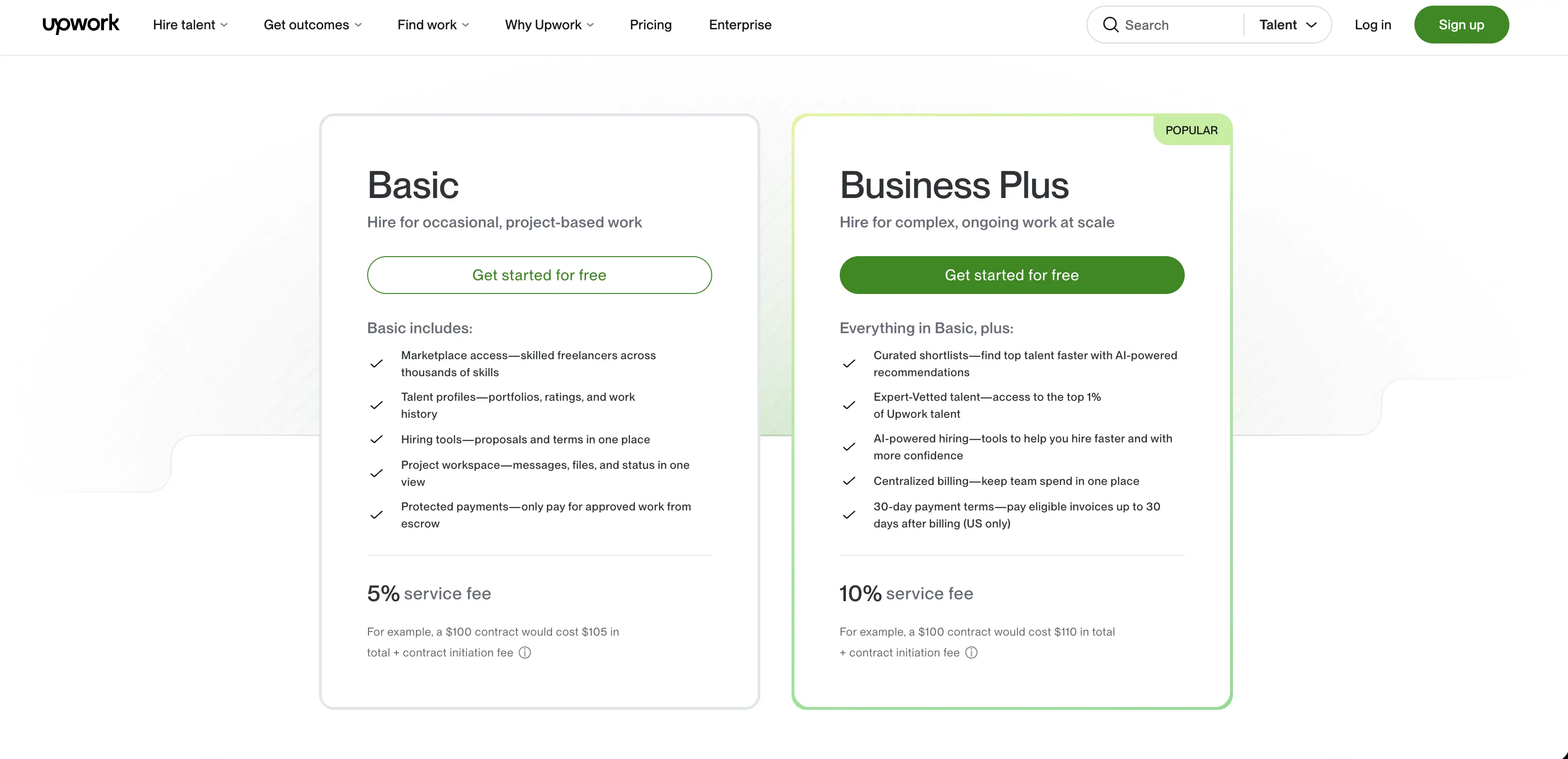
Clients pay 5% on the Basic plan or 10% on Business Plus, plus a small contract initiation charge on fixed price work. If Upwork itself does not fit, our full breakdown of Upwork alternatives covers 12 platforms priced against it directly.
2. Fiverr
Price: 20% flat commission for sellers. Buyers pay 5.5% plus a small flat fee on smaller orders.
Fiverr runs on packaged gigs at a fixed price, not open bidding, which is what makes it fast. My $500 logo brief got three full concepts back inside two hours, the fastest of any platform tested. The cost is the flat 20% cut, which does not shrink as you earn more. See our 13 Fiverr alternatives if that flat rate is the dealbreaker.
3. Toptal
Price: Freelancers pay nothing. Clients pay a $79 monthly matching subscription, refundable if no suitable candidate is found.
Toptal screens out more than 97% of applicants through coding challenges, live problem solving, and communication testing. That is the trade: a smaller, pricier talent pool for a vetting process most marketplaces skip. Our Toptal alternatives guide is worth a look if the $79 a month and the wait do not fit your timeline.
4. Freelancer.com
Price: 10% or $5, whichever is higher, for freelancers. Clients pay 3% or $3.
The oldest bidding marketplace still active at real scale, with a fee that sits in the middle of the pack. A $20 minimum balance is required to place a bid, which filters out the lowest effort accounts.
5. Contra
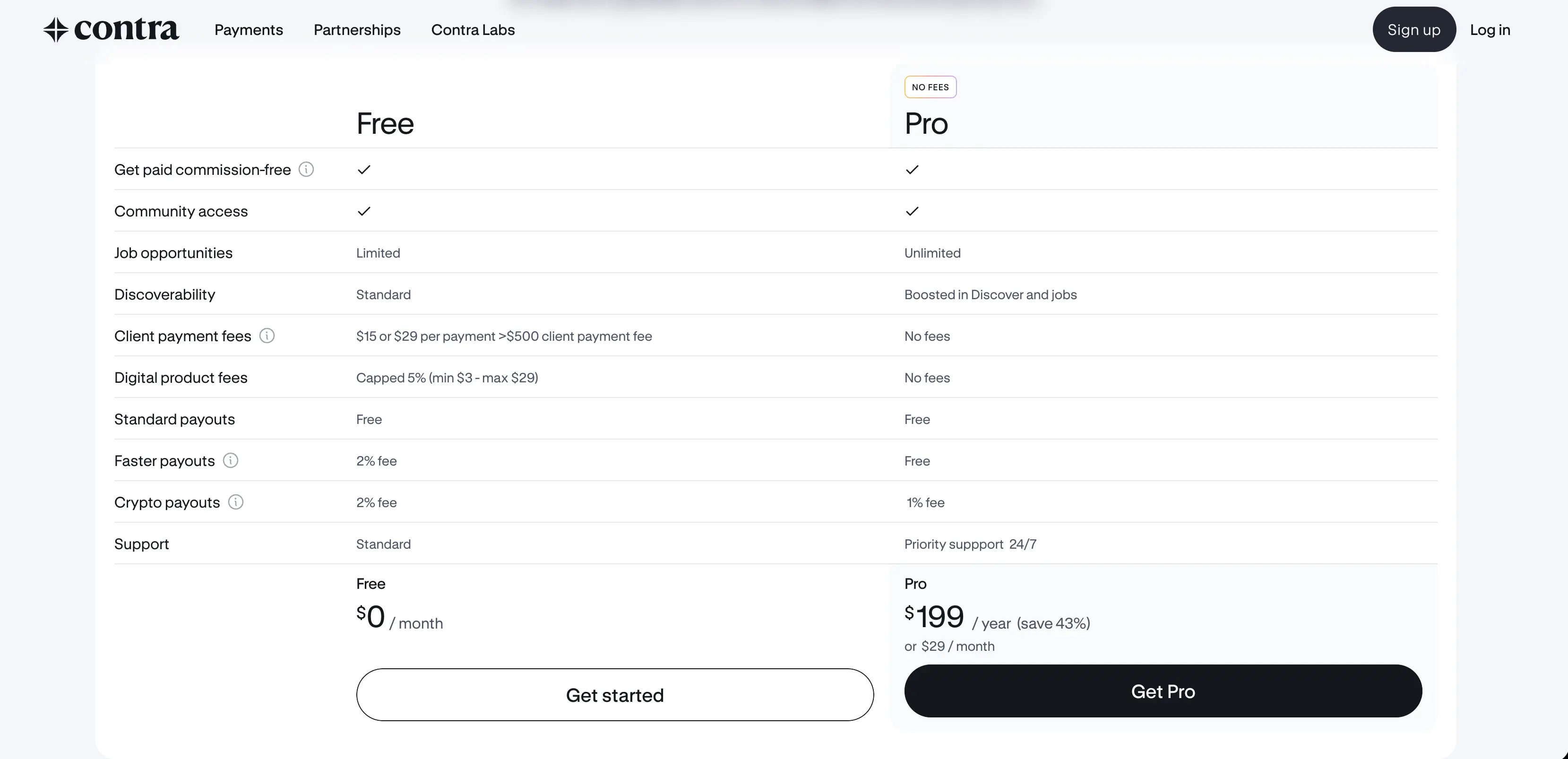
Price: 0% commission on the free plan. Contra Pro is $29 a month or $199 a year and removes the client side payment fee entirely.
Contra was built to compete directly with the 20% cuts on Fiverr and Upwork. The free plan still carries a payment processing charge on larger transactions, so it is not free at every scale, but it is the cleanest zero commission option for keeping the rate you quote.
6. Braintrust
Price: 0% for talent, always. Clients pay a 15% platform fee on top of the agreed rate.
Braintrust flips the usual model: the freelancer sets the rate and keeps every dollar, and the client sees the markup upfront instead of it hiding in a lower quoted rate. It fits longer contracts better than one off gigs.
7. PeoplePerHour
Price: 20% on the first £250 billed to a client, dropping to 7.5% then 3.5% as that relationship grows.
PeoplePerHour leans European, with more UK and EU clients than the platforms above it. The tiered structure rewards repeat clients heavily once you land one good account.
8. Guru
Price: 9% on the free membership, dropping to 5% on the paid Executive tier. Clients pay a 2.9% handling fee, refunded if paid by bank transfer.
Guru rewards a paid membership with a meaningfully lower cut, which almost no other platform here does directly. Its client pool is smaller than Upwork or Fiverr, so the lower fee only pays off once you are landing steady work there.
9. 99designs
Price: Logo contests run $249 to $1,050 depending on package, priced flat rather than as a commission.
The platform for one specific job: several designers competing on one brief so you can pick a winner. My $500 logo brief came back with four full concepts by the next morning, the widest spread of any platform tested, though the slowest to arrive.
10. We Work Remotely
Price: Free for job seekers to browse and apply. Employers pay $299 for a 30 day listing.
A job board, not a bidding marketplace, so there is no commission on completed work. It fits full time and long term remote roles better than one off gigs. One catch: unlimited applications require a $14.95 a month Pro plan, since the free account caps them.
11. FlexJobs
Price: Starts at $23.95 every four weeks, dropping to roughly $5.95 a month equivalent on the annual plan.
FlexJobs charges job seekers instead of employers, unusual on this list. The trade is a listings pool screened for scams before it goes live.
12. LinkedIn
Price: Free to use for job search and networking. Premium Career runs $39.99 a month or $239.88 a year.
LinkedIn is not a dedicated freelance marketplace, but enough freelance work gets found through warm introductions and posts to earn it a spot. Premium adds InMail credits and profile view data, useful once you are actively pitching.
13. Dribbble Pro
Price: $4 a month for Pro Lite, $8 for Pro Standard with 0% designer fees, up to $99 a month for Pro Plus.
Dribbble works as a portfolio and lead generation tool for designers more than a bidding marketplace. The Standard tier removes designer fees on leads sourced through the platform, a detail most other roundups skip.
Freelance platforms with 0% commission in 2026
Three platforms here charge freelancers nothing: Contra, Braintrust, and Toptal, though each shifts that cost elsewhere. Contra moves it to an optional $29 a month Pro plan and a processing fee on the free tier.
Braintrust moves it to a 15% fee the client pays. Toptal moves it to a $79 monthly subscription the client pays only if matched. Dribbble's Standard tier removes designer fees on platform sourced leads, though its own subscription still costs $8 a month.
No platform here is free for everyone in the transaction. Somebody always pays, and knowing whose side carries the cost tells you more than the word "free" ever will.
What clients pay, not just what freelancers keep
Almost every other roundup only shows the freelancer side of the fee, which leaves out half the real cost of hiring. Upwork clients pay 5% to 10% on top of the freelancer's rate.
Fiverr buyers pay 5.5%. Braintrust clients pay 15%. Toptal clients pay a flat $79 a month regardless of project size. If you are hiring, the client column in the table above matters more to your budget than the freelancer one every other list leads with.
Upwork's real 2026 fee structure, reconciled
Eight competing roundups gave me five different numbers for what Upwork charges freelancers: a flat 10%, a sliding 5% to 20%, a tiered 20/10/5% split, and a flat 15%. Only one is current.
Upwork replaced the tiered model with a variable fee set once per contract, between 0% and 15%, confirmed directly from Upwork's own pricing and support pages on August 21, 2026. Freelancer Plus members pay 0% on Direct Contracts. The tiered 20/10/5% number still circulating elsewhere describes a fee structure Upwork no longer runs.
A G2 reviewer who runs a small business put the platform's actual pull in thirteen words: "The platform makes communication, milestone payments, contracts, and file sharing straightforward and transparent."
What platforms actually cost after payment processing fees
The commission a platform advertises is rarely the last cut you see. Withdraw through PayPal, a wire transfer, or a card and you can lose another 2% to 4% before the money reaches your bank. Contra's free tier adds its own processing fee on larger transactions, on top of PayPal or Stripe's cut.
Guru refunds its 2.9% handling fee if the client pays by bank transfer, one of the few platforms that rewards a cheaper payment method rather than charging the same fee regardless. Run the math on your own payout method before comparing platforms by commission percentage alone.
Add every subscription and platform fee you currently pay into the SaaS spend calculator.
How fast each platform actually pays you
Speed of payment barely gets mentioned in most comparisons, and it should. Fiverr, Upwork, and Freelancer.com all use milestone or escrow based release, so funds sit until a client approves the work, then clear on the platform's own schedule before a withdrawal even starts.
Contra and Braintrust release funds closer to the agreed timeline, since there is no escrow layer to clear first. None of the thirteen platforms here publish a clean "days to payout" figure, worth asking about before committing to one for regular income.
Best freelance platforms besides Upwork
If Upwork is not the right fit, the closest substitute depends on why you are leaving: Freelancer.com for a lower flat commission, Braintrust or Contra for zero commission shifted to the client, Toptal for a smaller, vetted pool.
Our full Upwork alternatives roundup goes deeper on all twelve, priced the same way as this article.
How to avoid getting scammed on a freelance platform
Every platform here uses some form of payment protection, but the details differ. Upwork, Fiverr, and Freelancer.com hold funds in escrow until a milestone or the full job is approved, so a client cannot take delivered work without releasing payment.
Toptal and Braintrust vet clients as well as freelancers, cutting down on the fake postings common on open marketplaces.
The clearest warning sign is the same everywhere: a client who wants to move payment off the platform is asking you to give up the one protection it offers.
Which freelance platform fits your situation
If you have no portfolio yet and need your first paid job fast, start on Fiverr with a tightly scoped, affordable gig. It rewards fast delivery over reputation, which also suits data entry and admin work, alongside Upwork and Freelancer.com's open bidding.
If you are a senior developer or designer with real client references, Toptal's vetting is worth the wait, and Braintrust is worth checking too, since it lets you set your own rate without losing a cut.
If you are a writer, Upwork and Fiverr carry the deepest client pools for ongoing work, though neither is fee free. If keeping the largest share of what you earn matters more than pool size, test Contra and Braintrust first.
If you run an agency posting work for a team rather than freelancing solo, Guru's membership tiers and Upwork's Business Plus plan both scale better than a single freelancer account.
If you actually need full time salaried staff, this list is the wrong one. Our Indeed alternatives guide covers 12 hiring tools priced per open role, and our Shiftsmart alternatives roundup covers same day shift work, a different category of gig with different pay timing.
FAQs
Which freelance platforms have 0% commission in 2026?
Contra, Braintrust, and Toptal all charge freelancers nothing directly, though each shifts the cost to the client or an optional subscription. None here are free for both sides at once.
What is the best freelancing platform for beginners?
Fiverr, since its packaged gig format does not depend on the reputation or portfolio history that open bidding on Upwork or Freelancer.com does.
Is freelancing still worth it in 2026?
For most people, yes, though the math depends on which platform's fee structure you work against. A 20% flat cut on Fiverr eats more of a $50 gig than a $19.99 a month Upwork subscription does once you earn steadily.
Which freelancing skill is in demand in 2026?
Development, design, and marketing briefs got the fastest real replies in my side by side posting test.
Is Fiverr still worth it in 2026?
For fast, clearly scoped gigs, yes. The flat 20% commission does not shrink as you earn more, so it weakens once you land larger, repeat client work where Guru or Braintrust pays off instead.
What is the best platform for hiring freelancers in 2026?
It depends on the job. Upwork covers the widest range of skills for ongoing work, Toptal covers vetted senior developers, and 99designs covers one off design contests best.
How do I avoid getting scammed on a freelance platform?
Keep every payment inside the platform's own escrow or milestone system. A client asking to pay outside the platform is the clearest warning sign across all thirteen platforms here.
Conclusion
If I were starting from zero tomorrow, I would post the first small job on Fiverr for a fast result, run anything ongoing through Upwork now that its fee is variable instead of flat, and switch to Contra or Braintrust once a client relationship gets big enough that a flat commission starts costing real money.
The platform that fits changes as the job does. Rerun this comparison before your next big contract instead of defaulting to last time's platform.
Whether the fee difference is worth switching depends on your volume, which the SaaS ROI calculator works out.