If you want to keep the most money, Contra charges freelancers 0% commission. If you need tightly vetted, senior level talent fast, Toptal and Lemon.io do the screening for you. If you just need a quick, cheap gig done this week, Fiverr is still the fastest way to get one posted.
I run a small content site, and last month I needed a logo refresh, a landing page rebuild, and a batch of product screenshots done fast. Instead of guessing which platform would work best, I posted the same $600 brief on Upwork, Fiverr, and Contra on the same Tuesday afternoon and tracked exactly what came back: how many proposals landed in six hours, what each freelancer's quote actually worked out to after fees, and which platform got me a finished first draft first. The results are baked into the picks below.
When Upwork stops being the obvious choice
Upwork is still the biggest freelance marketplace on the internet, with more than 18 million registered freelancers and over 800,000 active clients. That scale is exactly why it starts to hurt for some jobs. Post a simple logo brief, and you can get 80 proposals in a day, most of them copy pasted. Screening takes longer than the job itself.
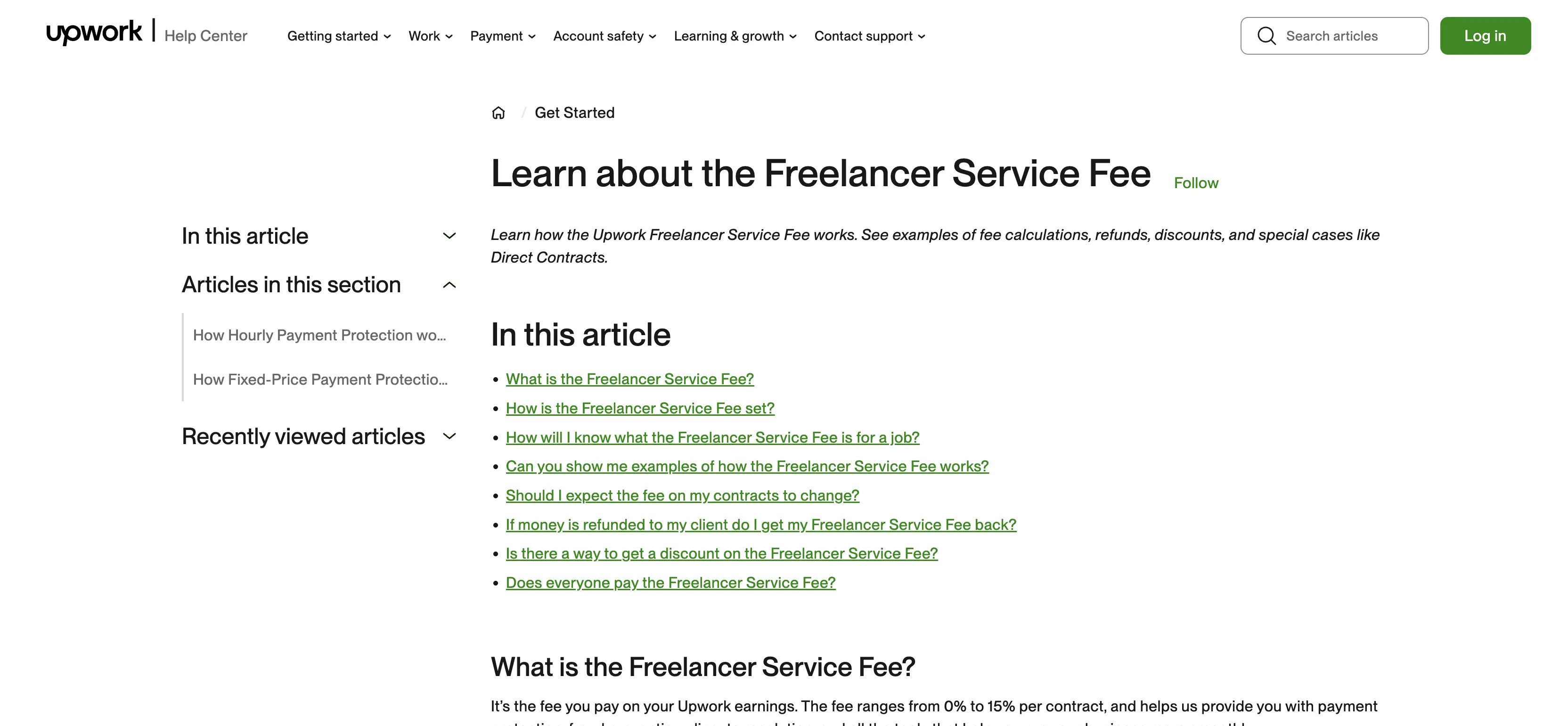
The bigger issue for freelancers is the fee. Since May 1, 2025, Upwork has charged a variable Freelancer Service Fee. Officially, Upwork's own Help Center says the fee "ranges from 0% to 15% per contract," and it's set before you accept an offer, then locked for the life of that contract. That sounds simple until you notice what it actually means for a real project.
The real cost math
Say a client hires a freelancer on Upwork's Basic plan for a $2,000 fixed-price project. The client always pays the same 5% marketplace fee plus a small contract initiation fee, so their total lands around $2,105 to $2,115 no matter who they hire. The freelancer's side is where it gets uneven. If their locked-in fee comes out at 0%, they keep the full $2,000. If it lands at 15%, the same job nets them $1,700. Two freelancers doing identical work for identical clients can walk away $300 apart, and neither one finds out their exact rate until an offer is on the table. Upwork's own combined take on that one project can range from roughly $105 to $315 depending on where that dial lands, which is close to a 3x swing on the same $2,000 job.
That opacity, combined with the sheer volume of proposals clients have to sort through, is the main reason people start looking elsewhere. On Trustpilot, Upwork currently carries a four-star average across more than 14,000 reviews, so most people don't hate the platform. They're usually looking for a specific fix: lower fees, faster hiring, better vetting, or a smaller pool where their proposal doesn't disappear into a pile of 90 others.
The 12 best Upwork Alternatives
General marketplaces (closest to Upwork)
1. Fiverr
Best for fast, small, one-off gigs
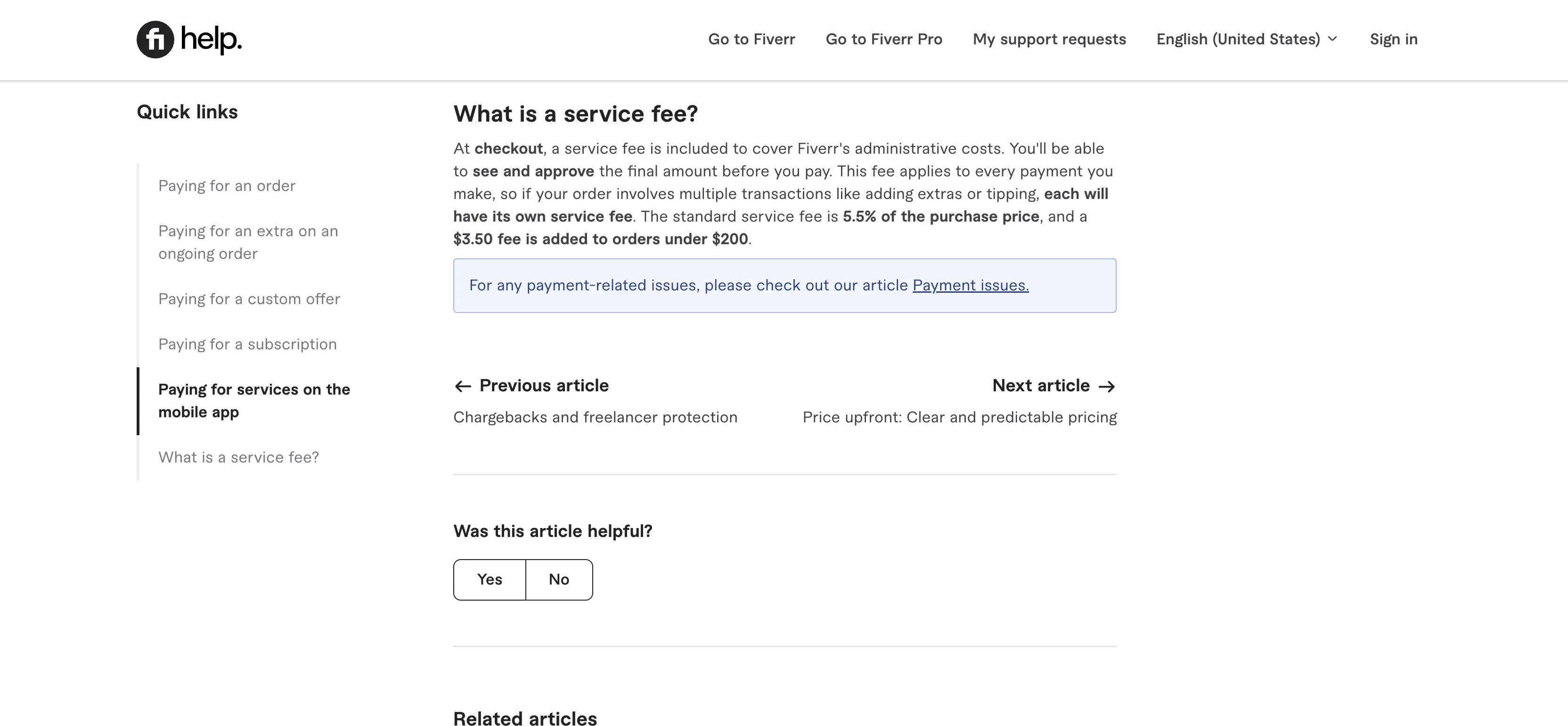
Price: flat 20% seller commission on every order, including tips. Best for: buyers who want a finished gig fast, sellers who want steady small-order volume
Fiverr flips Upwork's model. Instead of posting a job and waiting for bids, you browse pre-packaged gigs and buy one outright, often with delivery in a day or two. Sellers give up a flat 20% cut on every single order in exchange for that speed, with no volume discount and no path to a lower tier no matter how much you earn. Buyers also pay their own service fee on top of the gig price. It's the platform I'd reach for when I need something small and defined done this week, not for an open-ended engagement.
2. Freelancer.com
Best for budget-driven bidding
Price: 10% freelancer fee (or $5 minimum), reducible to 3% to 5% with a paid membership; clients pay 3% (or $3 minimum). Best for: clients comparing a large pool of bids on a tight budget
Freelancer.com runs on the same open-bidding model as Upwork, just with a flat fee instead of a variable one. Freelancers pay a 10% standard, which membership plans starting at $4.95 a month can shave down to 5%, then 3% on the $29.95 tier. The $5 minimum fee makes very small jobs proportionally expensive, so it works best above roughly $100 per project.
3. PeoplePerHour
Best for UK and EU-based hiring
Price: tiered freelancer fee, 20% under £250, 7.5% up to £5,000, 3.5% above £5,000 in lifetime billing with one buyer. Best for: freelancers building repeat relationships with UK or European clients
PeoplePerHour mixes gig-style "Hourlies" with a proposal system closer to Upwork's. Its fee structure looks like Upwork's old tiered model: you start high with a new client and the rate drops as your lifetime billing with that specific buyer grows. Every new client relationship resets you back to the 20% tier, so freelancers who juggle many small clients pay more than ones who land a few large repeat accounts.
4. Guru
Best for freelancers who bill enough to justify a subscription
Price: 9% base freelancer fee, roughly 5% with a $39.95 a month Executive membership. Best for: freelancers with steady monthly volume who want a lower flat rate
Guru's base fee already undercuts Upwork's upper range, and its paid membership pushes it lower still. The math only works if your monthly billing clears the subscription cost, so it's a poor fit for anyone posting a handful of proposals a month. For consistent freelancers doing $2,000-plus a month through the platform, it's one of the cheaper mainstream options available.
Zero and low-commission platforms
5. Contra
Best for keeping every dollar you bill
Price: 0% platform commission, only standard Stripe processing costs (2.9% plus $0.30). Best for: freelancers who already have their own client pipeline and want contracts and payment handled cleanly
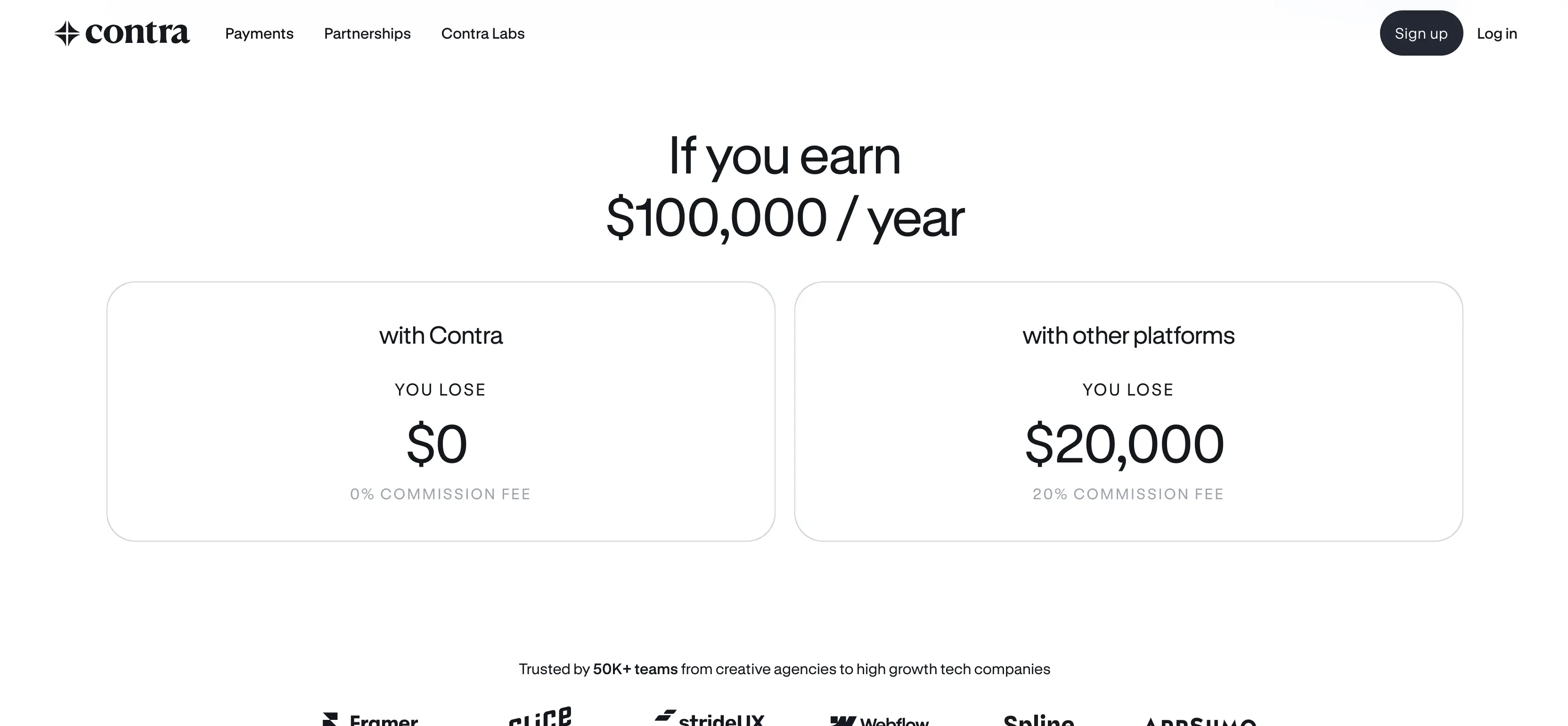
Contra's entire pitch is that freelancers should keep what they earn. A $2,500 project on Contra deposits close to $2,428 after processing, compared with $2,000 to $2,375 on Upwork depending on where that variable fee lands. The catch is job discovery: Contra's client pool is smaller and skews toward startups and creative work, so it works better as a payments and contracts layer for clients you already have than as a way to find brand-new ones from zero.
6. Braintrust
Best for seeing exactly where the markup goes
Price: talent keeps 100% of their quoted rate, client pays a separate flat fee on top (historically around 10% to 15%). Best for: clients who want fee transparency and freelancers who want to quote their real number
Braintrust runs the opposite direction from every other platform on this list. Instead of taking a cut from the freelancer's pay, it charges the client a visible fee on top of whatever rate the freelancer quotes. Senior US based specialists on the platform commonly quote $100 or more an hour, and because the fee sits on the client's invoice instead of buried in the freelancer's payout, both sides can see the actual split.
Vetted specialist networks
7. Toptal
Best for senior, high stakes technical hires
Price: blended hourly rate of roughly $60 to $200-plus, a refundable $500 deposit, plus a $79 monthly subscription. Best for: teams that need proven senior developers or designers and can't afford a bad hire
Toptal accepts fewer than 3% of applicants through a multi-stage screening process, then hands you a blended rate that folds in the freelancer's pay and Toptal's own markup. You never see that split, which is the most common client complaint, but for a senior hire where a wrong pick costs more than the premium, the vetting depth is real. If that opacity bothers you, we've compared cheaper vetted-developer options in our Toptal alternatives guide.
8. Lemon.io
Best for startups hiring vetted developers on a budget
Price: freelancers quote roughly $55 to $95 an hour and keep the full amount, no platform commission. Best for: startups that want pre-vetted developers without Toptal's price tag
Lemon.io runs a leaner version of the vetted-marketplace model, with rates that undercut Toptal while still filtering out the bulk of applicants before you ever see a profile. There's one detail worth knowing before you sign anything: hire a matched developer directly off the platform, and Lemon.io's own policy charges a flat $14,000 placement fee for that move, so factor that in if you're testing a long-term hire.
Design Only Marketplace
9. 99designs
Best for logo and brand identity work
Price: fixed contest packages from $349 to $2,499 depending on category and tier, plus a 5% fee on 1-to-1 projects. Best for: businesses that want to see 30-plus design directions before picking one
99designs works differently from every other platform here. Instead of hiring one freelancer, you run a contest, dozens of designers submit concepts, and you pick a winner who gets the fixed prize and you get full copyright. It's a strong fit for logos, packaging, and brand identity, and a poor fit for anything iterative like UI or product design where a single ongoing relationship works better.
Managed virtual assistant service
10. Wishup
Best for hands-off, ongoing admin support
Price: $1,299 a month for part-time (4 hours a day) up to $2,999 a month for a full-time elite-tier assistant. Best for: founders who want a dedicated assistant without screening candidates themselves
Wishup skips the marketplace model entirely. You describe what you need, and Wishup matches you with a pre-vetted assistant from a pool it says accepts roughly the top 0.1% of applicants, with a guaranteed replacement if the fit isn't right. It costs more than hiring an Upwork virtual assistant directly, but it removes the screening and backup-planning work that repeat, ongoing roles usually need.
Job boards (no bidding, no commission)
11. FlexJobs
Best for avoiding the proposal flood entirely
Price: roughly $24.95 a month or $59.95 a year for job seekers, no commission on what you earn. Best for: freelancers who want curated, scam-screened listings instead of competing against 90 other bids
FlexJobs isn't a marketplace at all. It's a subscription job board where every listing is manually screened before it goes live, which cuts out the spam and copy-paste postings that make open bidding exhausting. You pay a flat subscription instead of a percentage of your earnings, so the more you land through it, the better that math works out.
12. We Work Remotely
Best free option for remote-first roles
Price: free for job seekers to browse and apply. Best for: freelancers and full-timers targeting tech, design, and marketing roles specifically
We Work Remotely leans more toward remote full-time and part-time roles than one-off gigs, but its freelance and contract section is active enough to be worth checking alongside a marketplace. There's no bidding system and no commission on either side, since it's simply a listings board rather than a payment platform.
Upwork Alternatives: How the fees actually compare
Platform | What freelancers pay | What clients pay | Vetting level |
|---|---|---|---|
Upwork | 0% to 15%, variable per contract | 5% (Basic) or 10% (Business Plus) | Open, ID-verified only |
Fiverr | Flat 20% | 5.5% service fee | Open |
Freelancer.com | 10%, down to 3% with membership | 3% (or $3 minimum) | Open |
PeoplePerHour | 20% down to 3.5%, tiered by client | Included in project price | Open |
Guru | 9%, down to about 5% | Included in project price | Open |
Contra | 0% (processing only) | Included in project price | Open |
Braintrust | 0% (client pays the fee) | Roughly 10% to 15% | Light |
Toptal | Built into blended rate | $500 deposit, $79/month | Under 3% accepted |
Lemon.io | 0% (client pays the rate quoted) | No listed platform fee | Curated |
99designs | Prize-based, no separate cut | 5% on 1-to-1 projects | Open, contest-based |
Wishup | Not freelancer-facing | $1,299 to $2,999/month | Roughly top 0.1% |
We Work Remotely | Free | Job posting fee only | Unscreened |
How to pick the right one
If your main complaint is the fee, the choice is simple: Contra and Braintrust are the two platforms built specifically to stop taking a cut from your pay, and the only real question is whether you're bringing your own clients or need the platform to find them for you.
If your complaint is proposal volume and screening time, a vetted network solves it from the other direction. Toptal and Lemon.io both do the filtering before you ever see a candidate, which costs more upfront but saves the hours you'd otherwise spend sorting through dozens of generic pitches.
If you're hiring for something visual and one-off, like a logo or a brand refresh, 99designs' contest model gets you more creative range in a week than a single freelancer relationship usually does. And if what you actually need is ongoing, predictable coverage rather than project-based work, Wishup's managed model removes the hiring and backup planning that a marketplace never handles for you.
Freelancers optimizing for take-home pay should run the math on their own numbers before switching anything. A freelancer billing $4,000 a month keeps roughly $3,400 to $4,000 on Upwork depending on where their fee lands, all of it on Contra, and about $3,200 on Fiverr's flat 20%. That gap is real money over a year, but it only matters if the alternative platform can actually replace the client volume you're giving up.
Still weighing your options?
These twelve platforms cover the strongest Upwork alternatives specifically, but if you want to zoom out and compare the wider field, our best freelance platforms in 2026 roundup breaks down marketplaces, vetted networks, and niche platforms side by side.
FAQ: Upwork Alternatives
What is the cheapest alternative to Upwork for freelancers?
Contra is the cheapest on paper, since it charges 0% commission and only passes through standard payment processing costs. Braintrust comes close because the client absorbs the platform fee instead of the freelancer.
Is there a completely free alternative to Upwork?
We Work Remotely is free for job seekers to browse and apply, with no commission taken on either side. Contra is effectively free for freelancers too, since its only cost is a standard card-processing fee rather than a platform cut.
Which Upwork alternative is best for agencies?
Guru and Freelancer.com both offer paid membership tiers built around consistent monthly volume, which suits agencies billing regularly more than solo freelancers posting the occasional proposal.
Which Upwork alternative is best for hiring developers?
Toptal and Lemon.io are built specifically for vetted development talent. Toptal screens harder and costs more; Lemon.io is the more budget-friendly of the two for startups.
Do freelancers actually pay less on Upwork alternatives than on Upwork itself?
It depends which one. Contra, Braintrust, and Lemon.io all charge freelancers less than Upwork's fee range in most cases. Fiverr's flat 20% and PeoplePerHour's entry tier of 20% can end up costing more than Upwork's upper bound, depending on where a specific Upwork contract's variable fee lands.
Can I use more than one freelance platform at the same time?
Yes, and most active freelancers do. Running a marketplace like Upwork or Fiverr for discovery alongside a zero commission platform like Contra for existing clients is a common setup, since the two solve different problems rather than competing for the same job.
Conclusion
Upwork's scale is still hard to beat for sheer volume, but that scale is exactly what makes fees opaque and proposal screening slow. If cost is the deciding factor, Contra or Braintrust will save the most money over a year. If speed and vetting matter more than price, Toptal or Lemon.io do the filtering Upwork leaves to you. And if you just need one gig done well this week, Fiverr still gets it done faster than posting a job and waiting for bids.