
I put $1,100 of my own money through hiring tools this spring while staffing two client projects and one of my own sites. The cheapest way to keep five roles open for a month came out to $3 per role. The most expensive came out to $249.92. Same five jobs, same month, same person doing the posting.
If you want to pay nothing, Wellfound lists jobs at $0 forever and Google for Jobs is free once your careers page carries the right code. If you want a real system for a small budget, Manatal starts at $15 per user per month on annual billing and covers up to 15 open jobs. If you are hiring hourly shift staff, Homebase starts free for up to 10 employees at one location.
Why employers start looking past Indeed
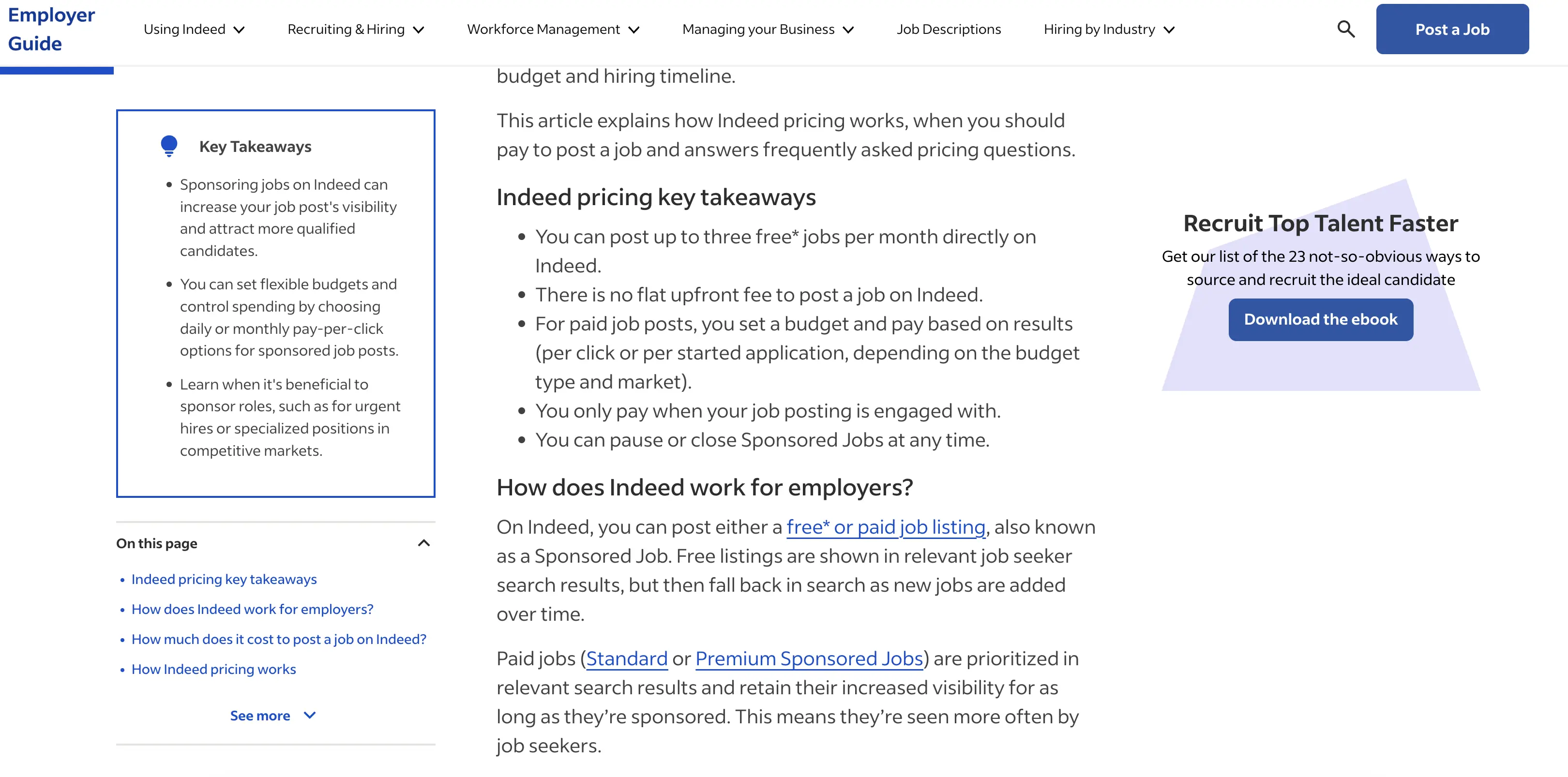
Indeed is not expensive to start. It is expensive to keep going. Indeed's own employer guide states that you can post up to three free jobs per calendar month, each live for up to 30 days. Past three, you sponsor. And Indeed's guidance on sponsoring says free posts fall back in search results as new jobs are posted, so a free listing on day 12 is not the listing you saw on day one.
Sponsored jobs run on a budget you set, and the charge lands per click or per started application depending on the setup. There is no flat fee. Indeed's pricing explainer also notes that hitting a $500 account balance triggers an invoice, which is the number most people find out about after the fact.
Employers rate Indeed 4.5 out of 5 across 7,605 reviews on Capterra, with ease of use at 4.6 and customer service at 4.3. The complaints cluster in one place. Ashley P, an HR manager, writes that "paying for clicks that don't result in qualified applicants can become expensive." That is the whole reason this list exists.
The 12 Indeed Alternatives Comparison
Tool | Price from its own pricing page | Free posting included | Cost per open role at five roles |
|---|---|---|---|
Wellfound | $0 forever for job listings | Unlimited | $0 |
Google for Jobs | $0 | Unlimited | $0 |
Manatal | $15 per user per month, annual | No | $3.00 |
Homebase | $24 per location per month, annual | Basic plan is $0 | $4.80 |
Recruiterflow | $149 per user per month | No | $29.80 |
Breezy HR | $157 per month, Startup plan | 1 active position | $31.40 |
JazzHR | $3,480 per year, Plus plan | No | $58.00 |
Workable | $299 per month, Standard | No | $59.80 |
Monster | $299 per month, Monster+ Pro | No | $59.80 |
Ashby | $400 per month, Foundations | No | $80.00 |
Dice | $749 per month, Standard, annual | No | $149.80 |
SmartRecruiters | From $14,995, Essential | No | $249.92 |
Indeed Alternatives: Ranked
Post for nothing: three tools that charge $0 to list a role
Wellfound. Wellfound is a startup focused job platform where companies list roles and candidates apply directly.
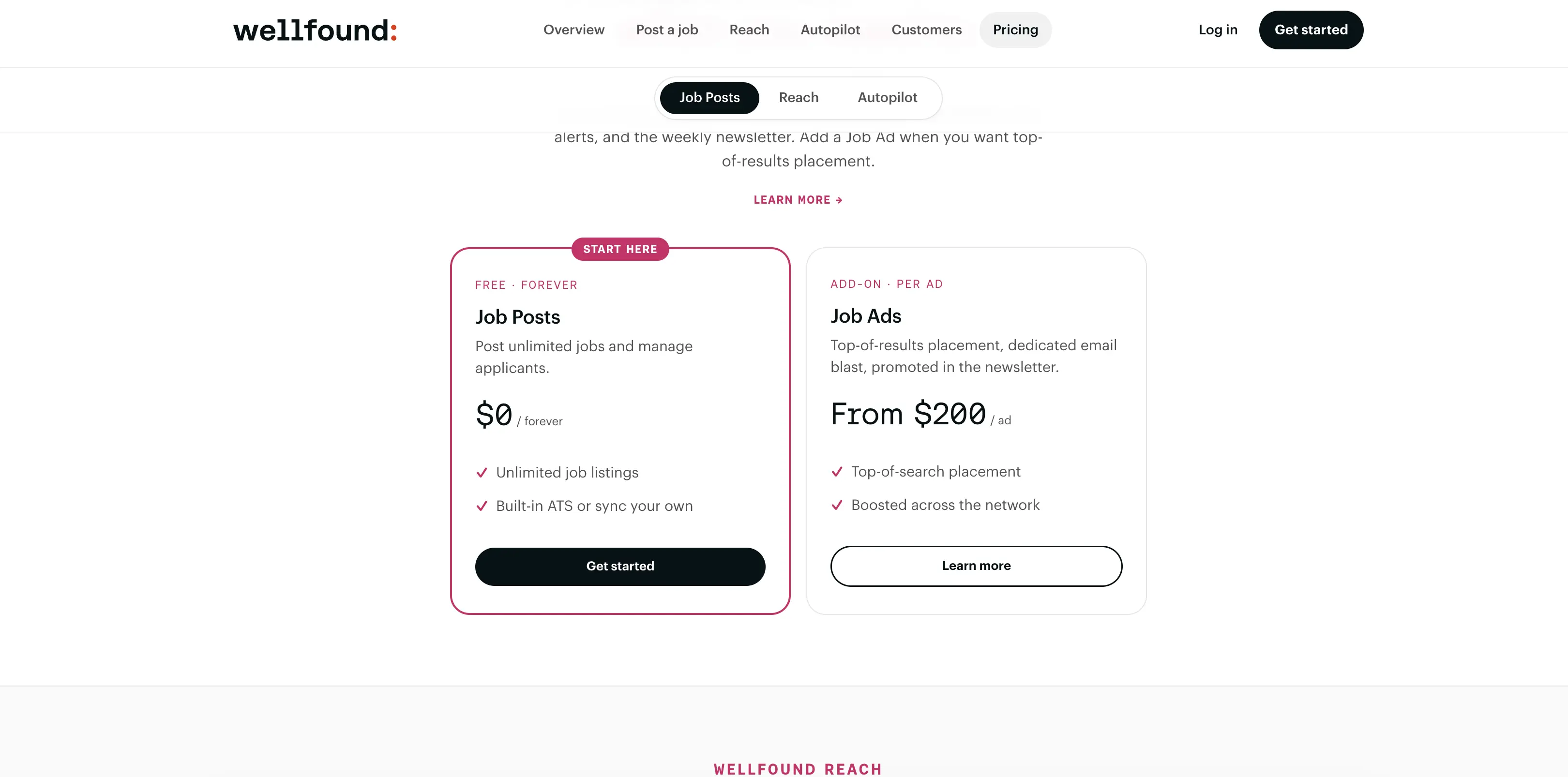
Its pricing page shows unlimited job listings and a built in applicant tracker at "$0 / forever." Paid tiers exist for outbound sourcing: Wellfound Reach Starter is $135 per seat per month for 250 contact reveals, Growth is $199 per seat per month for 1,000. A managed option called Autopilot runs $500 per month per open role plus 10% on hire. Job ads that push you to the top of search start at $200 per ad. For posting alone, you pay nothing.
Google for Jobs. Google for Jobs is not a job board you post to. It is a search feature that reads jobs off your own careers page.
Google's structured data documentation says adding JobPosting markup makes a listing eligible to appear in the job search experience, and nowhere in that documentation is a fee mentioned. The cost is a developer hour, once. After that every role you publish is eligible at no charge.
Breezy HR. Breezy HR is an applicant tracking system with a free tier.
The Breezy pricing page lists a Bootstrap plan at "Free!" with one active position, unlimited users, unlimited candidates, a branded careers site and distribution to more than 50 job boards. One open role at a time is the catch. Paid plans lift that to unlimited positions: Startup at $157 a month, Growth at $273, Business at $439, with annual billing including two months free.
Pay for each role you post: three tools with per posting rates
Dice. Dice is a job board for technology and engineering roles.
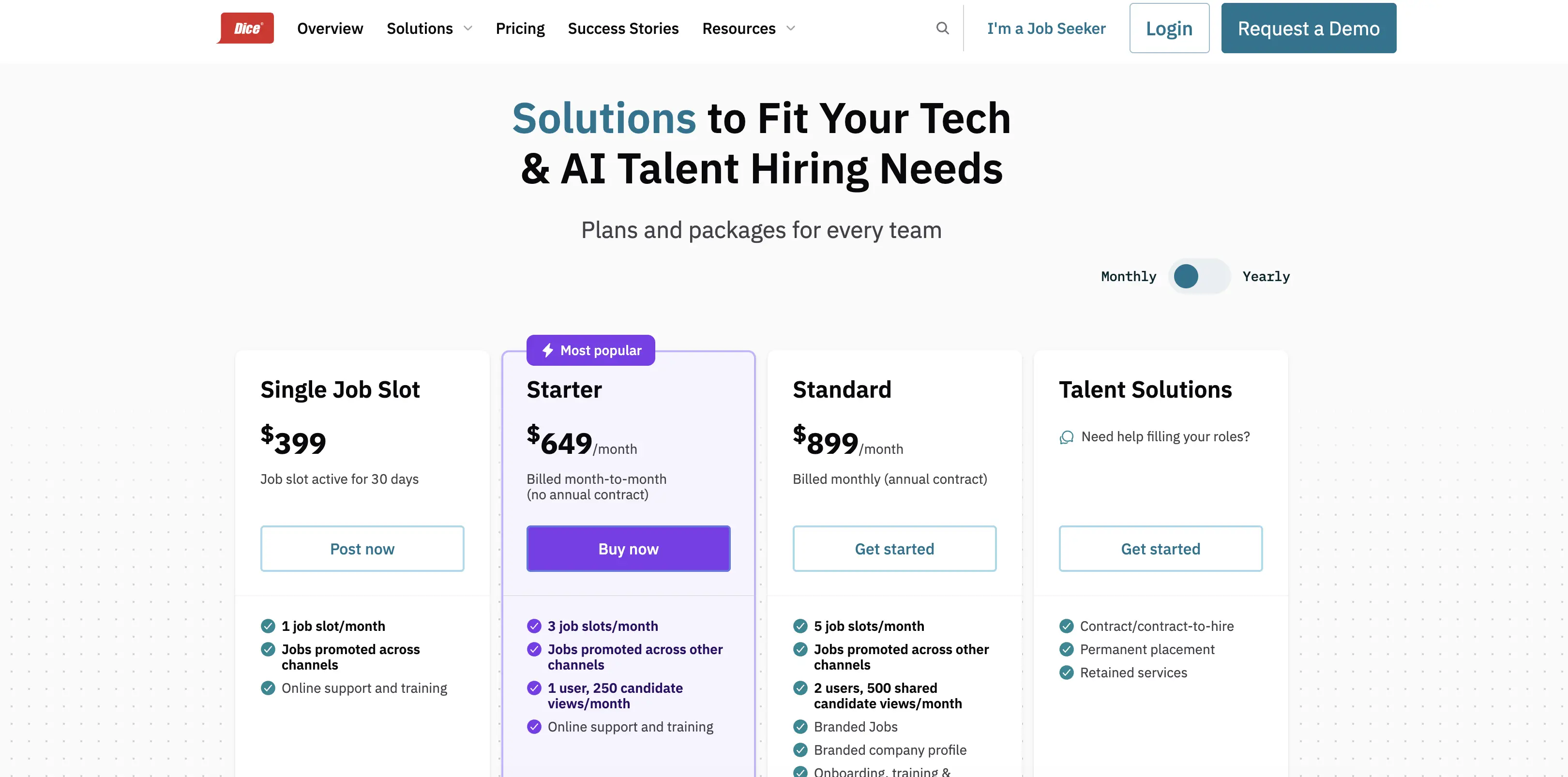
Its hiring pricing page lists a single job slot at $399 for a 30 day posting. Subscriptions bring that down: Starter is $649 a month on month to month billing or $549 on an annual contract, and includes three job slots, one user and 250 candidate views a month. Standard is $899 or $749 annual, with five job slots, two users and 500 shared candidate views. Dice notes the pricing is valid for new customers only.
Monster. Monster is a general job board that publishes your listing to Monster, CareerBuilder and its partner network.
The Monster hiring pricing page shows Monster+ Standard starting at $8 a day on a pay as you go basis, where you are charged when candidates click your posting, with a $10 verification charge the first time you promote. Monster+ Pro is $299 a month, or $2,990 prepaid, and hands you 299 credits a month. One credit is one dollar, and a resume view costs two credits.
Homebase. Homebase is scheduling and time tracking software for hourly teams, with hiring bolted on.
Its pricing page shows a Basic plan at $0 a month for up to 10 employees at one location, Essentials at $30 a month per location or $24 on annual billing, and Plus at $70 or $56 annual. Hiring is an add on: job post boosts start at $79 per post and a beta Hiring Assistant starts at $30 per post. For a coffee shop filling two shifts, that beats a sponsored Indeed budget you cannot cap by role.
Read Also: 13 Best Fiverr Alternatives in 2026, Priced against Fiverr's real 20% cut
Pay a flat monthly rate: six tools that stop charging you per job
Manatal. Manatal is a recruitment platform with applicant tracking and candidate scoring.
The Manatal pricing page lists Professional at $15 per user per month on annual billing, or $19 monthly, covering up to 15 jobs per account and 10,000 candidates. Enterprise is $35 annual or $39 monthly with unlimited jobs. Enterprise Plus is $55 or $59. The trial runs 14 days with no card. At five open roles on one seat, this is the cheapest paid option in the list by a wide margin.
Recruiterflow. Recruiterflow is recruiting software built for staffing agencies rather than in house teams. Its pricing page lists the Platform plan at "USD $149 per user / month," with a custom tier called AIRA above it.
If you place candidates for clients, the agency workflow is the reason to pay it.
JazzHR. JazzHR is an applicant tracking system aimed at small employers.
The JazzHR pricing page lists Hero at $1,000 a year with job postings starting at three a month, Plus at $3,480 a year with up to 200 active jobs, and Pro at $5,508 a year. Paying yearly saves up to 24%. Hero is the honest entry point at roughly $83 a month, as long as three live jobs cover you.
Workable. Workable is a hiring platform combining job distribution, an applicant tracker, and sourcing.
Its pricing page lists Standard at $299 a month or $3,588 a year, Premier at $599 or $7,188, and Enterprise at $719 or $8,628, with annual billing saving 20%. All plans carry unlimited active jobs subject to fair usage. The trial is 15 days with no credit card, and every paid plan starts with 3,000 AI credits.
Ashby. Ashby is an applicant tracking and analytics platform for companies that have outgrown a spreadsheet.
Its pricing page publishes one number: Foundations at $400 a month for companies up to 100 employees, with 10% off for an annual commitment. Single sign on adds $100 a month. Plus and Enterprise are quote based.
SmartRecruiters. SmartRecruiters is enterprise hiring software with applicant tracking, a CRM, and onboarding.
Its pricing page shows Essential "Starting at $14,995," with Professional, High Volume, and Complete all quote based. It is here so you can see where the range ends.
What Indeed's free posting actually gives you now
Three free jobs per calendar month, each live up to 30 days. That is the whole allowance, and it comes from Indeed's own employer help pages rather than a review site. Two details change how useful it is. Free posts lose position as newer jobs come in, so a role posted on the 1st is buried by the 20th without you doing anything wrong. And the allowance resets by calendar month, not by rolling 30 days, so posting three roles on August 30 does not stop you posting three more on September 1.
If you hire fewer than three roles a month and you can live with fading visibility, Indeed is still free and you do not need this list. If you hire a fourth role, you are in the sponsored auction, and that is where the cost comparison starts to matter.
Cost per open role, worked out at five open jobs
Every roundup quotes plan prices. None of them divide by the number of roles you are actually filling, which is the number that decides whether a plan is cheap. Here is that math at five open roles held for one month, using the verified rates above.
Manatal Professional on annual billing is $15 a month for one seat covering up to 15 jobs, so five roles cost $3.00 each. Homebase Essentials at $24 a month annual works out to $4.80 per role before any boost.
Recruiterflow at $149 a month for one seat is $29.80. Breezy Startup at $157 is $31.40. JazzHR Plus at $3,480 a year is $290 a month, or $58.00.
Workable Standard and Monster+ Pro both land at $299 a month, or $59.80. Ashby Foundations at $400 is $80.00.
Dice Standard on an annual contract is $749 for five job slots, or $149.80. SmartRecruiters Essential at $14,995 a year is $1,249.58 a month, or $249.92 per role.
The spread between the cheapest paid option and the most expensive is 83 times. Both are legitimate products sold to different buyers, and the per role number is the fastest way to see which buyer you are.
Which of these publish a price, and which numbers to distrust
Every tool in the table above publishes at least one rate you can read without talking to anyone. That is why they are in the table. Several well known names publish nothing. Recruitee, Teamtailor and Pinpoint show plan features with no dollar figures next to them. Zoho Recruit shows a calculator instead of a rate card.
That matters because roundups fill the gaps with numbers the vendor never printed. One page currently ranking for this keyword quotes Dice at "packages start ~$395/posting" and Monster at "plans start ~$279/month." Dice's own page says $399 for a single 30 day slot. Monster's own page says $299 a month for Monster+ Pro. Neither of those roundup figures matches the vendor. When a price is written with a tilde in front of it, treat it as someone's memory of a sales call.
What it costs to look at a candidate, not just post the job
Posting is half the bill. Reading candidate profiles is the other half, and almost nobody prices it side by side.
Monster+ Pro gives you 299 credits a month, and a resume view spends two of them, so each profile you open costs $2. Dice bundles views into the plan: 250 candidate views a month on Starter, 500 shared views on Standard.
Wellfound splits it out as contact reveals, with 20 a month free on the Explore tier, 250 on Starter at $135 per seat and 1,000 on Growth at $199 per seat.
Breezy, Workable, Ashby, JazzHR, Manatal and Recruiterflow do not meter candidate views at all, because they are trackers for people who applied to you rather than databases you go digging in.
If your problem is nobody applying, a metered database is worth paying for. If your problem is too many applicants, paying per view is money set on fire.
The Indeed alternatives that put your job back on Indeed anyway
Switching tools does not always mean leaving Indeed's audience, and that is a feature rather than a trap. Breezy's free Bootstrap plan includes distribution to more than 50 job boards. Monster publishes your listing to Monster, CareerBuilder and its partner network. Workable and JazzHR both sell job distribution inside the plan.
So the decision is whether you pay Indeed directly per click, or pay a flat monthly fee to a tool that syndicates for you. The second one has a ceiling. The first one does not.
Read Also: 12 Best Upwork Alternatives in 2026 (and what each one really costs)
If project-based or freelance hiring is also on your radar, our best freelance platforms in 2026 roundup covers that side of the market.
Where Indeed still wins
Volume, and speed to first applicant. For a warehouse role or a retail shift in a mid sized US city, no tool on this list will match Indeed's applicant flow in the first 48 hours. If you need bodies this week, sponsoring on Indeed is the fastest lever you have. The case for switching is about repeat hiring across a year.
Which Indeed alternatives to pick
You are a solo founder or freelancer hiring your first person. Wellfound at $0, or Breezy's free Bootstrap plan if you want the applications organised in one place. One active position is enough.
You are a marketing or ops agency hiring on behalf of clients. Recruiterflow at $149 per user per month is built for placing people for someone else, which is a different job from filling your own seats.
You are a restaurant, retail shop or clinic hiring hourly and shift staff. Homebase, free up to 10 employees at one location, with $79 boosts only on the roles that are struggling.
You are a startup filling five to fifteen roles at once. Manatal Professional at $15 per user per month on annual billing. At five roles that is $3.00 each, and the cap is 15 jobs.
You are a nonprofit or small charity with almost no budget. Google for Jobs. Add JobPosting markup to your own careers page once and every future role is eligible at no cost.
You are hiring nurses, aides or clinic staff. None of the general boards specialise here. Use Homebase for shift roles, then post the licensed roles to a healthcare specific board alongside it rather than instead of it.
You are a tech company hiring engineers. Dice at $399 for a single 30 day slot if you are filling one role, or Wellfound at $0 if the role is at an early stage company where equity is part of the pitch.
You are a 100 person company that has outgrown spreadsheets. Ashby Foundations at $400 a month, or Workable Standard at $299 if reporting matters less to you than distribution.
FAQs
Is Indeed still free for employers in 2026?
Partly. You get three free job posts per calendar month, each live for up to 30 days, posted directly on Indeed. Anything past three goes through Sponsored Jobs, which charges against a budget you set rather than a flat fee.
Is there another app like Indeed that costs nothing?
Yes. Wellfound lists unlimited jobs at $0 forever, and Google for Jobs costs nothing once your careers page carries JobPosting structured data. Breezy HR's Bootstrap plan is also free, capped at one active position.
What is the cheapest paid alternative to Indeed?
Manatal Professional at $15 per user per month on annual billing, covering up to 15 open jobs. At five open roles that works out to $3.00 per role per month.
What are the best Indeed alternatives for employers hiring hourly staff?
Homebase, because scheduling and hiring sit in the same tool. The Basic plan is $0 for up to 10 employees at one location, and job post boosts start at $79 per post.
Do Indeed competitors charge to view candidate profiles?
Some do. Monster+ Pro spends two credits, or $2, per resume view. Wellfound meters contact reveals, with 20 free a month. Applicant trackers like Breezy, Workable and JazzHR do not charge per view.
Why do roundups quote different prices for the same tool?
Because several vendors do not publish rates, so writers reuse figures from sales calls and old reviews. Every number here came from the vendor's own live pricing page on August 17, 2026.
My picks for Indeed Alternatives
If I were starting over tomorrow with my own money, I would run Wellfound at $0 alongside Google for Jobs on my careers page, and add Manatal at $15 a month the first time I had more than two roles open at once. That combination costs $180 a year and covers up to 15 open jobs. My last sponsored Indeed campaign spent more than that in eleven days.
Keep Indeed for the urgent hourly seat. Stop paying it for the roles you fill every year.
Pricing and features here were verified on August 17, 2026, by opening each tool's own pricing page and reading the current rate