Make is the strongest all-round pick for most teams switching off Zapier. n8n wins if you want to self-host and cut per-task costs to almost nothing. Pabbly Connect is the one to grab if price is the only thing that matters, since its lifetime plan removes the monthly bill completely.
I paid for four separate automation tools this month just to see what actually happens when a workflow blows past its plan limit. $187 later, I have the real numbers, not the marketing page version.
Why people go looking for a Zapier alternative
A short Dev.to post I'd bookmarked a while back summed up the whole problem in one line: you pay for every flow and every action it runs, and that adds up fast once a workflow does more than move one row of data. It's a short, single-comment post, not a viral thread, but it's the exact complaint I hear from every small business owner who emails me about switching.
On Capterra, Zapier holds a 4.7 rating across 3,058 reviews, which is a strong score by any measure. But scroll past the five-star ones, and the pattern repeats: teams with light, low-volume needs keep saying the tool works; they just can't justify what it costs them. One reviewer, a CEO in the health, wellness, and fitness space who'd used it for over a year, put it plainly: for her, "the value equation was mixed." Functionality delivered. The monthly bill for a handful of necessary automations didn't. Read the reviews on Capterra
Zapier counts every successful action as one task, and a five-step Zap running forty times a day burns 6,000 tasks a month, not 40. Run that math against the 750-task Professional plan, and you're deep into overage territory before the third week of the month.
The overage rate itself has a catch nobody mentions. Zapier's own support blog confirms extra tasks are billed at 1.25 times your plan's normal rate on annual billing, but 2.5 times the rate on monthly billing. Work out the dollars, and a monthly-billed account pays exactly three times as much for the identical overage as an annual-billed account on the same plan. On my 6,000-task lead-routing Zap, that's roughly $554 a month on monthly billing versus about $195 on annual. Same workflow, same overage, a $359 gap that comes purely from which billing cycle you picked at signup.
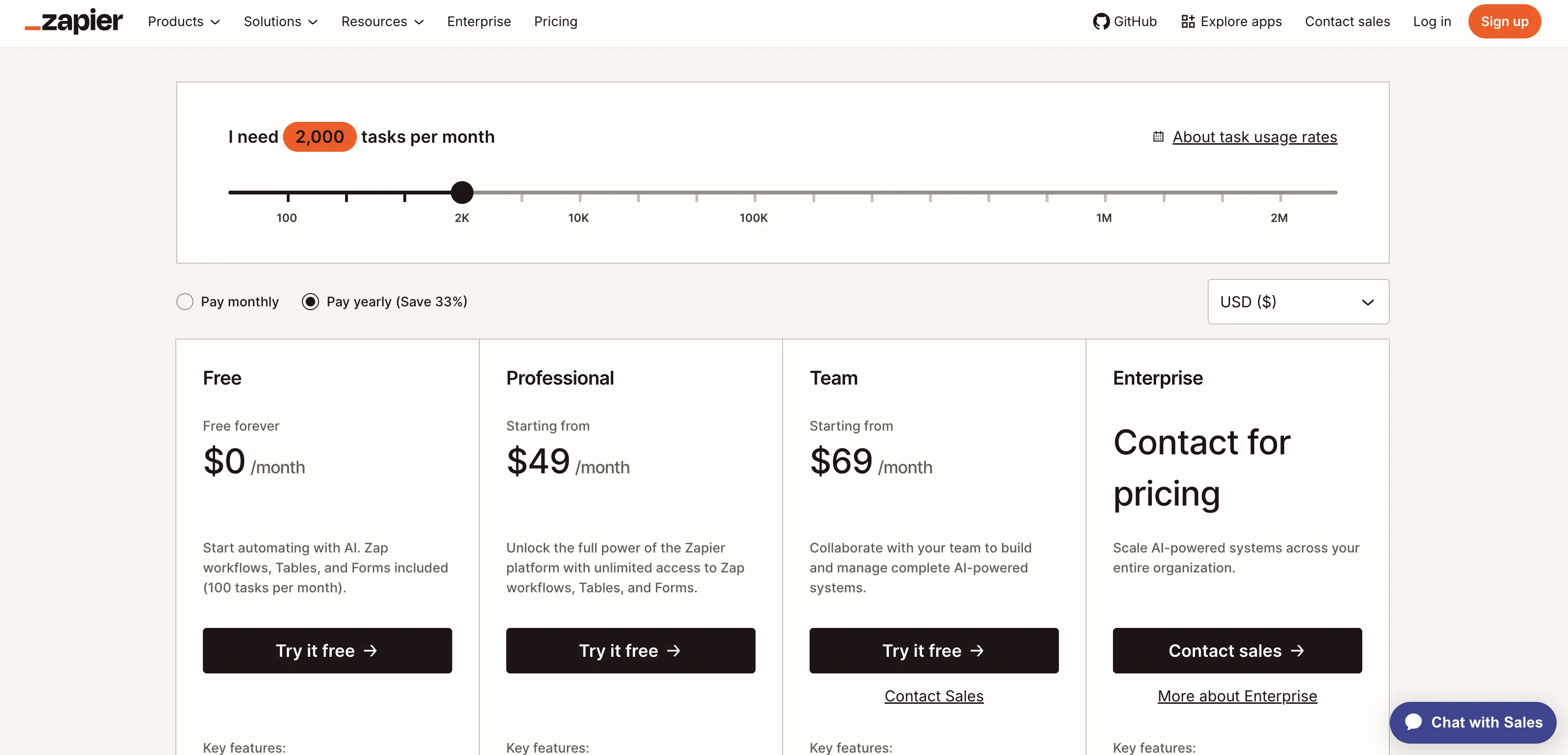
That single detail is the reason this list exists. It's not that Zapier is bad. With 9,000-plus app integrations, it still connects to more obscure tools than anything here. It's that the bill can double or triple in ways the pricing page doesn't make obvious, and once you've felt that, cheaper task pricing, a flat fee, or a one-time payment starts looking a lot more appealing.
The 12 Zapier Alternatives, Ranked by How Much Automation Power they actually give you
1. Make
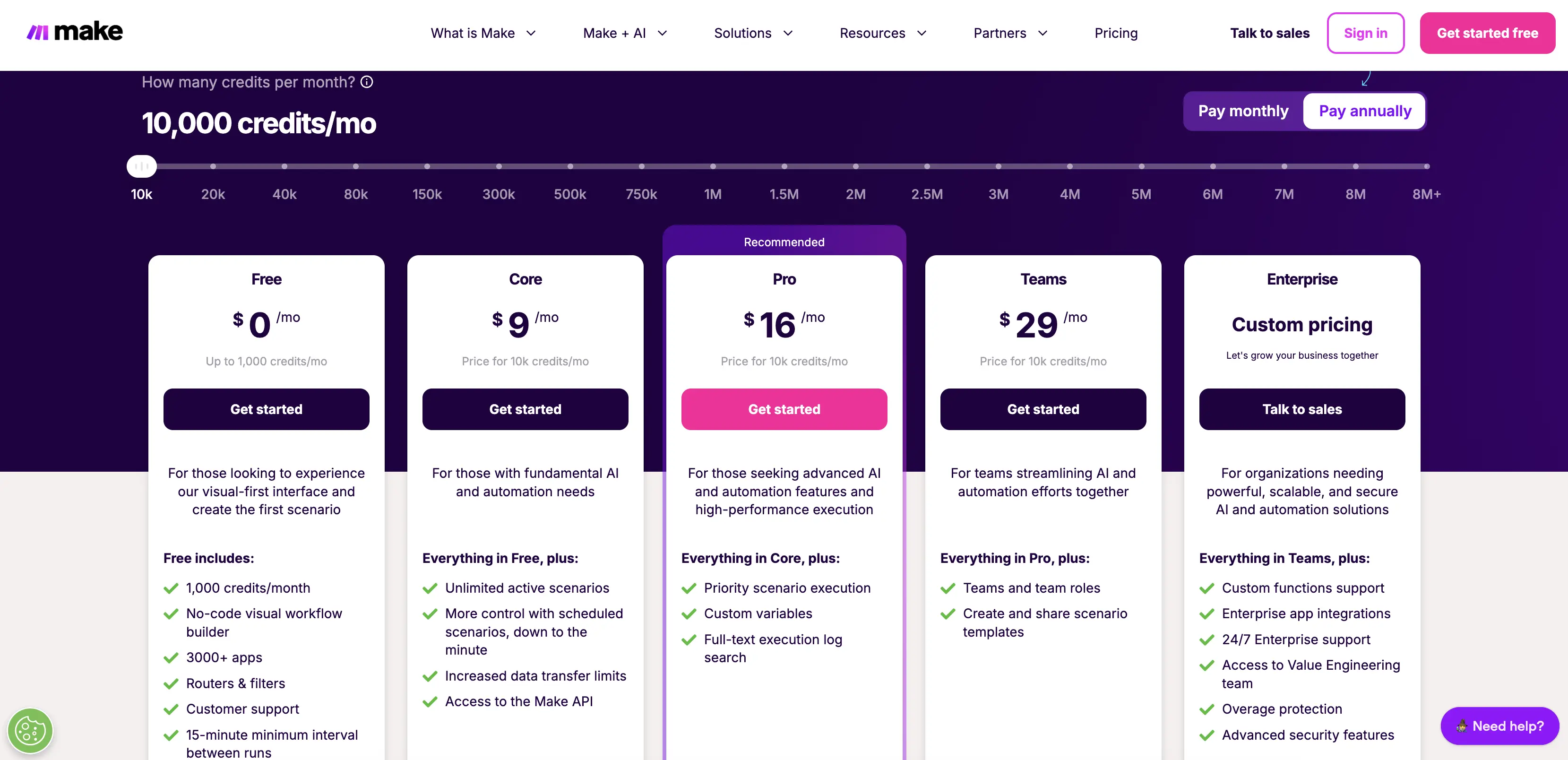
Starting price: free for 1,000 credits a month. Paid plans start at $12/month for 10,000 credits. Best for: teams that want Zapier's polish with a friendlier bill.
Run the same five-step lead-routing workflow from the intro through Make instead of Zapier, and 6,000 monthly runs use roughly 30,000 credits, which lands you on the Pro plan at $21 a month. Compare that to Zapier's roughly $195 to $554 for the identical volume, and the gap explains why Make shows up first on almost every switcher's shortlist.
2. n8n
Starting price: no permanent free tier on Cloud. Starter Cloud runs €20/month billed annually for 2,500 executions. Self-hosting the open-source Community Edition is free. Best for: developers and technical teams who want to self-host and pay almost nothing per run.
n8n counts one execution per workflow run, not per step, so a ten-step workflow that runs 40 times a day still uses 40 executions, not 400. That single difference is why n8n keeps coming up first in almost every developer thread about a cheaper Zapier alternative. The catch, as of this year, is that n8n dropped its free Cloud tier entirely, so testing the hosted version now means paying from day one.
Self-hosting sidesteps that. The Community Edition is free and open source under a fair-code license, runs on a $5 to $15 a month VPS, and has no execution cap at all. You give up managed hosting and the newer AI Assistant credits, but for a solo operator or a small dev team comfortable with Docker, the math is hard to argue with.
Read Also: 12 Best n8n Alternatives in 2026 (tested past the concurrency cap)
If you're comparing categories rather than just automation tools, our best iPaaS platforms in 2026 guide breaks the wider market down by who each platform actually serves.
3. Workato
Starting price: no published list price. Industry data puts small-team deployments around $10,000 a year. Best for: mid-size and large companies that need governance, not a cheaper monthly bill.
Where it earns its price is cross-departmental orchestration: shared recipes, role-based access, and audit trails that a five-person startup doesn't need but a 500-person operations team can't run without. Gartner has named it a Leader in its category for eight straight years, unusual staying power in a market that reinvents itself constantly.
4. Tray.ai
Starting price: custom, sales-led pricing. No public list price. Best for: enterprise teams that want AI agents built into the same platform as their integrations.
It's a strong pick for teams that already need governance-heavy automation and want agents that reason across multiple systems. It's a poor pick for a five-person team, since you'll pay enterprise prices for capabilities you won't touch for years.
5. Microsoft Power Automate
Starting price: free with standard connectors if your org already has Microsoft 365. Premium is $15 per user per month. Best for: teams already living inside Outlook, SharePoint, and Teams.
The licensing model trips people up. It's per user, not per organization, so a shared invoice-approval flow that twelve finance staff submit through needs twelve separate $15 licenses, not one. Budget for that before you commit, not after the renewal invoice.
6. Activepieces
Starting price: free for 10 active flows with unlimited runs. $5 per additional active flow per month after that. Best for: teams running a handful of high-volume workflows that would rack up huge task counts elsewhere.
It's open source under the MIT license, which is a real one, unlike some "open" competitors that restrict commercial resale. Self-hosting is free beyond your own server cost. The catch is a smaller connector library than Zapier's, so check your specific app list before switching a mission-critical workflow over.
7. Pabbly Connect
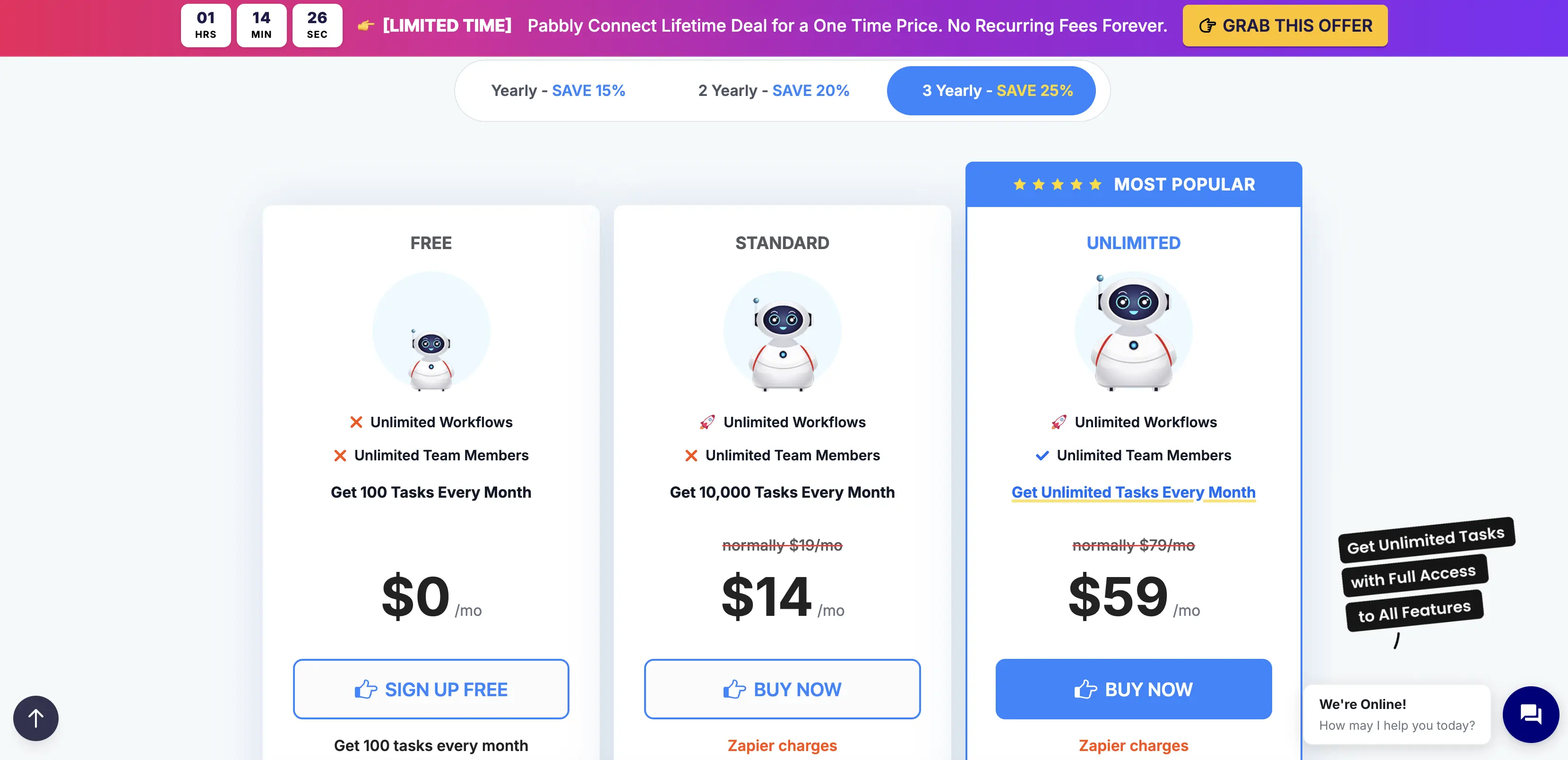
Starting price: free for 100 tasks a month. Paid plans start around $19/month for 12,000 tasks, or a one-time lifetime plan from $249. Best for: budget-conscious teams that want to stop paying a monthly bill entirely.
The interface is less polished than Zapier's, and support runs slower based on user reviews. But if your workflows are stable and you already know your monthly volume, a $249 payment that never needs renewing is hard to beat on pure economics.
8. Integrately
Starting price: free for 100 tasks. Starter is $19.99/month for 2,000 tasks. Best for: non-technical users who want pre-built one-click automations instead of building from scratch.
Branching logic, auto-retry, and unlimited automations only open up on the Professional tier at $39/month, so treat the $19.99 Starter plan as a trial run rather than the real cost of using it seriously.
9. Zoho Flow
Starting price: free for 100 tasks and 5 flows. Standard plan runs around $10/month for 5,000 tasks. Best for: businesses already running Zoho CRM, Zoho Books, or other Zoho apps.
The real value shows up once a company uses three or four Zoho products together. At that point, Zoho One's flat per-employee price often makes Flow effectively free, bundled in alongside CRM, Books, and dozens of other apps. Used on its own, outside the Zoho ecosystem, it's a solid budget pick but not a reason to switch by itself.
10. Relay.app
Starting price: free for 200 steps a month. Professional runs $19/month billed annually for 750 steps. Best for: teams that want a human to approve or edit a step before an AI automation goes live.
Pricing here has been reported inconsistently across review sites, with some quoting $9 a month and others $38, so I pulled these numbers straight from Relay's own pricing page rather than trust a third-party roundup. Just over 100 integrations is thin next to Zapier's library, so it fits best as an AI-approval layer alongside another tool, not a full replacement.
11. Gumloop
Starting price: free for 5,000 credits a month. Pro starts at $37/month for 20,000-plus credits. Best for: technical teams building AI-native workflows with heavy model use, web scraping, or document parsing.
Its connector library is thin next to Zapier's app directory, since it leans on AI and scraping rather than pre-built app connections. Pick it when the job is real AI-native work like summarizing documents or pulling structured data off the open web, not for routine CRM-to-spreadsheet syncing.
12. IFTTT
Starting price: free for 2 applets. Pro runs about $2.99/month for 20 applets. Best for: personal automation and smart home routines, not business workflows.
Business users outgrow it fast, but for the exact use case it was built for, personal and smart-home automation, it's still the cheapest paid option on this entire list at under $3 a month.
Zapier Alternatives Comparison
Tool | Starting price | Free plan | Best for |
|---|---|---|---|
Make | $12/mo (10k credits) | Yes, 1,000 credits/mo | All-round Zapier replacement |
n8n | €20/mo Cloud, or free self-hosted | Self-hosted only | Developers, self-hosting |
Workato | ~$10,000/yr | No | Enterprise governance |
Tray.ai | Custom | No | Enterprise AI orchestration |
Power Automate | $15/user/mo | Yes, with M365 | Microsoft-centric teams |
Activepieces | $5/active flow/mo | Yes, 10 flows | High-volume flat pricing |
Pabbly Connect | $19/mo, or $249 lifetime | Yes, 100 tasks/mo | Budget, one-time payment |
Integrately | $19.99/mo | Yes, 100 tasks/mo | One-click prebuilt Zaps |
Zoho Flow | ~$10/mo | Yes, 100 tasks/mo | Zoho ecosystem users |
Relay.app | $19/mo | Yes, 200 steps/mo | Human-in-the-loop approval |
Gumloop | $37/mo | Yes, 5,000 credits/mo | AI-native workflows |
IFTTT | $2.99/mo | Yes, 2 applets | Personal, smart home |
Worth pricing your own stack in the switch and save calculator before you shortlist.
How to pick Zapier Alternatives
Need the closest like-for-like swap with a friendlier bill? Go with Make.
Comfortable with a bit of setup and want to kill per-task costs almost entirely? Self-host n8n.
Need IT-grade governance across dozens of departments? Look at Workato or Tray.ai, and expect a sales call before you see a number.
Live inside Microsoft 365 already? Power Automate is probably already partly paid for.
Running a handful of workflows that fire constantly? Activepieces charges by the flow, not the run, so volume stops being the enemy.
Just want the bill to stop showing up every month? Pabbly Connect's lifetime plan is the only real answer to that on this list.
Need a human to sign off before an AI step goes live? Relay.app is built around exactly that pause.
Where Zapier still wins
None of this makes Zapier a bad product. Its 9,000-plus app directory is still the widest in the industry, and if your stack includes some obscure regional payment processor or a niche CRM, Zapier is often the only tool on this list that connects to it at all. The interface is still the easiest one to learn for someone who has never built an automation before, and Zapier MCP now lets AI assistants like Claude or ChatGPT take action across that same app directory, which none of the smaller tools here can match yet.
If your workflows are simple, low-volume, and stay under 750 tasks a month, Zapier's Professional plan is still a reasonable, well-supported choice. The problems start once volume grows past what the free and entry plans expect.
FAQ: Zapier Alternatives
Is there a free alternative to Zapier?
Yes. Make, Activepieces, Pabbly Connect, Integrately, Zoho Flow, and Relay.app all offer usable free plans, and n8n's Community Edition is free to self-host with no execution limit at all.
What's the cheapest Zapier alternative overall?
Pabbly Connect's one-time lifetime plan, starting around $249, works out cheapest over time since it removes the monthly bill entirely. IFTTT is cheapest on a pure monthly basis at under $3, but it only handles single-step personal automations.
Is there an open-source Zapier alternative I can self-host?
n8n and Activepieces are the two most actively maintained. n8n's Community Edition has no execution cap; Activepieces is MIT-licensed, which allows commercial use without restriction.
Which Zapier alternative works best for a small team on a budget?
Make and Pabbly Connect both fit here. Make gives you more polish and a bigger app library; Pabbly Connect gives you a lower long-term cost if you take the lifetime plan.
Do any of these alternatives support AI agents the way Zapier's MCP does?
Gumloop and Relay.app are both built AI-first, with Gumloop leaning toward model-heavy workflows and scraping, and Relay.app adding human approval steps. Tray.ai's Merlin Agent Builder covers this at the enterprise end.
My picks for Zapier Alternatives
If I had to move one client off Zapier this week with no other context, I'd start with Make. It's the closest match in capability, the credit pricing is transparent, and the migration path from an existing Zap is straightforward enough to do in an afternoon.
For anyone comfortable with a VPS and a bit of patience, n8n's self-hosted option is the one that actually changes the shape of your monthly bill instead of just shaving a few dollars off it. And if the whole point is to never think about a recurring automation bill again, Pabbly Connect's lifetime plan is still the only tool here that actually delivers on that promise.