The best CRM for solopreneurs depends on how you earn: HoneyBook or Plutio if you sell projects, Close Solo or Pipedrive if you work outbound deals, Streak or folk if you live in Gmail, and HubSpot or Bigin free if the budget is zero.
One user pays between $84 and $588 a year on the paid plans below, with every figure taken from the vendor's own pricing page on 1 October 2026.
HubSpot's own pages show how confusing CRM pricing can be. Its pricing page lists Starter at $20 per seat per month and shows $7 as a limited time rate for new customers, while its CRM product page still says Starter starts at $15.
A solo owner comparing those two tabs gets three answers for one plan. Most CRMs sell by the seat, so a team of one ends up paying for software sized for ten.
Short Answer
You sell projects, proposals, and invoices: HoneyBook Starter at $29 a month on annual billing, or Plutio Core at about $15.
You work outbound deals: Close Solo at $9 a month on annual billing, or Pipedrive Lite at $14.
You live in Gmail or run on relationships: Streak Pro at $49, or folk Standard at $24.
You start at zero: HubSpot free (2 users, 1,000 contacts) or Bigin free (1 user, 500 records).
Do you need a CRM, or is a spreadsheet enough?
A spreadsheet is enough while you can name every open deal and every promised follow up without opening it. It stops working the day a lead goes quiet, and nothing tells you to write to them.
A CRM (customer relationship management software) fixes that with reminders, a pipeline view, and a log of past conversations in one place.
The question on Quora about a CRM for solopreneurs who hate complicated software carries the same worry: too much tool for one seat. Its top answer points to an open source system with basic lead and task tracking.
The free plans in this guide hold 500 to 5,000 records, more than most solo spreadsheets reach, so size rarely forces the move; a missed follow up does.
Ten picks for solopreneurs and freelancers, grouped by how you earn
Every price below is for one user. Each price names its billing term, and annual billing costs less than monthly on every plan below that lists both.
If you sell projects, proposals, and invoices
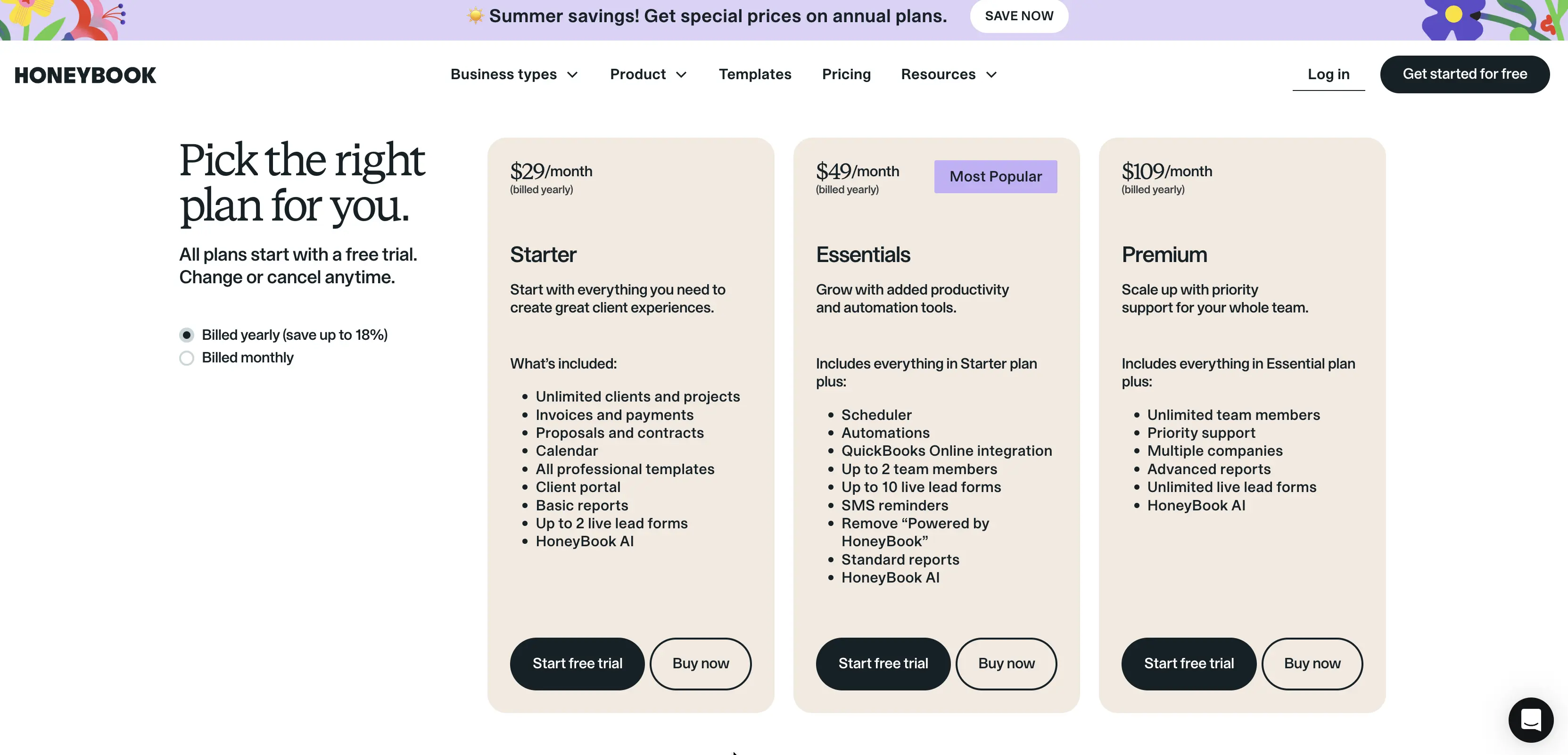
HoneyBook (Starter: $29 a month on annual billing, $36 monthly)
HoneyBook is a client management tool that combines a CRM with invoices, proposals, and contracts, and Starter includes all three plus unlimited clients and projects and 2 live lead forms.
The scheduler and automations start on Essentials at $49.
HoneyBook also offers a full refund in the first 60 days.
Plutio (Core: about $15 a month on annual billing, $19 monthly)
Plutio is a client portal and project tool that puts proposals, contracts, invoices, and a CRM on every plan.
Core is built for one person: it allows 9 active clients, 800 AI credits and 900 workflow actions a month, and it has no contributors.
You get 7 days to try it. After that, if you do not pay, your account moves to a free plan with limits.
If you work outbound deals
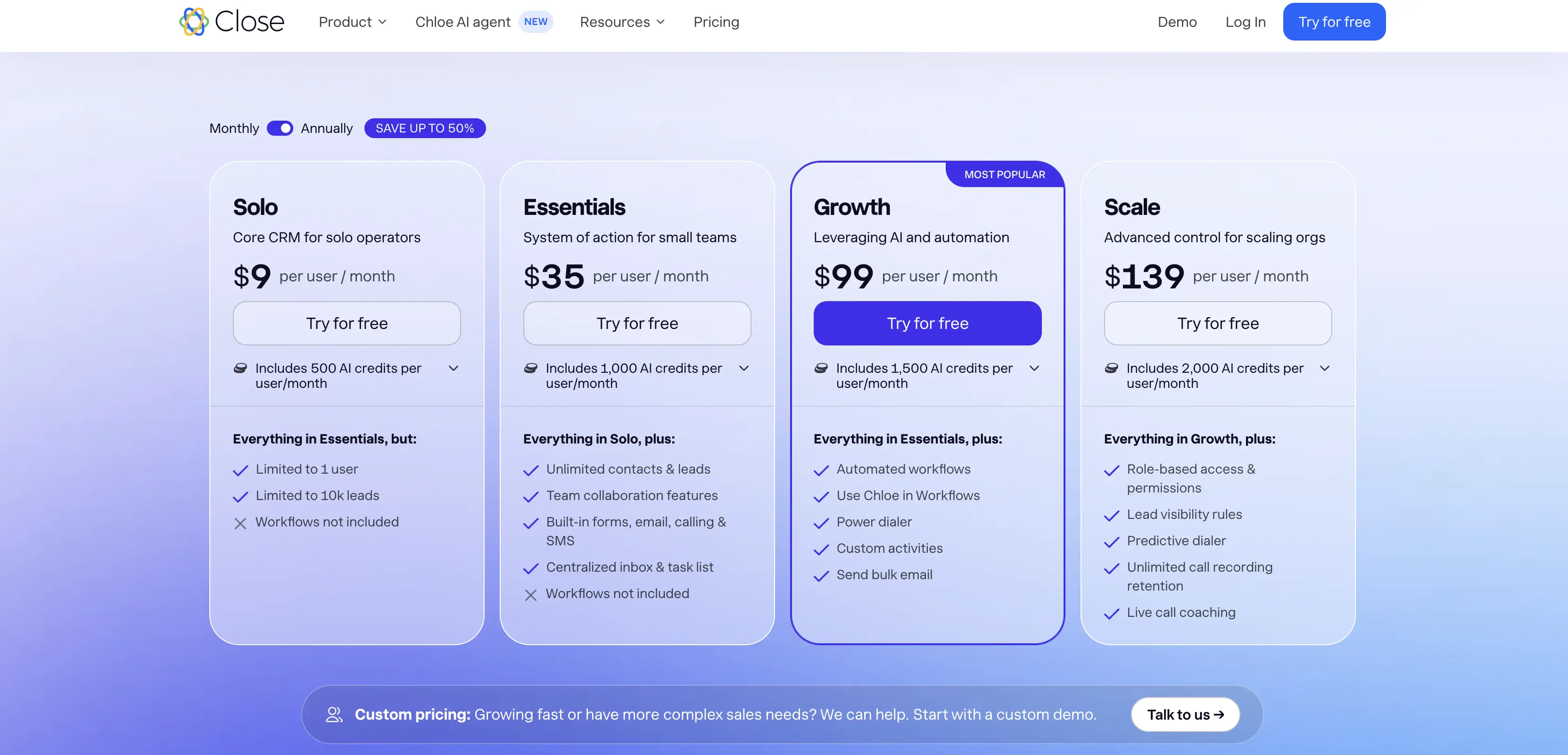
Close Solo ($9 a month on annual billing, $19 monthly)
Close is a sales CRM, and Solo is its one user plan, described on its own pricing page as "Core CRM for solo operators". It is limited to 1 user and 10,000 leads, leaves out workflows, and includes 500 AI credits a month.
The next tier, Essentials, costs $35 on annual billing or $49 monthly, and our Close CRM pricing guide covers the rest of the ladder.
Pipedrive Lite ($14 a month on annual billing, $168 a year)
Pipedrive is a pipeline CRM built around deal stages. Lite covers leads, deals, contacts and a calendar, and connects to 500+ apps. Full email sync with tracking and automations start on Growth at $24 a month on annual billing, so Lite works as a deal board that does not read your inbox.
If you spend all day in Gmail or work with people you know
Streak (Pro: $49 a month on annual billing, $59 monthly)
Streak is a CRM that runs inside Gmail. Its free plan holds Gmail email tools only, with 50 mail merge sends a day and no pipelines, so it does not work as a CRM.
Pro adds unlimited pipelines and records and 20 AI credits a month. Automations, Zapier and direct integrations start at Pro+, which costs $69 on annual billing or $89 monthly.
folk (Standard: $24 a month on annual billing, $30 monthly)
folk is a contact CRM for people who work through networks, partnerships, and introductions. It has no free plan, only a 2 week trial with no card. Premium, at $48 on annual billing, adds sequences, dashboards, and API access.
If you start at zero or want one flat price
HubSpot free CRM ($0)
HubSpot is a CRM platform, and its free tools allow up to 2 users and 1,000 contacts with no card.
The paid Starter price is the confusing part, and the next section sorts it out.
Bigin (Free: $0, Express: $7 a month billed yearly)
Bigin is Zoho's lightweight CRM for the smallest businesses. The free plan allows 1 user, 500 records, 1 pipeline and 3 automations.
Express adds 3 team pipelines, 50,000 records and 30 automations, and the paid plans start with a 15 day trial.
Zoho CRM free edition ($0)
Zoho CRM is a full sales CRM, and its free edition lists 3 users, 5,000 contact records, 150 emails a day and 5 workflow rules, with no time limit.
Less Annoying CRM ($15 per user per month, one price)
Less Annoying CRM is a simple CRM for small businesses with a single plan, no tiers, and no long term contracts.
It offers a 30 day trial that asks for no payment details, and a year for one user comes to $180.
HoneyBook or HubSpot for a one person business?
HubSpot's pricing page lists Starter at $20 per seat per month and shows $7 as special pricing for new customers, marked as a limited time offer.
The CRM product page adds that the discount has no set end date and can be discontinued at any time. Twelve months at $20 comes to $240, and at $7 it comes to $84.
That $156 gap closes whenever HubSpot ends the offer, so budget for $20 and treat anything lower as a bonus. Our HubSpot pricing guide covers the tiers above Starter.
The free tools cost nothing for up to 2 users and 1,000 contacts, which suits a solo owner who tracks leads and deals.
Pick HoneyBook if your work is proposals, contracts, and invoices. Its Starter plan is $29 on yearly billing, and it has all three.
Pick HubSpot Free if your work is a list of leads and deals. When you go over 1,000 contacts, plan to pay $20 for each person who uses it.
What does a CRM cost one person over 12 months?
Seat prices hide the number a solo owner feels, which is what leaves the bank account in a year. This table multiplies each monthly rate by 12 on annual billing for one user.
Plan, one user | Per month, annual billing | 12 months | Catch to know |
|---|---|---|---|
Bigin Express | $7 | $84 | 30 automations, 50,000 records |
Close Solo | $9 | $108 | 1 user, 10,000 leads, no workflows |
Pipedrive Lite | $14 | $168 | No full email sync |
Less Annoying CRM | $15 | $180 | One flat price, no tiers |
Plutio Core | about $15 | about $180 | 9 active clients, no contributors |
Pipedrive Growth | $24 | $288 | Adds email sync and automations |
folk Standard | $24 | $288 | No free plan, 2 week trial |
HoneyBook Starter | $29 | $348 | 2 lead forms, payment fees on top |
HoneyBook Essentials | $49 | $588 | Adds scheduler, automations, 2 team members |
Streak Pro | $49 | $588 | No automations or Zapier until Pro+ |
The cheapest paid plan here and the most expensive one are $504 apart. That is 7 times the price, for tools that all call themselves a CRM.
Paying each month costs more than paying for the whole year:
HoneyBook Starter costs $84 more. It is $432 when you pay monthly and $348 when you pay yearly.
Streak Pro costs $120 more. It is $708 monthly and $588 yearly.
Close Solo costs $120 more. It is $228 monthly and $108 yearly.
folk Standard costs $72 more. It is $360 monthly and $288 yearly.
Plutio Core costs about $48 more. It is $228 monthly and about $180 yearly.
Usage allowances sit inside those prices too. Close Solo includes 500 AI credits a month, Streak Pro includes 20 against 150 on Pro+, and Plutio Core includes 800 AI credits and 900 workflow actions.
Best free CRM for solopreneurs: which plans run out first?
Four free plans work as real CRMs, and each ends at a different cap. A fifth looks free but is not a CRM.
Free plan | Users | Records | Other caps |
|---|---|---|---|
Capsule | 2 | 250 contacts | 5 custom fields, 1 pipeline |
Bigin | 1 | 500 records | 1 pipeline, 3 automations |
HubSpot | 2 | 1,000 contacts | Starter is $20 a seat after that |
Zoho CRM | 3 | 5,000 contact records | 150 emails a day, 5 workflow rules |
Streak | Not a CRM | Gmail email tools only | 50 mail merge sends a day, no pipelines |
For a solo owner, the contact cap ends the free ride first: Capsule at 250, Bigin at 500, HubSpot at 1,000 and Zoho at 5,000, which is 20 times Capsule's limit.
Capsule's signup page lists its caps next to a 14 day trial of the paid plans. Our guide to free CRM plans and their upgrade cliffs compares the wider field.
What changes when you add a second person?
Price lists stop at one user. This is where people who work alone and small teams go different ways.
When the second person joins, a plan for one person does one of two things. It adds a price for each extra person, or it stops you from adding anyone.
Tool | One person | Two people | Change |
|---|---|---|---|
Close | Solo, $9 | 2 Essentials seats, $70 | 7.8 times the Solo bill |
Plutio | Core, about $15 | Pro, about $39 | about $24 more |
HoneyBook | Starter, $29 | Essentials, $49 | $20 more, a 69% jump |
Bigin | Free, $0 | 2 Express seats, $14 | $14 more |
Pipedrive | Growth, $24 | 2 Growth seats, $48 | $24 more |
Streak | Pro, $49 | 2 Pro seats, $98 | $49 more |
folk | Standard, $24 | 2 Standard seats, $48 | $24 more |
Less Annoying CRM | $15 | 2 seats, $30 | $15 more |
All prices are per month, with yearly billing. Some tools charge for each person, so the price doubles when you go from one person to two.
These are Pipedrive Growth, Streak Pro, folk Standard, Less Annoying CRM and Bigin Express.
Other plans put a limit on users, and the price jumps when you pass it:
Close Solo allows 1 user. When you hire someone, you move to Essentials. With monthly billing, two Essentials seats cost $98, and Solo costs $19. That is 5.2 times as much.
Plutio Core has no contributors at all. Pro includes 30 and costs $30 more with monthly billing.
HoneyBook Essentials covers up to 2 team members. Premium, for a bigger team, costs $60 more than Essentials with yearly billing.
HubSpot free is different, because it allows up to 2 users.
If you expect a virtual assistant or a partner within 12 months, price the second seat before you sign up.
Which CRM fits which solo business?
Freelancer or consultant who sends proposals: HoneyBook Starter or Plutio Core, because both keep invoices and contracts beside the client record.
Plutio caps you at 9 active clients, while HoneyBook Starter allows unlimited clients and projects.
Sales-led solo founder: Close Solo at $9 or Pipedrive Lite at $14, moving to Pipedrive Growth at $24 once you need email sync.
Networker or partnerships owner: Streak Pro at $49 if your inbox is Gmail, or Folk Standard at $24 if people matter more than deals.
Solo agency owner planning a hire: Pipedrive, folk, or Less Annoying CRM, since each adds a seat at its listed price without a plan jump.
Zero budget or personal use: HubSpot free or Bigin free, and move when you near 1,000 or 500 records.
Once a team grows past two people, our guide to the best CRM software for small business prices the cheapest seat for each size.
Questions solopreneurs ask about CRMs
What is the best CRM for solopreneurs?
The best CRM for people who work alone is the one that fits how you make money. Pick HoneyBook or Plutio if you do project work. Pick Close Solo or Pipedrive if you win deals by reaching out to people first.
Pick Streak or folk if you spend all day in Gmail and work with people you know. Pick the free plan from HubSpot or Bigin if you have no money to spend.
Does a sole proprietor need a CRM?
A sole proprietor needs a CRM once follow ups outgrow memory or a spreadsheet.
Four free plans from HubSpot, Bigin, Capsule and Zoho cost nothing to try, so the cost of starting early is setup time.
Is there a 100% free CRM, and is Zoho CRM still free?
Yes, a few plans stay free with no time limit, each with caps. Zoho CRM's free edition still lists 3 users, 5,000 contact records and 150 emails a day as of 1 October 2026.
HubSpot free stops at 2 users and 1,000 contacts, and Bigin free at 1 user and 500 records.
How much should a solopreneur spend on a CRM?
Between $0 and $588 a year covers every plan in this guide for one user on annual billing, with most solo picks at $84 to $348.
Spend more only when a feature you use daily, such as automations or invoicing, sits on the higher plan.
Which CRMs include invoicing and proposals?
HoneyBook and Plutio include invoices, proposals and contracts on every plan, starting at $29 and about $15 a month on annual billing.
Is per seat pricing wasteful for a team of one?
With one seat, per seat pricing equals the plan price. The cost shows up when a second person joins. Close Solo and Plutio Core are built for one user, and Bigin Express charges $7 per user, so a solo owner pays for a single seat on each.
Which one to pick
Start with how you earn, then price the second seat. If invoices and contracts are the work, take HoneyBook Starter at $29 a month on annual billing.
If the work is a pipeline of deals, take Close Solo at $9 and expect $35 a seat the day you hire.
If the budget is zero, start on HubSpot free or Bigin free and move when you reach the contact cap.
Vendors change prices, as HubSpot's three Starter figures show, so read the plan page on the day you buy.