
Zoho CRM has the most honest free plan in this list: three users, no time limit. EngageBay lets the most people in for free at once: fifteen users.
HubSpot is the name everyone tries first, but its free plan runs out of contacts faster than most teams expect. Plan around that now.
monday does not offer a free CRM plan at all. Freshsales only hands you one if you go looking for it, buried in account settings after a trial ends.
Nine tools on this page call themselves a free CRM, and their terms pages tell a different story than the marketing card at the top does.
Three of the best known names on this list are not free in the way most people assume when they type this search in.
That gap between what a homepage implies and what the terms page says is the whole story here.
Below is what each plan actually includes, what forces the jump to a paid seat, and which "free" CRMs on this list quietly are not free at all once you look past the homepage.
Which "free" CRMs are not actually free
Three names that show up on almost every "best free CRM" list are not free to sign up and use today.
monday's own support documentation says it plainly: "monday sales CRM and monday dev are not available on the Free Plan. To use either of these products, you will need to upgrade to a paid plan." monday's general Free Plan covers its work management boards, not the CRM product.
The CRM itself starts at $12 a seat a month (billed yearly) with a three seat minimum, after a fourteen day trial.
Freshsales works differently again. There is no free option on the Freshworks signup flow. You start a trial, and Freshworks' own support article walks you through downgrading it afterward: go to Admin Settings, then Plans and Billing, then Change Plan, then choose Free.
The result is capped at three users. Nothing about that path appears on the pricing page itself.
Pipedrive is trial only. There is no free tier to downgrade into at all.
None of this means these three are bad tools. It means "free" on their pricing page and "free" on Google's autocomplete are not the same claim.
Check the terms page first, not the ad copy, before you build a sales process around one of them.
The upgrade cliff nobody prices
Every free CRM plan on this page has a specific point where the next contact, the next seat, or the next feature you actually need forces a card into the system. Almost nobody writing about free CRMs does the actual math on what that costs. Here is that math.
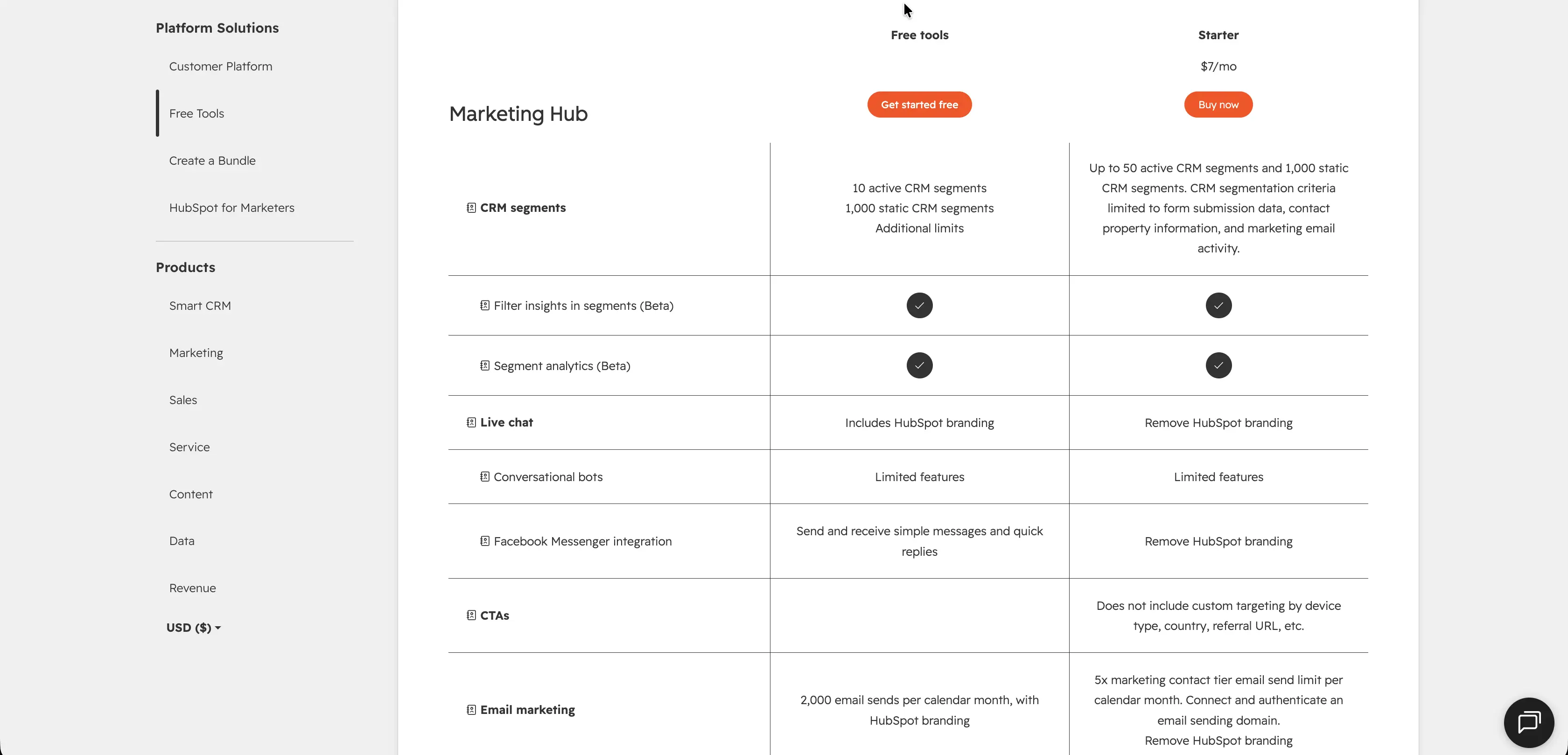
HubSpot's free tools plan covers two users, 1,000 contacts, and 2,000 branded marketing emails a month. Add a third teammate or a real automation, and you land on Starter, priced at $20 a user a month on monthly billing.
HubSpot's free plan also ships with zero AI credits. Paid credits for its Breeze features start at 500 a month, only on Starter and up.
We broke down HubSpot's full tier ladder, including the annual versus monthly gap, in our HubSpot pricing guide.
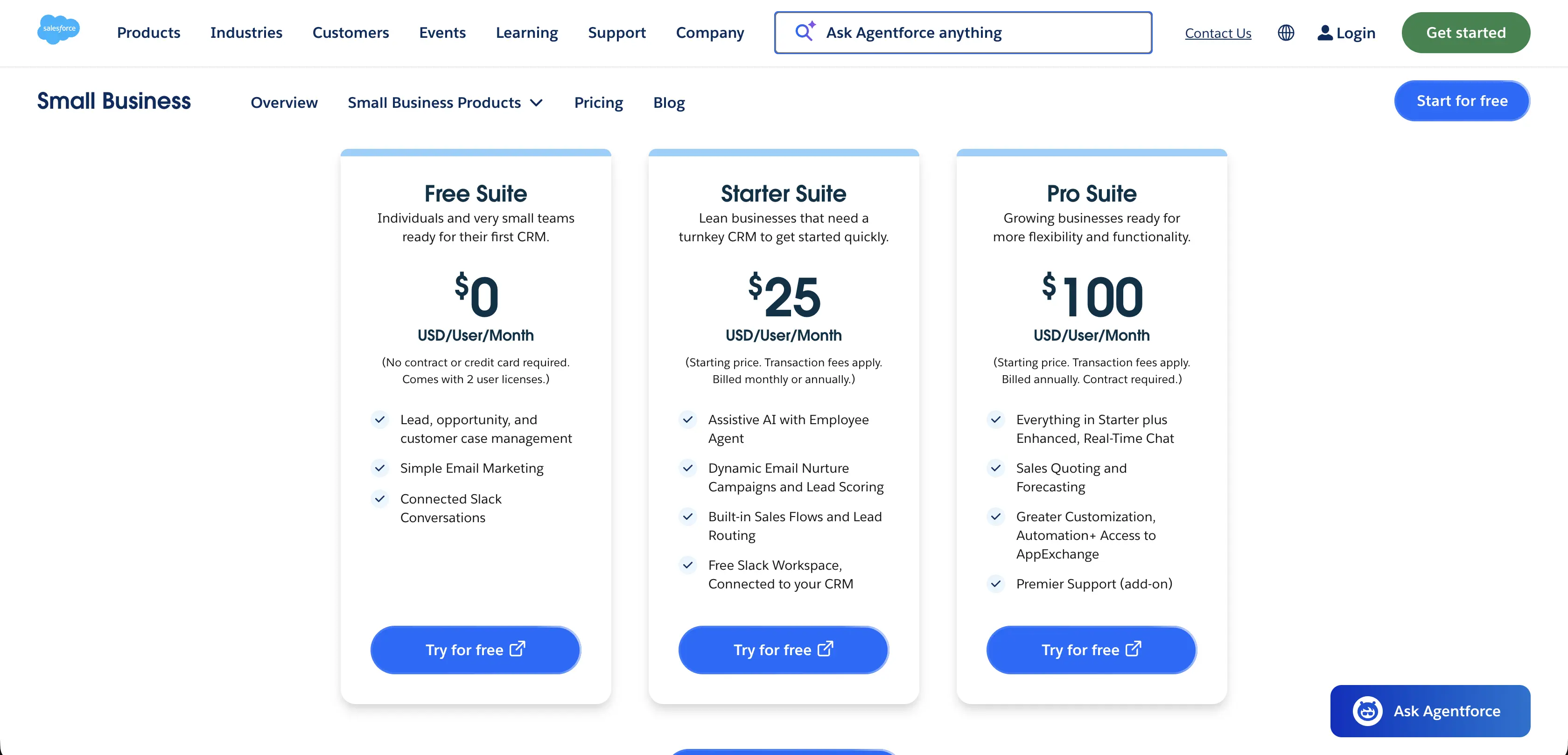
Salesforce's Free Suite covers two user licenses. A third person costs $25 a user a month on Starter Suite. That is more than double what most of the tools on this page charge for their entry paid tier.
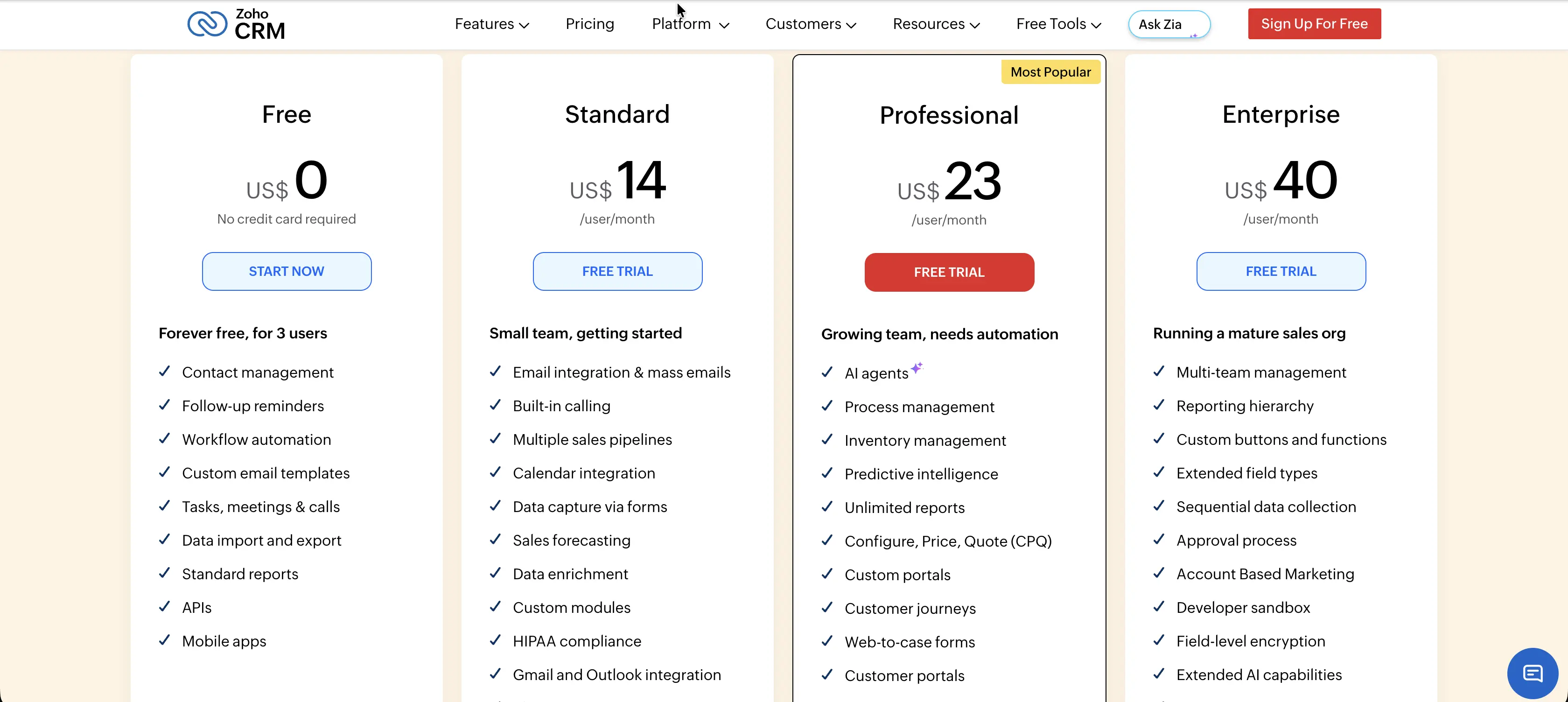
Zoho sits at the generous end. No card required. Its free plan holds three users, and Standard for a fourth seat starts at roughly $14 a user a month on annual billing, the lowest jump of any big name CRM on this list.
Meet the CRMs that are actually free right now
Zoho CRM
Zoho CRM is a sales and pipeline tool built by Zoho, and its free edition is the most direct about staying free. Three users, 5,000 records across every module, 1GB of file storage, and up to five workflow rules, all with no expiration date.
Zoho's own free CRM page states it outright: "So, we will never force you to move to a paid edition."
HubSpot CRM
HubSpot is a customer relationship platform best known for bundling contact records with marketing and sales tools in one dashboard.
Free covers two users, 1,000 contacts, 2,000 branded email sends a month, one automated action, ten active CRM segments, and ten dashboards.
It is the CRM most people already know. That familiarity is exactly why its limits catch people off guard.
EngageBay
EngageBay is an all in one sales and marketing platform aimed at small teams. Its free plan allows fifteen users, the highest seat count on this page, alongside 250 contacts, 1,000 branded emails, twenty AI conversations a month, and 500 API calls a month.
Nothing else on this page seats fifteen people for free. Paid plans start at $12.74 a user a month on two year billing.
Agile CRM
Agile CRM is a sales and contact management tool with built in marketing automation. Ten free seats. Free covers ten users and 1,000 contacts and companies, with one campaign workflow and 500 API calls a day.
Starter begins at $8.99 a user a month.
Capsule CRM
Capsule is a lightweight contact and opportunity tracker built for small teams that do not want a learning curve or a long onboarding process before the first deal gets logged.
Free covers two users, 250 contacts, five custom fields, and one sales pipeline. Small numbers, on purpose. Starter runs $18 a user a month billed annually.
Bitrix24
Bitrix24 bundles CRM, tasks, and team chat into one platform. Its own pages disagree about who can use the free tier for nothing. The pricing card promises "100% free for 1 to 2 users" with 5GB of storage.
The FAQ on the same page says something else: "You can add an unlimited number of users and enjoy the available tools completely free of charge for as long as you wish." Both statements were live on bitrix24.com on 24 September 2026.
Bitrix24 recently rebuilt its paid lineup around new "Vibe+" plans, priced by organization rather than by seat: Basic Vibe+ runs $59 a month billed annually for up to five users, discounted from $89 as part of a launch offer running through 10 December 2026.
Salesforce Free Suite
Salesforce's free tier covers two user licenses and 100 marketing emails a month, with one condition most people miss: you have to log into the account at least once every 60 days or it stops being free.
It skips AppExchange access entirely. Starter Suite is the next step up, at $25 a user a month, and our Salesforce pricing guide covers what the tiers above that actually add.
Twenty
Twenty is an open source CRM built to be self hosted, aimed at teams comfortable running their own server. The core product is free with no user cap when you host it yourself.
No trial. No seat count. A managed cloud version exists too, starting at $9 per user a month on the Pro plan.
What actually happens when you hit the cap
Knowing a cap exists is not the same as knowing what happens the moment you cross it, and most pages about free CRMs stop at the first part.
On HubSpot, a HubSpot Community thread from a user who imported 1,592 contacts into a free account shows the exact failure: a banner reading "You've reached your 1,000 contact limit," blocking any further contact creation or import.
A reply in the same thread points out that the cap counts every contact record in the account, not just the ones on a marketing list, which matches HubSpot's own free plan wording: "unlimited data and up to 1,000 contacts."
There is no soft warning zone. You either fit under 1,000, or you do not.
Ask this before you build a real process on top of any free plan: what happens the day you cross the line, not just where the line sits.
Salesforce Free Suite's 60 day catch
This deserves its own section. It is the easiest free plan detail on this whole page to lose an account over without ever noticing.
Salesforce's Free Suite does not expire on a calendar date. It expires on inactivity. Log in at least once every 60 days and the two included licenses stay free indefinitely.
Miss that window and the account no longer counts as free, based on the exact terms Salesforce publishes on its own Free Suite pricing page today.
For a two person team that set the CRM up once and moved on to actually selling, 60 days can pass fast. Nobody notices the countdown started until the account locks. Set a reminder.
Bitrix24 prices its free plan two different ways on the same page
Bitrix24's contradiction changes what you should expect before you sign up, not after. It is worth calling out on its own.
The plan selector caps the free tier at one or two users. The FAQ directly beneath it, on the same URL, says you can add unlimited users for free.
Both were live on 24 September 2026.
If you are a team of three or more hoping to run entirely on Bitrix24's free plan, read the actual account limits inside your own dashboard once you sign up rather than trusting either public page to settle it for you.
Free CRM comparison table
CRM | Free users | Free plan limit that matters most | First paid tier |
|---|---|---|---|
Zoho CRM | 3 | 5,000 records, 1GB storage | About $14/user/mo annual |
HubSpot CRM | 2 | 1,000 contacts, 0 AI credits | $20/user/mo monthly |
EngageBay | 15 | 250 contacts, 1,000 emails/mo | $12.74/user/mo (2 yr) |
Agile CRM | 10 | 1,000 contacts, 1 workflow | $8.99/user/mo |
Capsule CRM | 2 | 250 contacts, 5 custom fields | $18/user/mo annual |
Bitrix24 | 1 to 2, or unlimited per its own FAQ | 5GB storage | $59/mo for 5 users (launch price) |
Salesforce Free Suite | 2 | 60 day login requirement | $25/user/mo |
Twenty (self hosted) | Unlimited | Requires your own server | $9/user/mo cloud |
Which one fits your situation
If you are a solo founder or freelancer, Capsule's two free seats and 250 contacts are plenty. Nothing to configure on day one. That covers most solo workloads until you hire your first salesperson.
If you are a small team of three to ten, pick Agile CRM. Ten free seats. More headroom than HubSpot, Salesforce, or Capsule give a team that size.
If you are a nonprofit or volunteer run group, EngageBay's fifteen free seats mean an entire volunteer roster can log in without a budget line item, something none of the other tools here come close to.
If data ownership matters more than convenience, pick Twenty. Its self hosted option means your customer data never sits on someone else's free tier waiting to be capped.
If you already run on Google Workspace or Gmail and want the least setup, go with HubSpot. It has the most documented integration path. Just track that 1,000 contact count from day one.
If you expect to outgrow free within the year, start with Zoho. Small jump later. Its $14 a month step to Standard is the smallest paid move of any tool on this page, so the eventual upgrade will not double your software budget overnight.
Our CRM pricing comparison lines up six vendors' paid tiers side by side if you want to plan that far ahead now.
For a broader ranking of paid and free small business CRMs together, not just the free tier mechanics covered here, see our best CRM software for small business roundup.
Free CRM FAQs
Is there a completely free CRM?
Yes, several. Zoho CRM, HubSpot, EngageBay, Agile CRM, Capsule, and Twenty (self hosted) all offer permanently free tiers with no trial clock running out, though each one caps users or contacts differently.
Is HubSpot CRM actually free?
Its Free Tools plan is free forever for two users and 1,000 contacts. It is not a trial. It does cap out fast, and paid AI features start at $20 a user a month once you need them.
Does Google have a free CRM?
No. Google does not build one. Most "Google CRM" tools are third party apps that connect to Gmail and Google Sheets rather than anything Google sells itself.
Which CRM is best for beginners?
Capsule and Zoho both stay out of the way early on. Capsule sets up faster. Zoho gives more room to grow before a bill shows up.
Can I export my data out of a free CRM before I leave?
Check first. HubSpot's free tools allow contact exports. Zoho's free plan does not publish an export cap on its main pricing pages. Confirm inside your own account first, before you commit real client data to any free plan.
What happens when I hit my free plan's contact limit?
On HubSpot, new contact creation and import both stop. A banner names the exact limit you hit. No exceptions. Other tools in this list behave the same way in practice: once you are at the cap, you add no more until you either delete existing records or upgrade.
Where to start
Pricing and limits above from each vendor's own pricing and support pages, as of 24 September 2026.
None of these eight plans is free in exactly the same way. Zoho is the plan you can build on without watching a clock. EngageBay is the plan for the biggest free team.
HubSpot is the plan everyone already half knows, with a contact ceiling worth marking on a calendar the day you sign up.
Read the terms page first. Read the pricing card second.