
HubSpot prices AI in monthly credits. monday CRM prices it as a one time trial that never comes back. Zoho and Pipedrive do not price it at all. They just lock features behind a tier.
Put six CRM pricing pages side by side and the seat price is the one number you actually can compare. Almost everything sitting under it uses a different rulebook.
I put the pricing pages for HubSpot, Salesforce, Pipedrive, Zoho CRM, Close CRM, and monday CRM next to a widely shared independent buyer's guide and a Reddit thread arguing about the same six tools. The seat numbers mostly lined up.
Six vendors, six different plan renames in the past year. Three different ways to bill AI usage under the same word, credits.
A seat floor on two of the six that bills you for logins nobody uses. None of that shows up on a chart that only lists the sticker price.
This page does not rank the six. Each one already has its own full pricing breakdown, linked throughout below.
What follows is the part no single vendor page and no generic comparison chart puts in one place: where the real cost sits once seats, AI, and add ons are all counted at the same time.
Why a sticker price chart does not answer the question you're asking
Type "crm pricing comparison" into Google and most of what comes back is a table: one row per tool, one number per row. That number is real. It is also the smallest decision in the whole purchase.
A seat price tells you what one login costs on the cheapest tier that vendor will sell you.
It does not tell you whether that vendor sells seats one at a time, what happens when your AI usage runs past the included allowance, or whether the plan name on the chart you are reading still exists on the vendor's own site.
Every fact below came from checking the six vendors' current pricing pages and support docs directly, cross referenced against each other rather than against a single chart. Pricing verified 16 September 2026.
The plan names on comparison charts are not the plan names on the vendor's own site
Pipedrive renamed all four of its plans: Essential became Lite, Advanced became Growth, Professional and Power both folded into Premium, and Enterprise became Ultimate.
Close did the same thing to its own four: Base became Solo, Startup became Essentials, Professional became Growth, and Enterprise became Scale.
monday quietly renamed its highest plan from Enterprise to Ultimate too, footnoted on its own pricing page but still sold as "Enterprise" on parts of monday's own blog.
Salesforce is the strangest case, because the rename argument is not settled even on Salesforce's own site. Three of its pricing pages, checked the same week, tell three different stories: one still sells "Sales Cloud Enterprise" at $175 a seat, one shows only the new Core, Advanced, and Max tiers with no Enterprise line at all, and a third names Enterprise and Unlimited as real editions without pricing either one.
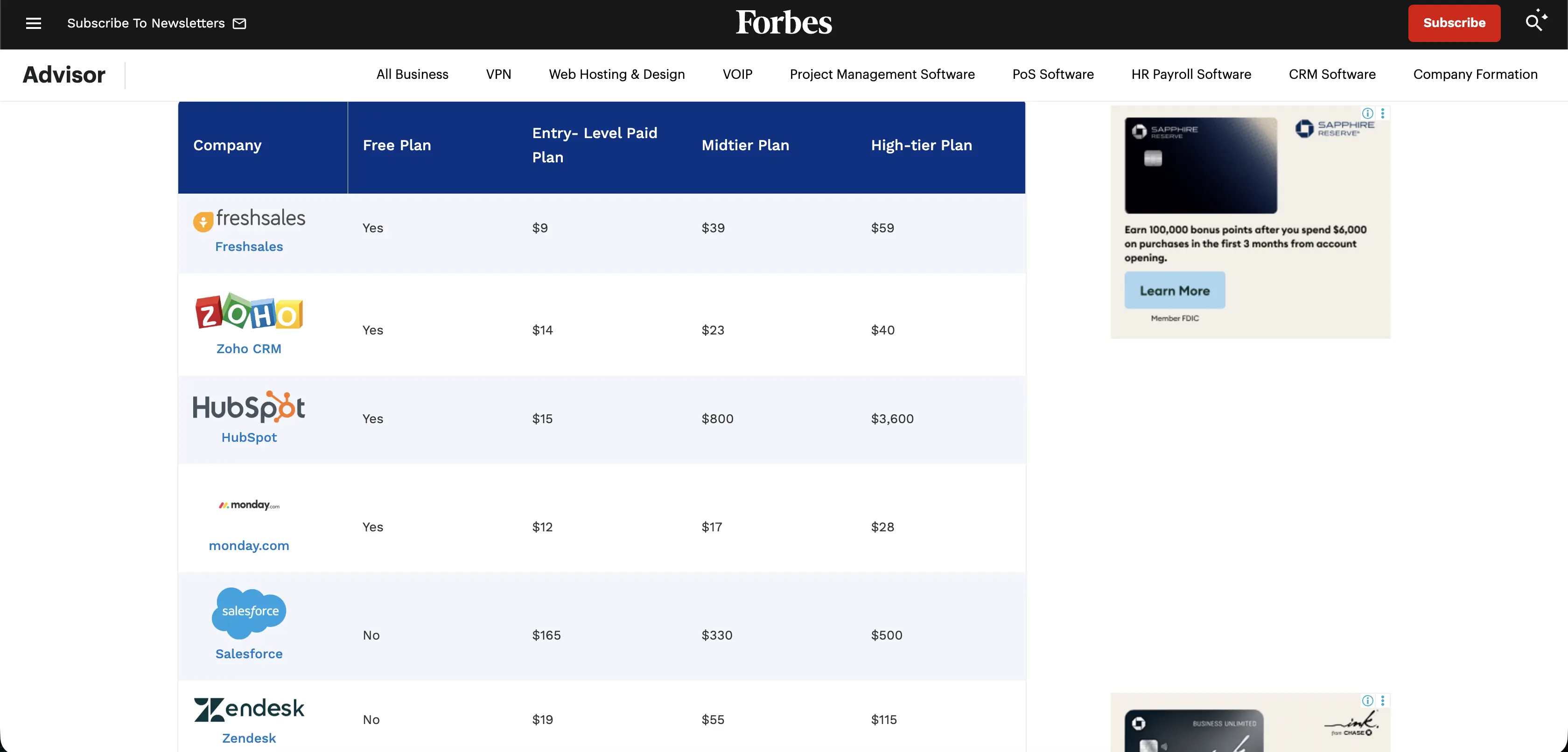
One widely cited independent CRM buyer's guide, still ranking for broad CRM pricing searches, lists Salesforce at $165, $330, and $500 across its three tiers.
That is not this year's Core, Advanced, and Max ladder ($195, $395, $550). It is not even last year's Enterprise and Unlimited numbers; most of the search pages are still quoting.
A comparison chart covering six or more tools at once goes stale faster than any single vendor's own page, because updating one number is a five minute fix and updating six is a research project most guides never repeat.
AI is not one line item. It is three different pricing models wearing the same word
"AI credits" means something different at every vendor that uses the phrase, and two vendors here do not use it at all.
Vendor | How AI is priced | What's included | Rolls over? |
|---|---|---|---|
HubSpot | Monthly credit allowance | 500 / 3,000 / 5,000 credits by tier, $9 per 1,000 extra | No, resets each month |
Salesforce | Bundled annual Flex Credits | 500,000 / 1,000,000 / 2,750,000 by edition, roughly $500 per 100,000 more | Part of the yearly Flex Credit pool |
Close | Monthly credit allowance, pooled per account | 500 to 2,000 per user, pool stops growing at 10 seats | No, resets each month |
monday CRM | One time trial grant, not a recurring allowance | 6,000 or 12,000 credits, once | Never refills, an add on has to be purchased |
Zoho CRM | No credit system, feature gated by tier | AI agents now included from Standard up | Not applicable |
Pipedrive | No credit system, feature gated by tier | Import assistant and report builder on every plan; email AI on Premium and Ultimate only | Not applicable |
The monday CRM row is the one worth reading twice. monday's own support article calls the 6,000 credits a "trial," used once and gone. Not monthly.
A separate monday support article for its Smart Call calling feature bills every connected minute against that same account in AI credits, on every CRM tier. Two pages. Two different answers.
Put those two pages side by side, and monday CRM has no published monthly AI allowance at all, only a one time grant and a feature that quietly draws it down.
Nobody catches that from one chart. It takes reading two different support articles on the same vendor's site to see it.
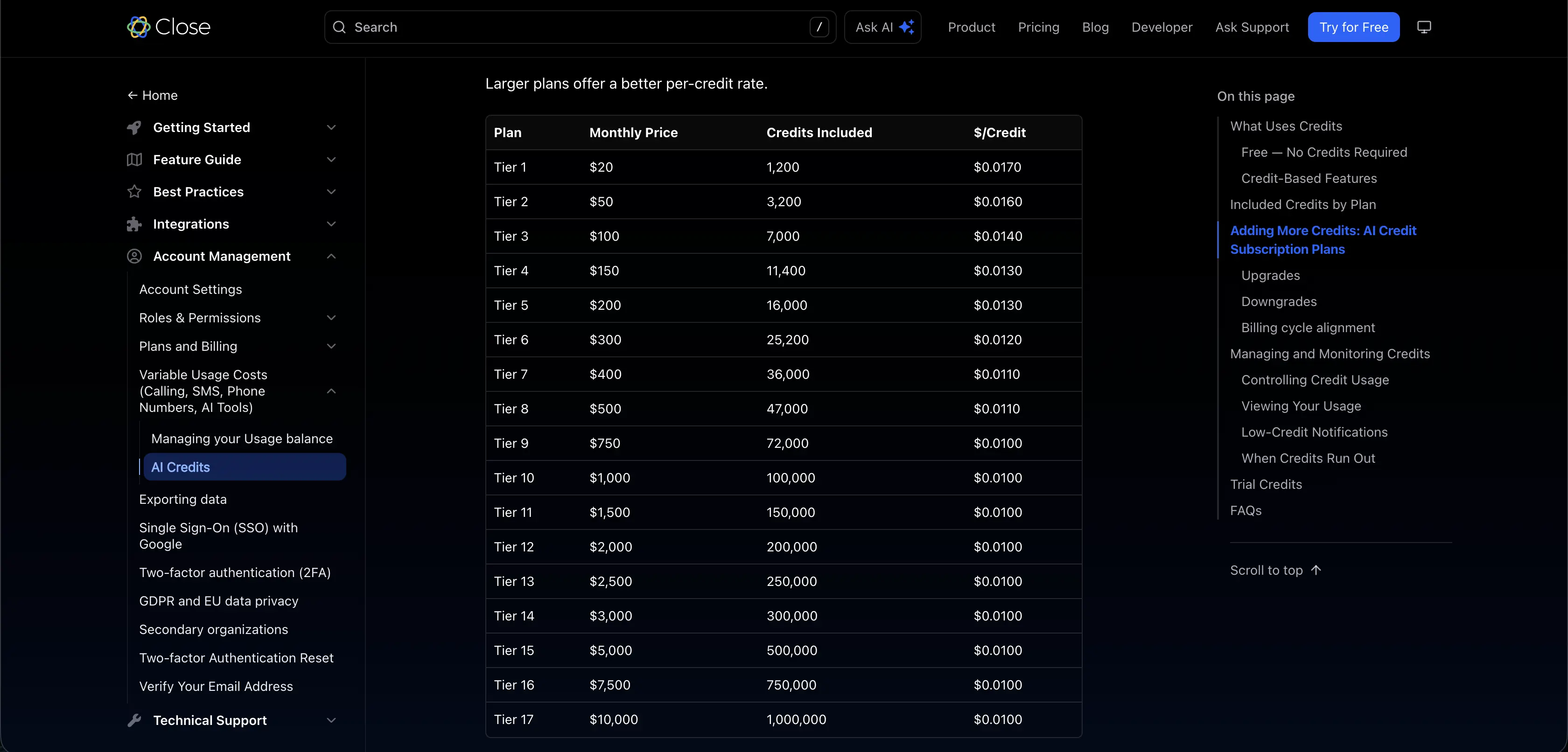
Close's version is the opposite problem. The credits are real, and they do renew. But the pool stops growing once an account passes 10 seats.
An eleven person team on Close Growth shares the exact same 15,000 monthly credits as a ten person team, so per seat AI usage drops the moment a team crosses that line, whether anyone budgeted for it or not.
Seat floors and ladders that bill for logins nobody uses
Two of the six vendors here do not let you buy exactly the number of seats your team has. Not even close, in one case.
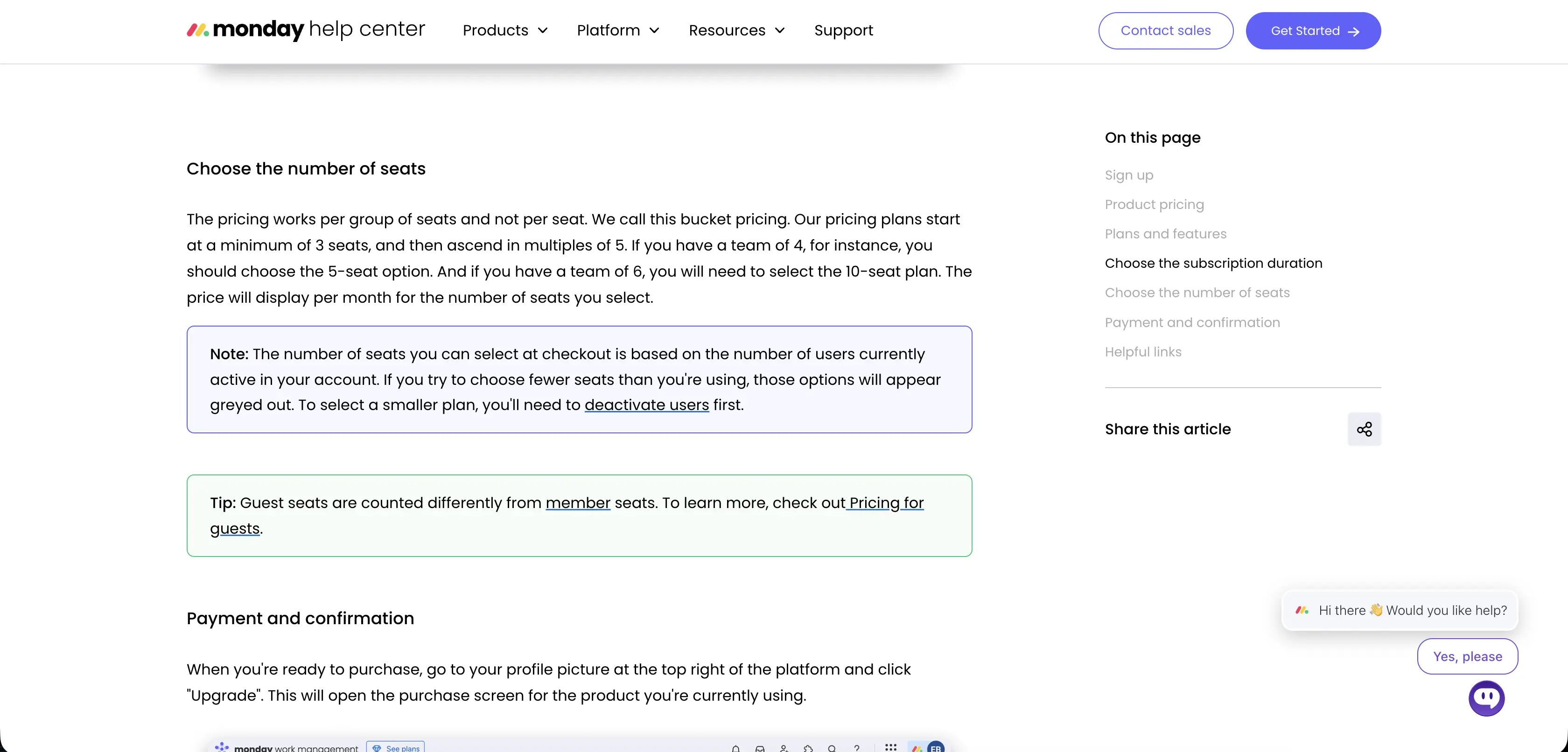
monday CRM sells seats in fixed steps: 3, 5, 10, 15, 20, 25, 30, 40, 50. There is no 4. Nothing between 30 and 40, either.
A six person team buys 10 seats. A thirty two person team buys 40.
monday's own support content describes the ladder as growing "in multiples of 5," which holds up to 30 seats and then breaks on the next rung.
Close CRM has the opposite shape of problem. Solo is capped at exactly one user, so the moment a second person joins, the plan jumps straight to Essentials, nearly four times the per seat rate on annual billing, with no smaller team tier in between.
HubSpot, Salesforce, Pipedrive, and Zoho CRM all bill per actual seat with no floor.
HubSpot has a different forced cost mechanic instead: cross your marketing contact limit by even one record and the account upgrades to the next contact tier automatically, at midnight, and stays billed there until renewal, per HubSpot's own support documentation. No warning either.
The annual discount is never the same percentage twice
"Save up to X percent" is on every one of these six pricing pages. The percentage behind it moves a lot depending on which plan you actually buy.
Close's real discount for paying yearly runs from 52.6 percent on Solo down to 6.7 percent on Scale, four different numbers behind one "up to 50 percent" claim.
Zoho's runs from 30 percent on Standard up to 34 percent on Professional, then back down to 20 percent on both Enterprise and Ultimate.
HubSpot and monday CRM are the two exceptions here. HubSpot's annual discount sits close to 10 percent on every hub that publishes both figures, and monday's sits close to 32 percent across Basic, Standard, and Pro, both about as flat as an "up to" banner can honestly be.
Salesforce and Pipedrive do not give you a clean side by side at all. Neither publishes a plain monthly, pay as you go rate next to its annual number the way the other four do, so the size of their annual discount is not something you can check on the page itself. No page, no number.
Onboarding, training, and support costs that never sit next to the seat price
The seat price is rarely the only number on the invoice in year one.
HubSpot charges a separate onboarding fee, from $1,500 on most Professional hubs up to $3,500 to $7,000 on Enterprise.
Zoho charges no flat onboarding fee. Online training runs $999 per person instead, Premium support adds 20 percent on top of the licence, and Enterprise support adds 25 percent.
Pipedrive is the one vendor here that turns this into a benefit instead of a cost: implementation is free once your annual plan clears $400 a year, which a single Growth seat does by itself.
Salesforce states plainly that implementation is not included at any tier, without naming a figure, which its own pricing article notes is often the single biggest year one line item for a mid sized team.
Close and monday CRM publish no separate onboarding charge on their standard tiers.
The six ladders, side by side
Vendor | Free plan | Entry tier (annual, per seat) | Mid tier | Highest tier |
|---|---|---|---|---|
HubSpot | 2 users | Starter, $7 to $20 | Professional, from $90 (hub dependent) | Enterprise, $150/seat or $3,600/mo (hub dependent) |
Salesforce | No (nonprofits excepted) | Starter Suite, $25 | Pro Suite $100 or Core $195 | Max, $550 |
Pipedrive | No, 14 day trial | Lite, $14 | Growth $39 or Premium $59 | Ultimate, $79 |
Zoho CRM | 3 users | Standard, $14 | Professional, $23 | Ultimate, $52 (CRM Plus bundle, $57) |
Close CRM | No, 14 day trial | Solo, $9 (1 seat only) | Essentials $35 or Growth $99 | Scale, $139 |
monday CRM | No, 14 day trial | Basic, $12 (3 seat floor) | Standard, $17 | Pro $28, Ultimate by quote |
Each row here is one tier of one vendor. Nothing more. The full breakdown for each, including every add on covered above plus a handful more specific to that tool, lives on that vendor's own pricing guide, linked in each section above and again below. No guesswork.
If what you actually want out of this page is a single winner for a small team rather than the full anatomy of all six, our best CRM software for small business roundup already runs that comparison at the cheapest working seat across ten tools, this one included.
Which of these six actually fits your situation
AI usage is the reason you're comparing these tools at all.
Look closer. Check whether the vendor bills it as a monthly meter (HubSpot, Salesforce, Close) or a one time grant that quietly runs dry (monday CRM) before assuming "AI included" means the same thing twice.
Your team is under 10 people, and you're deciding between Close and monday CRM specifically.
Both bite hardest at small headcounts, just in opposite directions: Close's one seat Solo tier jumps to nearly four times the price the moment you hire a second person, and monday's 3 seat floor bills a two person team for a login nobody uses.
You expect to cross 30 seats on monday CRM within the next year.
Check the ladder now. The jump from 30 to 40 is the steepest step in the whole structure, and there is nothing to buy in between.
You're about to sign an annual contract on Close or Zoho CRM.
Pull the plan specific discount percentage first. Not the "save up to" banner. Both range from single digits to more than 50 percent depending on which tier you're actually buying.
You're budgeting a first year total, not a monthly number.
Add onboarding, training, or the support surcharge from the section above before comparing any two of these six on seat price alone.
You run a nonprofit.
Salesforce's Power of Us program gives 10 free licences, monday CRM gives 10 free Pro seats plus 70 percent off beyond that, and both HubSpot and Zoho run separate nonprofit pricing tracks outside their public tiers.
None of the four public price pages mention this without you asking.
CRM pricing comparison Questions
How much does CRM software cost per user per month?
Across these six vendors, a workable paid seat runs from $9 (Close Solo, capped at one user) to $28 (monday CRM Pro) before AI usage, add ons, or onboarding. Salesforce starts higher. Its entry seat is $25, and its highest tier reaches $550.
Is a free CRM plan actually free, and when do you outgrow it?
HubSpot's free plan has no time limit for up to two users, and Zoho CRM's free plan covers three users indefinitely. Both stay real working tools at that size.
The limit shows up in automation and reporting, which sit behind a paid tier on both.
What's the cheapest way to run a 10 or 20 person team, once seat floors are counted?
Zoho CRM, Pipedrive, HubSpot, and Salesforce all charge per actual seat with no floor, so a 10 or 20 person bill is exactly that many seats.
monday CRM's ladder already covers both sizes cleanly at 10 and 20. Close is the one to check by hand, since its AI credit pool stops growing at 10 seats regardless of headcount.
Do CRM AI credits roll over month to month?
No. Not on any of the six. HubSpot and Close both reset unused credits at the start of the next cycle. monday CRM's 6,000 or 12,000 credit grant is not monthly at all. It is a one time trial that never refills.
Why does the same CRM show a different price on different comparison sites?
Plan renames are the biggest reason. That's it. Pipedrive, Close, and monday CRM have all renamed at least one tier in roughly the past year, and a chart covering six or more vendors at once is harder to keep current than any single vendor's own page, so older figures linger for months after the vendor moves on. Nobody circles back to fix them.
Is there a calculator for comparing CRM pricing by seat count?
Yes. Our own annual versus monthly billing calculator runs the real break even math for any of the six vendors above, and the switch and save calculator compares your current CRM against a new one over one to three years, switching costs included.
Where to start comparing
Six sticker prices are not six comparable numbers. Not once AI and seat floors enter the picture.
Once those and the plan renames above are counted, "which CRM is cheaper" stops being a single question and starts being six separate ones, one per vendor, most of which the seat price alone cannot answer.
The full breakdown for each of these six, including every add on and gotcha specific to that vendor, lives on its own page: HubSpot pricing, Salesforce pricing, Pipedrive pricing, Zoho CRM pricing, Close CRM pricing, and monday CRM pricing.
Start with whichever one you're already closest to signing, not the one at the top of a chart.
Pricing and plan mechanics checked 16 September 2026 against each vendor's own pricing page and support documentation, cross referenced against a widely cited independent CRM buyer's guide (Forbes Advisor) and a live discussion thread comparing three of these six tools on r/CRM.