
Zendesk still runs a dedicated landing page telling startups to pick Sell as their first CRM.
Zendesk's own support site says Sell and its mobile app retire on 31 August 2027. The startup page does not mention that.
That gap between marketing and documentation is the reason a "best CRM for startups" list needs a different filter than a generic small business roundup: not just what a tool costs today, but whether the discount you were promised actually shows up on the invoice, and whether the tool will still exist when your contract renews.
TL;DR
Attio and Streak both run a real free plan if you are pre seed or solo and only need to stop losing deals to spreadsheets.
Pipedrive, Close, or Zoho CRM cover the seed funded stage once you are hiring a first sales rep and want a discount program without an enterprise sales call.
HubSpot and Salesforce both run funding stage discount programs worth checking before you assume they are out of budget, and Salesforce is the one built for a 10 plus person team that needs real forecasting.
Why a generic CRM roundup does not answer this
Most "best CRM" lists rank tools by star rating or feature count, a fine filter once a company already knows its budget and headcount.
A startup doesn't know that yet, and the two numbers that matter most (what a funding-stage discount cuts your bill to, and whether the tool will still be sold next year) rarely show up in that format.
The list below is grouped by the real decision: how far along you are and how many people will touch the CRM, not by which vendor scored best on a review site.
If sticker price alone is the filter rather than funding stage, the our's broader best CRM software for small business roundup covers that comparison instead.
Startup CRM picks by stage
If you are pre seed or working solo
Attio. Free for up to 3 seats, 50,000 records, 200 sent emails a month, 50 GB of file storage, and up to 3 saved reports, per Attio's own pricing page.
There is no teams feature on the free plan, so it works until a co founder needs a second permission level. Paid seats start at $35.48 a month billed annually ($44.35 billed monthly).
Streak. Runs entirely inside Gmail, which matters if your whole stack right now is a Google Workspace inbox.
The free plan is real, but it is not a CRM in the pipeline sense: Streak's own pricing page lists it as email and link tracking, snippets, 50 mail merge sends a day, and a thread splitter, with no deal pipeline included.
Pipeline tracking starts on the Pro plan at $49 a seat a month billed annually ($59 billed monthly).
Bigin by Zoho. The cheapest named seat on this list: free for a single user capped at 500 records, per Bigin's own pricing page, then $7 a seat a month annually ($9 monthly) on the Express plan once a co founder joins.
It is a lighter product than Zoho CRM above, built for a founder tracking a first pipeline rather than running a sales team.
Once you have raised and are hiring your first rep
Pipedrive. Lite starts at $14 a seat a month, Growth at $39, Premium at $59, and Ultimate at $79, all billed annually, per Pipedrive's own pricing page. A 14 day trial needs no card.
Premium is the plan most seed stage sales teams actually land on once they need automation and revenue forecasting.
Close. Solo runs $9 a seat a month annually ($19 monthly) with 500 AI credits per seat, Essentials $35 ($49 monthly, 1,000 credits), Growth $99 ($109 monthly, 1,500 credits), and Scale $139 ($149 monthly, 2,000 credits), confirmed on Close's own pricing page.
Calling and texting are metered on top at roughly $0.02 a minute, with numbers from about $1 a month, so a founder doing outbound calling should model that add on cost before comparing sticker prices.
Zoho CRM. Free for up to 3 users, which covers a founding team before the first sales hire.
Paid tiers run Standard, Professional, Enterprise, and Ultimate; Zoho's pricing page geo prices by billing address, and the USD figures most recently confirmed there run roughly $14, $23, $40, and $52 a user a month annually ($20, $35, $50, and $65 monthly).
Copper. Built as a Google Workspace native CRM, living inside Gmail and Calendar rather than a separate tab. Basic runs $23 a seat a month annually ($29 monthly) capped at 2,500 contacts, Professional $59 ($69 monthly) at 15,000 contacts, and Business $99 ($134 monthly) with unlimited contacts, per Copper's own pricing page.
Folk. A lighter relationship tracker popular with founders who came from a spreadsheet of warm intros. Standard runs $24 a member a month annually ($30 monthly), Premium $48 ($60 monthly), and Enterprise from $80 ($100 monthly), per Folk's own pricing page.
There is no permanent free plan, only a two week trial with no card required.
monday CRM. Basic starts at $12 a seat, Standard at $17, and Pro at $28, with Ultimate by quote, per monday's own pricing page.
Every plan requires at least 10 purchased seats, so it suits a team already past its first few hires rather than a two person founding pair.
Freshsales. Growth runs $9 a user a month annually, Pro $39, and Enterprise $59, confirmed on Freshworks' own pricing page, one of the widest jumps between an entry tier and the next rung on this list.
Once you are past Series A with a real sales floor
Salesforce. Free Suite is $0, Starter Suite $25 a user a month, Pro Suite $100, and the Core, Advanced, and Max editions run $195, $395, and $550 a user a month billed annually, all confirmed on Salesforce's own pricing page.
This is the tool built for forecasting and investor style reporting across a 10 plus person floor, not for a two person founding team.
If your team is technical or leans product led
Attio again, this time for its API and its native support for tracking usage and product events alongside contacts, rather than the free tier alone.
Clay, addressed in its own section below, since it is not actually a CRM.
What HubSpot for Startups and Salesforce Launchpad actually pay out
HubSpot and Salesforce both discount startups, and the two programs pay out in almost opposite ways once you read the actual terms rather than the headline percentage.
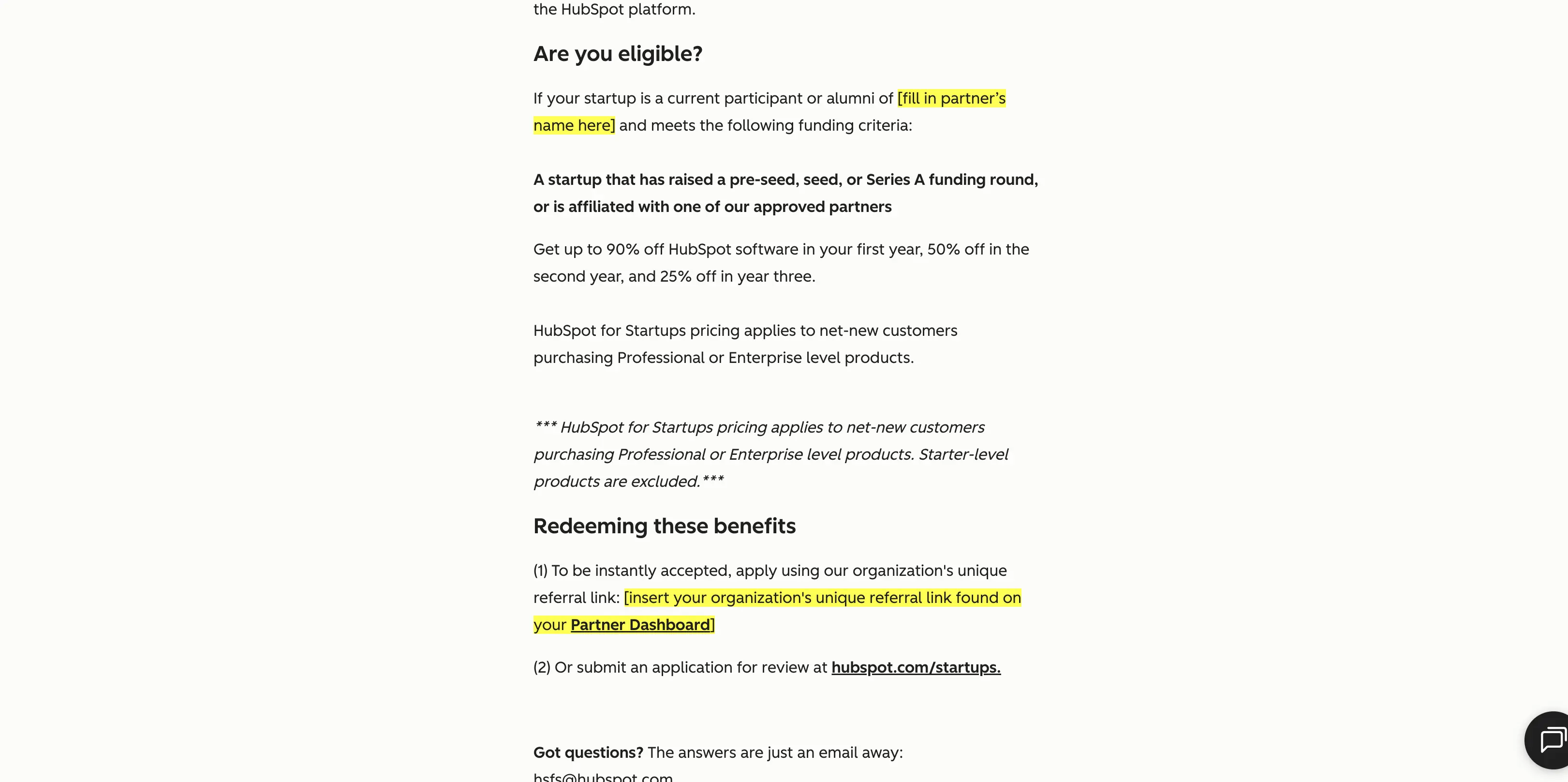
HubSpot's top track cuts 90 percent off year one, 50 percent off year two, and 25 percent off year three, confirmed on HubSpot's own startup program page.
It requires either verified pre seed, seed, or Series A funding checked against Crunchbase or Pitchbook, or an approved partner referral from HubSpot's directory of more than 4,000 accelerators and VC firms.
A lower track, 30 percent off year one and 15 percent off year two, covers startups affiliated with an approved entrepreneurial organization without direct funding verification.
Both tracks apply only to Sales Hub Professional or Enterprise, require an annual commitment, and are for net new customers only. HubSpot's full Sales Hub tier breakdown covers what a seat costs once list price returns.
On HubSpot's own Trustpilot page, rated 1.5 out of 5 across more than 1,100 reviews, a recurring complaint is the size of the jump between the cheapest paid plan and the next tier up, with reviewers pointing out there is functionally nothing priced between the low end and several hundred dollars a month. That is exactly the gap the math below is meant to close.
Run the math on Sales Hub Professional at $100 a seat a month for a 5 person team: $6,000 a year at list price.
On the 90 percent track, that is $600 in year one, $3,000 in year two, and $4,500 in year three before it returns to list price.
On the 30 percent track, it is $4,200 in year one and $5,100 in year two.
Salesforce Launchpad is the opposite shape. Salesforce's own program page states plainly that there is no cost to join, and that members get access to "exclusive Salesforce discounts," without publishing a single percentage anywhere on the page.
It is application only, with no stated minimum funding stage or VC backing requirement, reviewed by Salesforce's team within 5 business days.
A startup comparing the two programs on paper can see HubSpot's exact numbers before applying and cannot do the same with Salesforce's, a gap worth knowing before spending an afternoon on either application.
Salesforce's own Core, Advanced, and Max tier breakdown covers what the discount would apply against.
Why Zendesk Sell will not make it to 2027
Zendesk's own support site confirms it directly: "Zendesk Sell and Sell mobile app will be retired on August 31, 2027." The announcement went up on 9 September 2025, and Zendesk named Pipedrive as the official migration partner, with Pipedrive built migration tools for the transition.
Zendesk's dedicated CRM for startups landing page, still live, makes no mention of any of this.
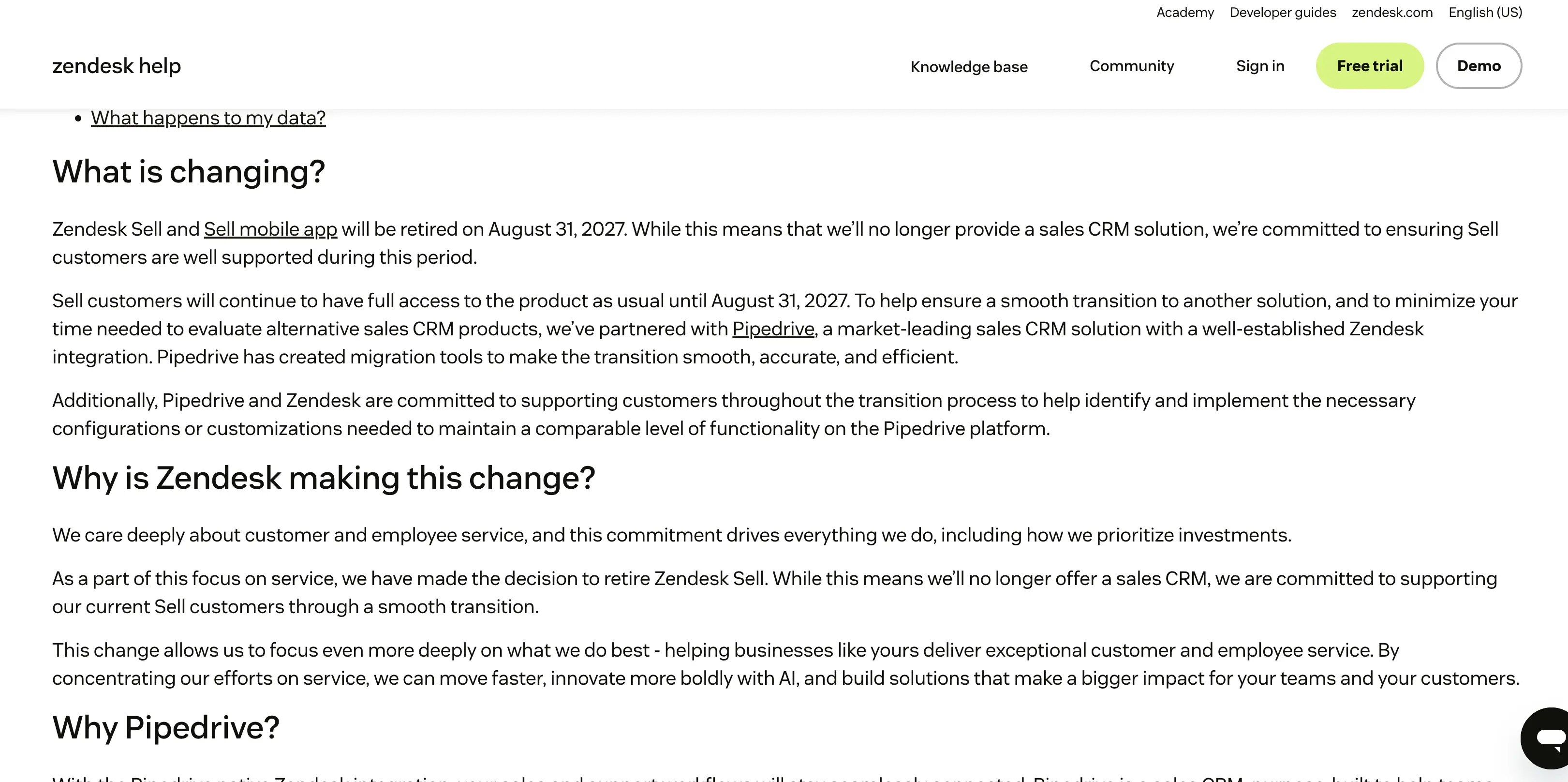
It promotes Sell as a startup's first CRM and even runs its own comparison of other vendors' startup discounts on the same page, with no note that its own product is on a fixed retirement clock.
A startup picking a CRM today needs a tool that will still be sold when the contract comes up for renewal in two or three years, and Sell is not that tool regardless of its current price.
The free CRM plans that are not full CRMs
"Free CRM for startups" is one of the most searched phrases around this topic, and the free plans worth checking are not all free in the same way.
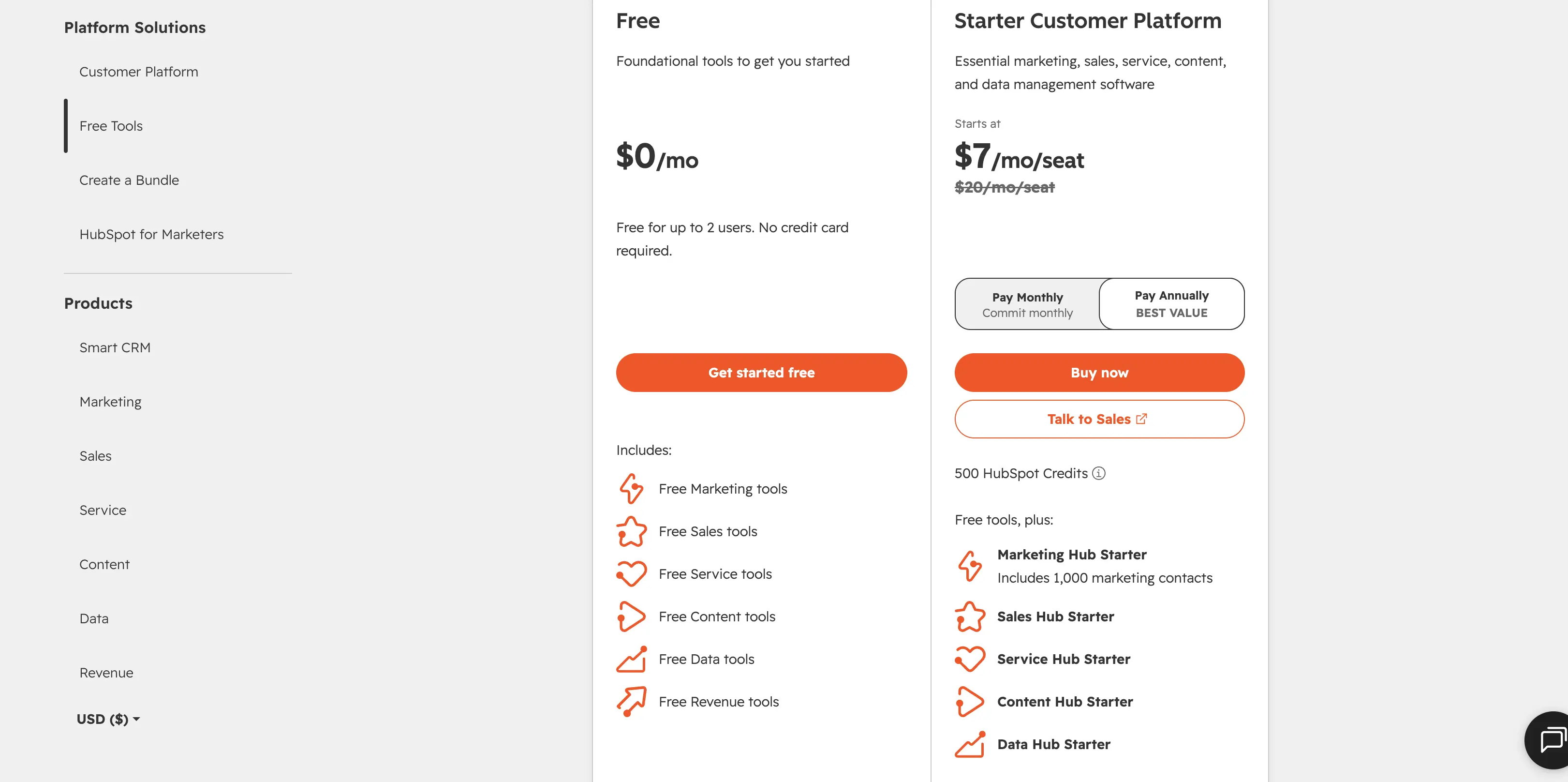
HubSpot's free CRM caps out at 2 users and 1,000 contacts, a hard stop that arrives sooner than an "unlimited" framing might suggest.
Attio's free plan allows up to 3 seats but no teams feature, plus caps on records, sent email, and storage, all listed above.
Streak's free plan, as shown on its own pricing page, does not include pipeline tracking at all: it is an email and mail merge tool wearing a CRM's name, and the deal pipeline only starts on the $49 a month Pro plan.
None of that makes these plans bad picks. It means the honest comparison is what each free tier actually lets you do, not whether the word "free" appears on the page.
Is Clay a CRM, or something else?
Clay's own homepage never calls it a CRM. It is built and marketed as a go to market automation and data platform, in its own words, for teams that "build and scale any GTM play... to grow pipeline, win deals, and expand customers," combining contact enrichment from more than 150 data providers with workflow automation.
Clay shows up on startup CRM searches because early sales teams use it to build and enrich a lead list before that list ever lands in a real pipeline tool like the ones above.
Clay's free plan runs 500 actions and 100 data credits a month at $0. Launch starts at $167 a month for 15,000 actions and 2,500 credits, and Growth at $446 a month for 40,000 actions and 6,000 credits, per Clay's own pricing page, with Enterprise by quote.
A technical early team often runs Clay alongside Attio or Pipedrive rather than instead of one; it fills the list-building step neither of those tools is built for.
One more split worth a single line: some "CRM for startups" searches actually mean an investor and fundraising tracker rather than a sales CRM, a separate category covered by tools like Visible.vc.
Everything in this guide is about the sales and customer side, not the cap table and investor update side.
Which stage you are actually shopping for
Pre seed or solo: start with Attio's free plan or Streak inside Gmail, and skip a paid seat until you have a repeatable sales process worth tracking.
Just closed a funded round, hiring your first account executive: apply to HubSpot for Startups before assuming Sales Hub Professional is out of reach, and weigh Pipedrive, Close, and Zoho CRM's own prices against the discounted HubSpot number, not the list price.
Past Series A with a sales floor of 10 or more: submit a Salesforce Launchpad application even though it will not show the discount upfront, since Core at $195 a seat a month is the realistic entry point at that headcount either way.
Technical or product led team: pair Attio's API with Clay for list building rather than hunting for one tool that does both.
FAQ
Do startups need a CRM?
Once deals stop fitting in one founder's memory or a shared spreadsheet, yes. Most of the picks above have a genuine free or near free tier, so the honest cost of starting early is mostly setup time, not budget.
What is the best free CRM for startups?
Attio's free plan (3 seats, 50,000 records) and HubSpot's free plan (2 users, 1,000 contacts) are the two real options. Streak's free plan is worth knowing about but does not include pipeline tracking, so it is not a full free CRM on its own.
How much does a CRM cost a startup in year one?
It depends entirely on whether a discount program applies. A 5 seat HubSpot Sales Hub Professional plan runs $600 in year one on the top HubSpot for Startups track versus $6,000 at list price, a gap most sticker price comparisons never show. The site's cross vendor CRM pricing comparison runs the same math for HubSpot, Salesforce, Pipedrive, Zoho, Close, and monday CRM side by side.
When should a startup switch CRMs?
The clearest trigger is a seat minimum or contact cap you are about to hit, not a fixed headcount number. monday CRM's 10 seat purchase minimum or HubSpot's 1,000 contact free cap are both concrete moments to reassess, well before a generic "you have grown out of it" feeling sets in.
Is Zendesk Sell being discontinued?
Yes. Zendesk confirmed on its own support site that Sell and its mobile app retire on 31 August 2027, with Pipedrive named as the migration partner, even though Zendesk's startup marketing page does not mention it.
Is Clay a CRM or a data enrichment tool?
Clay markets itself as a go to market automation and data platform, not a CRM, and most teams run it alongside a real pipeline tool rather than in place of one.
Where each pick actually lands
Pricing and features verified 28 September 2026 from each tool's official pricing page.
CRM | Free tier or trial | Real starting price | Startup discount |
|---|---|---|---|
Attio | Free, 3 seats | $35.48/seat/mo annual | None published |
Bigin by Zoho | Free, 1 user | $7/seat/mo annual | None published |
Streak | Free, no pipeline | $49/seat/mo annual | None published |
Pipedrive | 14 day trial | $14/seat/mo annual | None published |
Close | 14 day trial | $9/seat/mo annual | None published |
Zoho CRM | Free, 3 users | ~$14/user/mo annual | None published |
Copper | Free trial | $23/seat/mo annual | None published |
Folk | 2 week trial | $24/member/mo annual | None published |
monday CRM | Free trial | $12/seat/mo, 10 seat minimum | None published |
Freshsales | Free trial | $9/user/mo annual | None published |
HubSpot | Free, 2 users | $20/seat/mo (Starter, list) | Up to 90% years 1 to 3 |
Salesforce | Free Suite, $0 | $25/user/mo (Starter Suite) | Undisclosed, apply to see |
Clay (not a CRM) | Free, 500 actions/mo | $167/mo (Launch) | None published |
Where to start
Funding stage decides more of this than any feature list does. A free Attio or Streak account costs a pre seed founder nothing but setup time.
A funded seed stage team gets more from ten minutes on a HubSpot for Startups application than from another hour comparing star ratings.
A startup with an actual sales floor should weigh Salesforce's Core price against what a Launchpad application might cut it to, not against the free tier it outgrew two hires ago.