
A Make scenario with five modules, run 10,000 times a month, uses 50,000 credits.
On Make's yearly Core plan, that lands on the 80,000-credit tier at $55 a month. Activepieces counts the same 10,000 runs as 10,000 credits, at $16 a month on yearly billing.
If your Make bill grew after credits replaced operations, a tool that counts runs instead of steps is the fix to price first.
Make (make.com, formerly Integromat) is a visual automation builder. You join apps with steps called modules, and a chain of modules is a scenario. This page is about Make, the automation tool, not the Linux make command.
Pricing and features verified 7 Oct 2026 from each tool's official pricing page. Every price below names its basis. Yearly is paid for the whole year up front. Monthly is paid month to month.
Findings
Activepieces: a whole run is one credit, regardless of how many steps it has. Plus is $20 monthly or $16 on yearly billing for 10,000 credits.
n8n: a whole run is one execution. Pro is $50 a month on yearly billing for 10,000 executions, and the self-hosted Community Edition costs nothing to run.
Zapier: easiest to learn, and it counts only successful action steps. The 10,000 task plan is $129 a month on yearly billing.
Latenode: no base fee, and the first 10,000 seconds of run time each month are free.
Why people leave Make now
Make switched its billing unit from operations to credits on 27 Aug 2025, announced on its community forum. One credit is one module action, so a long scenario costs more every time it runs.
Make's pricing page says a single run can use anywhere from two credits to thousands.
The pain shows up in two places. The first is the monthly limit, because credits run out before the month does. The second is the price of going over, covered below.
Developers who write about leaving, such as this Dev.to migration write up, say Make suits quick builds. Once workflows became business critical, they wanted more control and a choice of hosting.
How much does Make cost at 10k, 80k, and 150k credits?
Make sells one pool of credits per month, and the price depends on the plan and on how you pay.
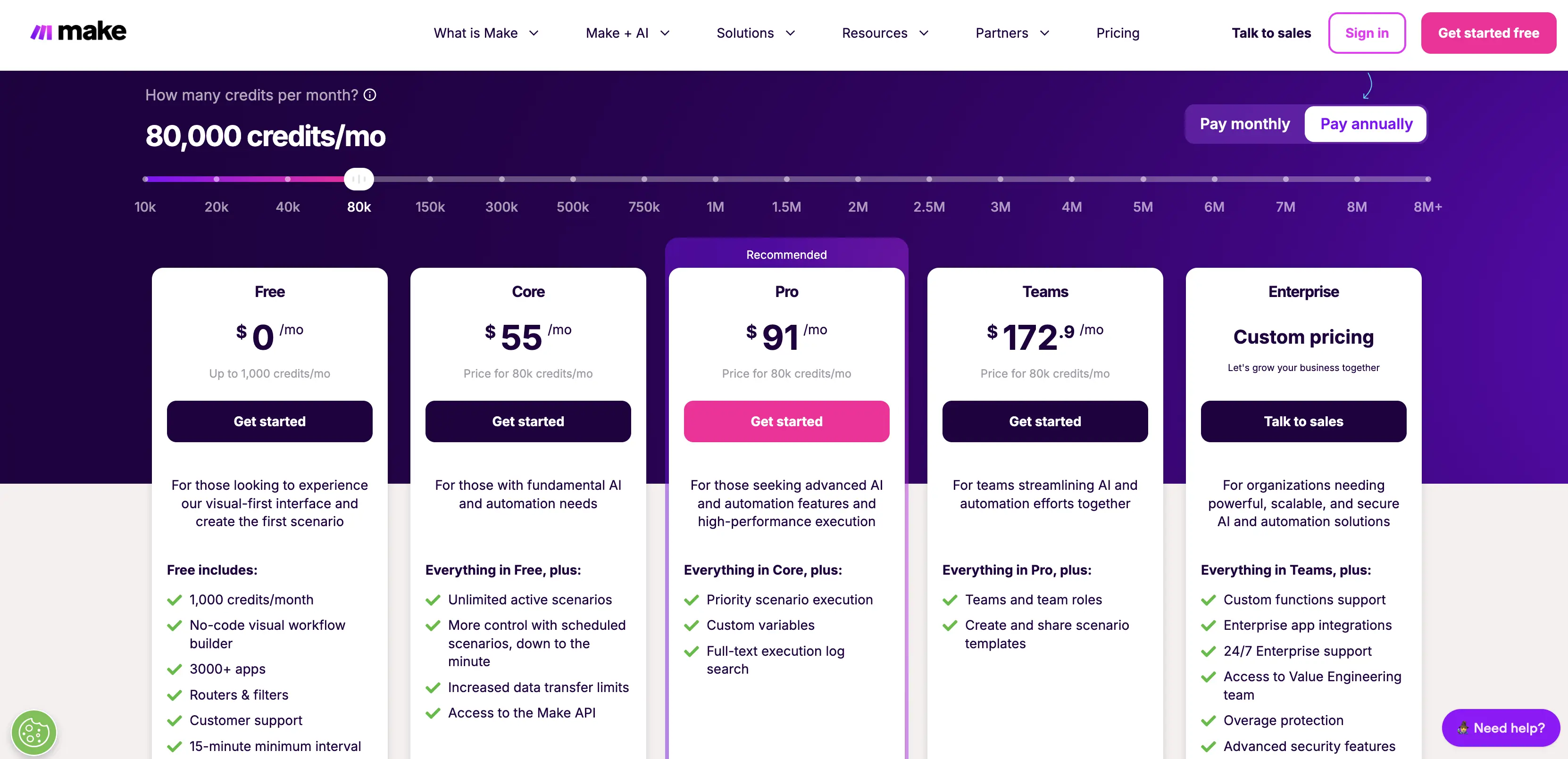
Credits per month | Core, yearly | Core, monthly | Pro, yearly | Pro, monthly |
|---|---|---|---|---|
10,000 | $9 | $10.59 | $16 | $18.82 |
80,000 | $55 | $64.71 | $91 | $107.06 |
150,000 | $99 | $116.47 | $153.45 | $180.53 |
At 40,000 credits on monthly billing, Core is $34.12, Pro is $62.35, and Teams is $116.47.
Teams costs $29 a month at 10,000 credits on yearly billing and $291.56 at 150,000.
Many roundups print "$9" or "$10.59" with no basis, and those are the same plan on different billing.
What happens when Make credits run out?
Scenarios stop unless you buy more. Make's help center says that "All extra credits include a 25% additional cost", whether you buy them by hand or automatically. The pricing page FAQ still says extra credits come at the fixed price in your subscription. The help page is newer (updated 15 Sep 2026), so plan on the 25% rate.
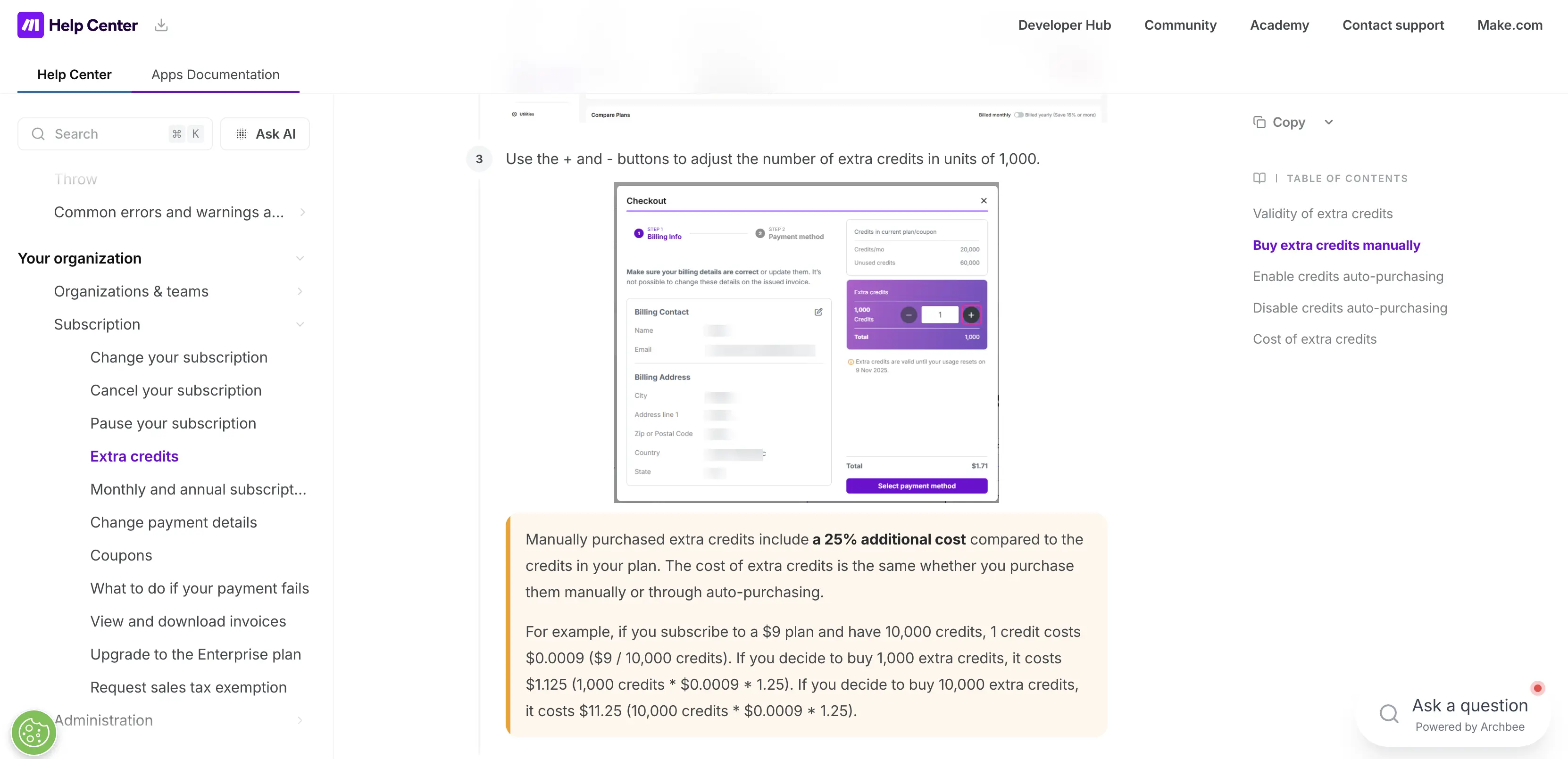
Auto purchase is opt in, and it buys 10,000 credits at a time.
Take the $9 plan: one credit costs $0.0009, so 10,000 extra credits cost 10,000 x $0.0009 x 1.25 = $11.25.
One credit over your limit can cost more than the plan itself. On a monthly basis ($10.59), the same step is $13.24.
Auto purchase also has a ceiling. It stops at the number of credits in your plan per cycle, so an 80,000 credit plan can auto buy 8 times.
If a card payment fails, scenarios pause until you fix it.
Credits also expire. On Core with yearly billing, regular credits reset every month, and extra credits expire at each reset.
The plan table lists credits that last 12 months as a separate feature, and only Pro, Teams, and Enterprise carry it.
Is Make cheaper than Zapier or n8n at the same volume?
It depends on how the tool counts. Make counts every module. Zapier counts successful action steps only, and triggers, filters, and paths are free. n8n and Activepieces count the whole run once.
Here is one scenario: a trigger plus four actions, run 10,000 times a month.
Tool | What it counts | Count for 10,000 runs | Price on its own page | Basis |
|---|---|---|---|---|
Make | Credits, one per module | 50,000 credits | Core, 80,000 credit tier: $55 | Yearly ($64.71 monthly) |
Zapier | Tasks, successful actions | 40,000 tasks | Starts at $129 for 10,000 tasks, so more at 40,000 | Yearly ($193.50 monthly) |
n8n | Executions, one per run | 10,000 executions | Pro: $50 | Billed annually |
Activepieces | Credits, one per run | 10,000 credits | Plus: $16 | Yearly ($20 monthly) |
Latenode | Seconds of run time | 10,000 seconds at 1 second a run | $0 at 1 second, $4.80 at 5 seconds | No base fee |
The Latenode math at 5 seconds a run: 10,000 runs use 50,000 seconds, the first 10,000 are free, and the other 40,000 cost $0.00012 each, which is $4.80.
Your own run time sets the real number. For a deeper look at per-task pricing, see the Zapier alternatives guide.
Why does Make credit use run higher than expected?
Credits follow actions, and some actions cost more than one. Make's pricing FAQ says the Code app uses 2 credits per second, and AI modules use a variable number.
Routers and error handler modules cost nothing.
So a scenario that calls an AI model or runs code can burn credits far faster than its module count suggests.
Count your modules per run first, then add the AI and code steps on top.
A per run tool such as n8n or Activepieces hides that step count completely, which is why long scenarios look cheaper there.
Can you export a Make scenario and rebuild it elsewhere?
Yes, partly. Make's blueprint help page describes an Export blueprint option that saves a scenario as a JSON file. The file is limited to 2 MB, and your app connections are not included, so you sign in to every app again.
The file is in Make's own format. A community-built converter for n8n, posted 5 Jun 2026, turns blueprints into n8n JSON, and its author offers 5 conversions to try.
A reply in the same thread warns that some conversions look right at import. They fail only when the workflow runs, so you have to run it to catch them.
The Dev.to write up suggests a safer order. List every scenario by trigger and complexity, and rebuild the simple ones first.
Run both tools side by side before you switch off Make.
Best Make alternatives, grouped by what you need
Ten alternatives to Make.com are below. Relay.app is missing on purpose: it shut down in September 2026 and deleted all accounts, though older roundups still list it.
Closest to Zapier's simplicity
Zapier
Price: Professional at 10,000 tasks is $129 a month on yearly billing, or $193.50 monthly.
Free is 100 tasks.
Best for: people who left Make for simplicity. Zapier is an automation tool built around short chains of apps called Zaps.
It is easy to learn, and failed steps do not use tasks.
Integrately
Price: Professional at 10,000 tasks is $39 a month billed annually, or $49 billed monthly.
Best for: non technical users who want ready made automations. Integrately is an automation tool with one click templates.
Each completed action, search, condition check, or data change counts as a task, so counts rise quickly on long chains.
Albato
Price: Free gives 100 transactions, with 5 active automations and 2 steps each.
Paid plans sell transaction packs, with yearly billing saving up to 30%.
Best for: small teams that like per-step counting. Albato counts every step after the trigger as a transaction.
If you go over your pack, extra transactions cost 50% more, against Make's 25%.
IFTTT
Price: Pro is $2.99 a month billed annually, or $4.99 monthly. Pro+ is $8.99 billed annually, or $14.99 monthly.
Best for: light personal automations. IFTTT is a service that links apps through small rules called Applets.
Free allows 2 Applets, Pro allows 20, and Pro+ is unlimited with filter code. It has no credits at all.
Cheaper when scenarios have many steps
n8n
Price: Pro is $50 a month billed annually for 10,000 executions. Starter is $20 for 2,500. Business is $800 for 40,000 and is self hosted only.
Best for: technical teams. n8n is a workflow tool that counts one execution per run, with unlimited steps.
You can self host n8n on your own server, and its Community Edition is free on GitHub.
See what n8n costs at your number of runs, or other tools for people who find n8n too technical.
Activepieces
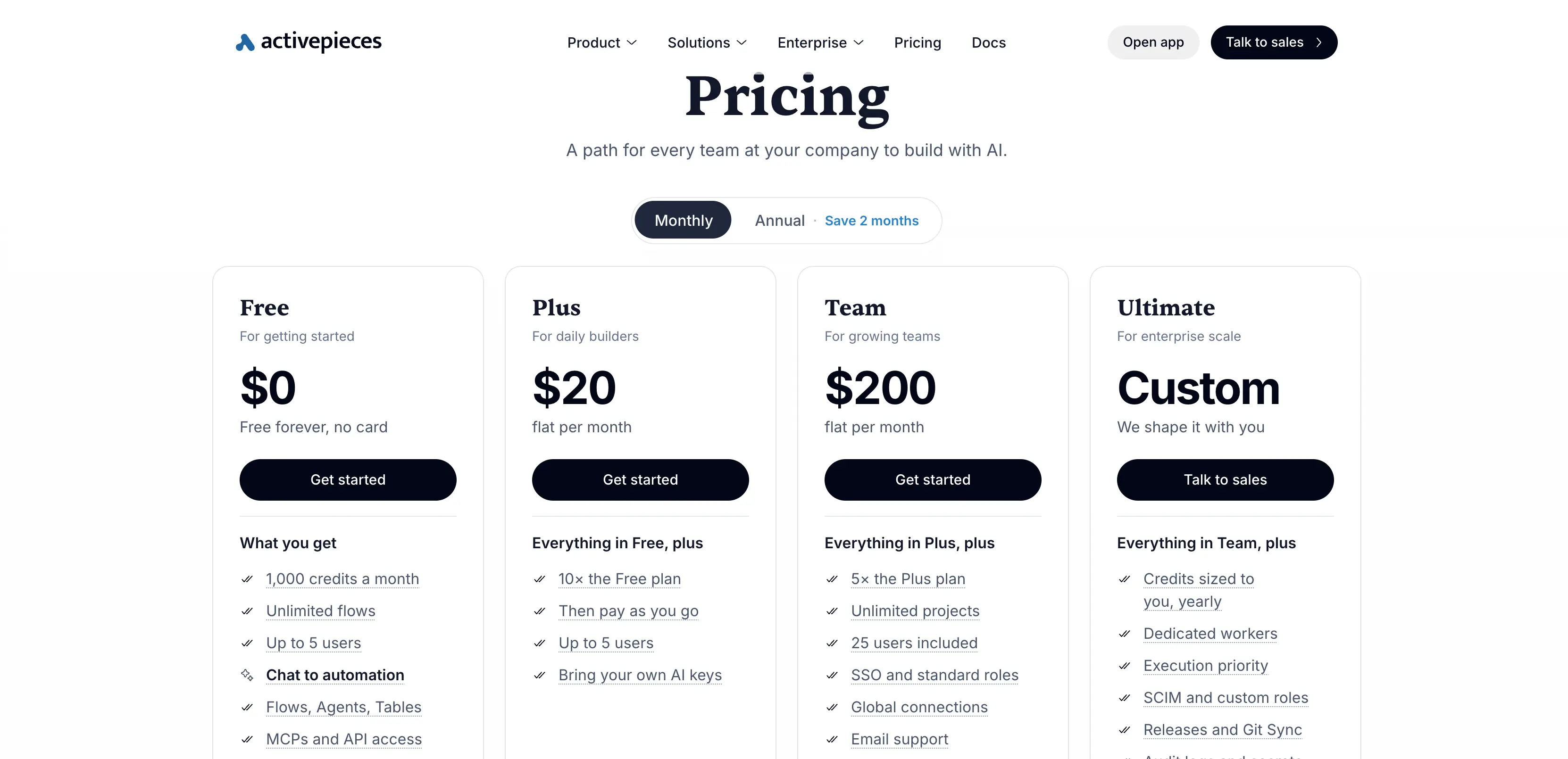
Price: Plus is $20 a month on monthly billing for 10,000 credits, or $16 on yearly billing. Team is $200 monthly for 50,000. Extra credits cost $0.007 each.
Best for: teams that want open source and flat counting. Activepieces says a run is one credit however many steps it has.
AI steps cost 2, 10 or 20 credits depending on the model. Free gives 1,000 credits a month.
Latenode
Price: no base fee, 10,000 CPU seconds free each month, then $0.00012 per second up to 100,000.
Best for: many short runs with several steps. A CPU second is one second of computing time.
Latenode charges for run time, not for each node, so quick scenarios stay cheap and slow ones do not.
Developers, Microsoft shops and AI agents
Windmill
Price: Community Edition is free, self-hosted, with unlimited executions and up to 10 users on SSO. Paid plans exist.
Best for: developers who write scripts. Windmill is open source and runs scripts and flows. Cloud pricing is based on compute units.
Power Automate
Price: Premium is $15 per user per month, paid yearly. Process is $150 per bot per month, paid yearly.
Best for: Microsoft 365 companies. Power Automate is Microsoft's automation tool. A bot here is an unattended automation that runs with no person present.
Pricing is per user or bot, with no step count.
Lindy
Price: Plus lists $29.99 per user per month with 3,000 credits per user. Pro lists $99.99 with 15,000.
Best for: teams that want an AI agent inside Slack. Lindy is an AI agent tool.
Its agents work inside Slack threads and mentions, and it offers scheduled routines.
Where Make still wins
At low volume, Make is the cheapest on this page. Its Free plan has 1,000 credits a month with no time limit. Core gives 10,000 credits for $9 a month on yearly billing, while Zapier's 10,000 task plan is $129.
A two-module scenario run 5,000 times fits inside those 10,000 Make credits, and Zapier would count 5,000 tasks for it.
Make also gives you 3,000+ apps, a visual builder, and free routers. If you keep scenarios short and stay under your credit limit, there is little reason to move.
Pro, Teams, and Enterprise also let yearly credits last 12 months.
Which Make alternative fits you
You run one or two short scenarios on Free or Core. Stay on Make and watch your credit count.
You are a small team past 40,000 credits. Price Activepieces Plus and n8n Pro against Make Pro at your own volume. The switch and save calculator does the arithmetic.
You are rebuilding scenarios by hand or by converter. Choose n8n or Activepieces, rebuild the simple scenarios first, and keep Make running until the new tool matches.
You want something as simple as Zapier. Pick Zapier or Integrately and accept the higher price per step.
You live in Microsoft 365. Power Automate prices by user, so the step count stops mattering. For a wider view, read the best iPaaS platforms with real prices.
You write code. Windmill, or n8n on your own server, gives you the most control.
FAQ
Do unused Make credits roll over?
Not on most plans. Core on yearly billing resets credits every month.
Credits that last 12 months are a plan table feature on Pro, Teams, and Enterprise only.
Extra credits last to the end of your billing cycle, or your billing year on yearly plans, except on Core where they expire monthly.
Which is better, n8n or Make?
Make has a visual builder and 3,000+ apps. n8n counts a run as one execution and offers a free self hosted edition.
I'd pick n8n for long scenarios and a team that can handle some setup, and Make for short ones.
Are there free or open source alternatives to Make.com?
Yes. Activepieces and Windmill describe themselves as open source on their own pages. n8n has a free self hosted Community Edition.
Zapier Free gives 100 tasks, Activepieces Free gives 1,000 credits, and Latenode gives 10,000 free seconds each month. Make's own Free plan gives 1,000 credits.
What happened to Integromat?
Integromat is the old name of Make. The company moved billing from operations to credits on 27 Aug 2025, and old operation counts converted automatically.
Is there a Make alternative to Zapier that is just as simple?
Zapier and Integrately are the closest. Both use short chains of steps and ready made templates.
Both cost more per step than Make at low volume.
Where to start
Count the modules in your busiest scenario, then multiply by its monthly runs. If the result is under 10,000, stay on Make.
If it is over 40,000, price a per-run tool at your real volume before you pay for extra credits.