

ClickUp is the cheapest real switch, since its free plan covers unlimited members with no seat count to round up. Smartsheet is the pick if your team lives in spreadsheets and needs real resource planning. ProofHub is the one flat bill, at $45 a month no matter how many people you add.
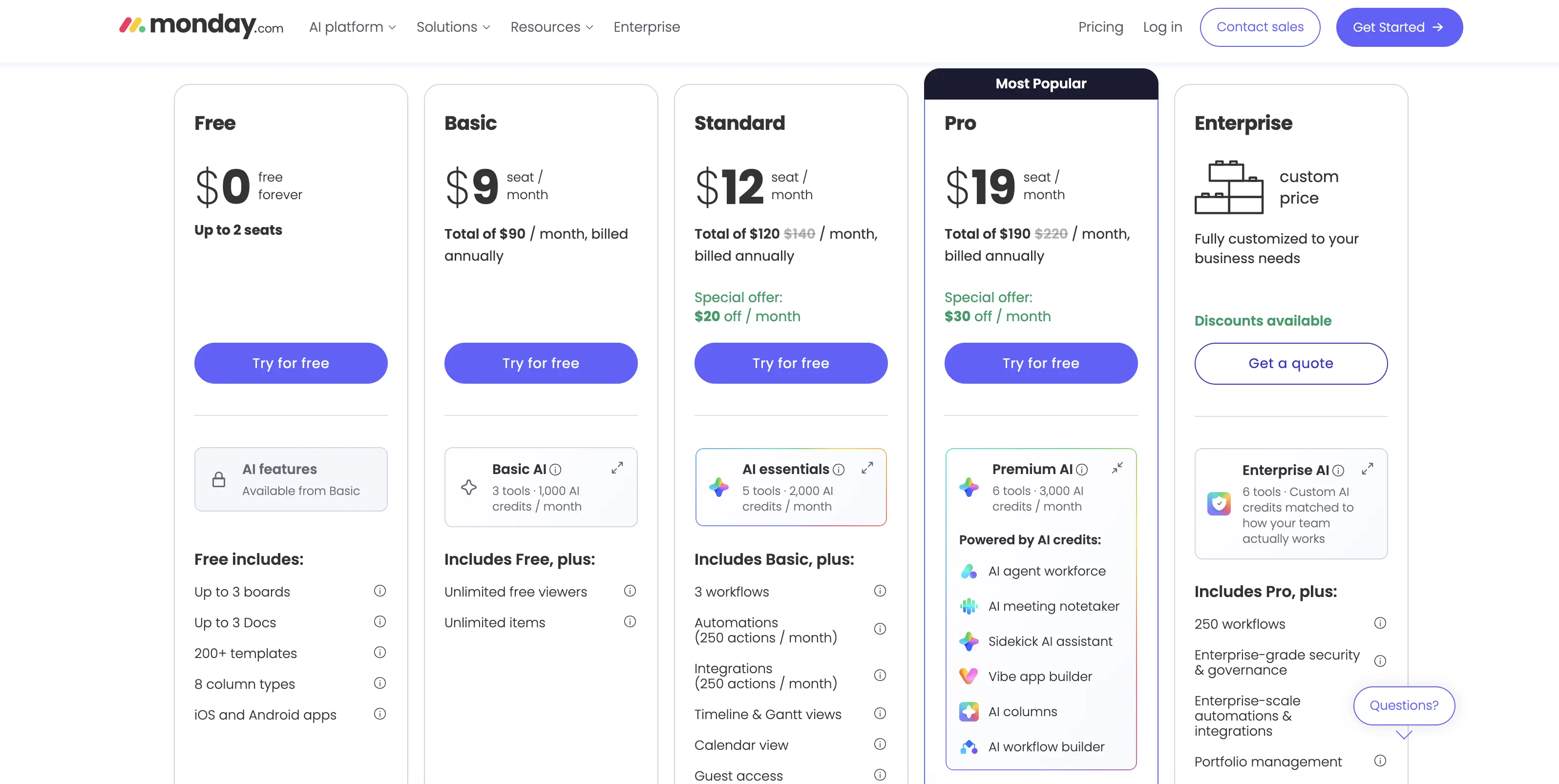
I priced 12 monday.com alternatives against a 4 person team's actual checkout screen this month, not just the number on the pricing page. monday.com's own Basic plan sells in buckets of 3, 5, 10, and 15 seats, so a 4 person team cannot buy 4 seats. Checkout forces you up to 5, turning a $36 bill into $45 a month, billed annually, for one seat nobody uses. That gap between sticker price and real invoice is the part most alternatives roundups skip, so I ran it for all twelve tools below.
Why teams start looking for a monday.com alternatives
monday.com is a work management platform, software that organizes tasks, timelines, and team boards into one shared workspace, and it earns its reputation for looking good fast. The trouble shows up at billing time. monday.com's own support documentation confirms the seat structure directly: "We call this bucket pricing." Plans start at a 3 seat minimum, then jump in fives, so a 6 person team pays for 10 seats whether the extra 4 logins get used or not.
Customers describe the same pattern. monday.com's Trustpilot page carries roughly 3,000 reviews and a 4.3 star average, with most praise going to the visual boards and automations. The complaints cluster in one place: pricing that looks simple on the marketing page and gets harder to justify once admin controls and deeper features turn out to sit behind a higher tier than expected.
None of that makes monday.com a bad work management platform. It just means the real question is not what monday.com costs, it is what monday.com costs for the team size you actually have, and that is the number the rest of this guide runs for every pick. Bucket pricing is monday.com's version of a problem that shows up across the category, which is why I priced the best project management software in 2026 on real per seat cost and free plan caps rather than the number on the marketing page.
The 12 best monday.com alternatives in 2026
Grouped by why a team actually switches, since the cheapest pick rarely matches the right pick for a data heavy operations group.
Cheapest way off monday.com
1. ClickUp
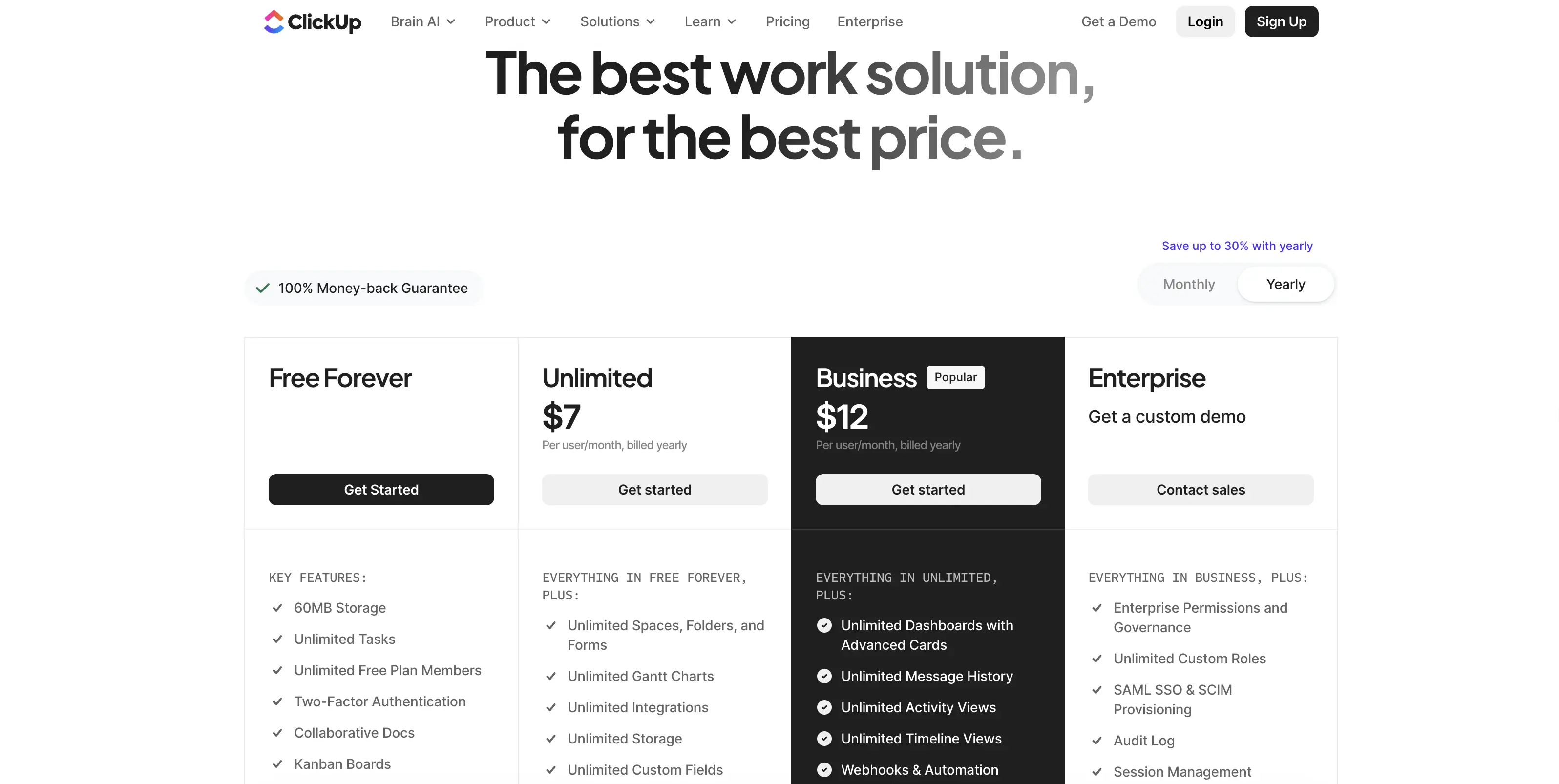
Price: free for unlimited members, or $7/seat a month for Unlimited, billed annually. Best for: a 4 person team that wants to pay nothing.
ClickUp is a project and task management tool combining boards, docs, and goals in one workspace. Its free plan covers 4 people at $0, with a 100MB storage cap as the real limit rather than a headcount. Sprints and Agile points for dev teams sit inside ClickUp natively, the same angle our Jira alternatives guide covers from a different starting point.
2. Zoho Projects
Price: $4/user a month for Premium, billed annually. Best for: the lowest real bill among the paid tiers.
Zoho Projects is a task and timeline tool built into the wider Zoho suite. Premium prices out at $16 a month for 4 people, under half of monday.com's forced $45, with Gantt charts and time tracking included standard rather than gated behind a higher plan.
3. Trello
Price: $5/user a month for Standard, billed annually. Best for: teams who want kanban boards and nothing else.
Trello is a kanban style board tool where tasks move across columns as cards, without the timelines and dashboards monday.com bundles by default. A 4 person team lands at $20 a month on Standard, or $0 on the free plan. Our Trello alternatives guide compares Trello itself against 12 other picks for teams who outgrow it.
Built for bigger teams and reporting
4. Smartsheet
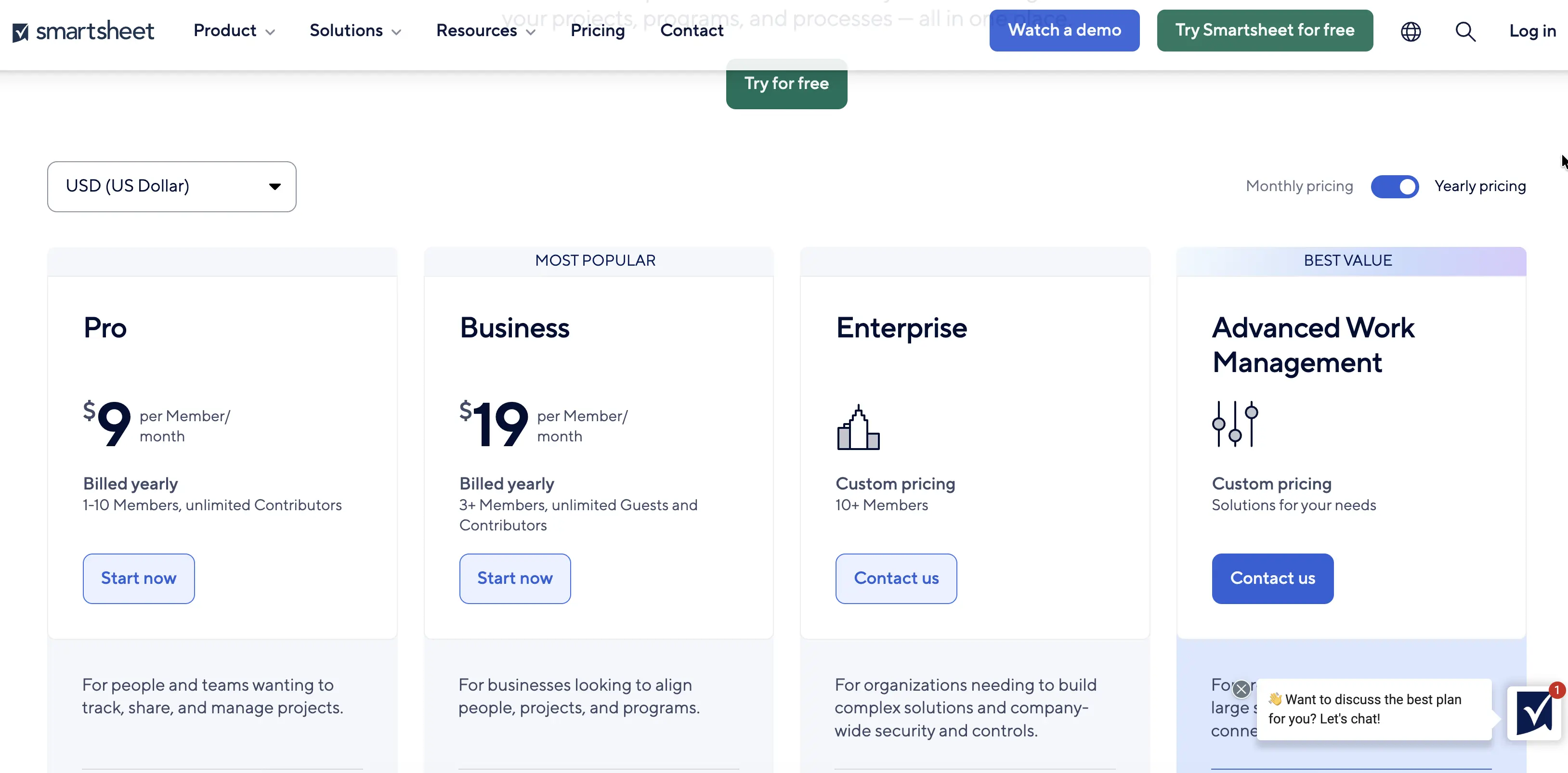
Price: $9/user a month for Pro, billed annually. Best for: resource planning inside a spreadsheet a finance team already trusts.
Smartsheet is a spreadsheet style work management tool with grid, Gantt, and card views. A 4 person team pays $36 a month on Pro, the same figure monday.com's bucket rounding produces, except every seat gets used. Resource management and workload views on the Business tier answer exactly what shows up in searches for the best monday.com alternatives for resource planning.
5. Wrike
Price: around $10/seat a month for Team, billed annually. Best for: teams that need SSO and two factor authentication without an enterprise contract.
Wrike is a work management platform with custom workflows and approval chains for teams managing several projects at once. Single sign on and two factor authentication sit on the Business tier, features monday.com's lower tiers do not cover, though Business carries its own 5 seat minimum.
6. Asana
Price: $10.99/user a month for Starter, billed annually. Best for: goal tracking layered on top of task boards.
Asana is a task and project tool built around timelines, portfolios, and team goals rather than freeform boards. A 4 person team runs $43.96 a month on Starter, just under monday.com's forced $45, with automation included up to 250 actions monthly.
Docs, whiteboards, and creative work
7. Notion
Price: $10/user a month for Plus, billed annually. Best for: teams that want docs and tasks in the same tool.
Notion is a docs and workspace tool layering task boards, wikis, and databases on flexible pages instead of fixed templates. A 4 person team pays $40 a month on Plus, with AI features bundled into the $20 a seat Business tier since Notion folded its separate AI add on into that plan earlier this year.
8. Airtable
Price: $20/seat a month for Team, billed annually. Best for: database driven workflows with a spreadsheet feel.
Airtable is a database and spreadsheet hybrid where records carry attachments, linked tables, and custom views. It costs more than monday.com's Standard tier at $80 a month for 4 people, but seat charges apply only to editors, so read only collaborators join free.
9. Hive
Price: $5/user a month for Starter, billed annually. Best for: proofing and approval workflows for content teams.
Hive is a project management tool with proofing built in, so reviewers mark up a file directly instead of leaving comments elsewhere. A 4 person team pays $20 a month on Starter, Gantt charts included from the entry tier. Add ons like time tracking cost a further $5 per user each, so a heavily customized setup can climb past monday.com's price.
Client work and predictable billing
10. Teamwork.com
Price: $10.99/user a month for Deliver, billed annually. Best for: agencies billing client hours by the project.
Teamwork.com is a project management tool built for client work, with time tracking and budgets tied directly to profitability reporting. A small agency running 4 seats pays $43.96 a month, and the billing tools answer exactly what shows up in searches for the best monday.com alternatives for small agencies.
11. Basecamp
Price: $15/user a month, or a flat $299 a month for Pro Unlimited with any number of users, billed annually. Best for: teams past about 20 people who want one predictable bill.
Basecamp is a project and team communication tool built around message boards and to do lists instead of Gantt charts. At 4 people, the per user plan at $60 a month beats the flat tier, though agencies adding contractors as guests cross into flat rate territory faster than headcount alone suggests.
12. ProofHub
Price: a flat $45 a month for Essential, unlimited users included, billed annually. Best for: matching monday.com's forced 5 seat bill without a seat cap.
ProofHub bills one flat price regardless of headcount. A 4 person team pays exactly what monday.com's bucket rounding would charge for 5 seats, $45 a month, except the 6th, 10th, and 20th person all join free. Ultimate Control moves to $89 a month flat for unlimited projects, still with no per seat math to run.
Best monday.com alternatives for project management
For classic project management work, timelines, dependencies, and cross team reporting, Smartsheet and Wrike carry the most depth of any tool here, with Asana close behind for teams that weight goals over spreadsheet style grids.
All three replace monday.com's boards without losing the reporting a growing team ends up needing.
How to pick the right monday.com alternatives
If you run a creative or content team, Airtable or Hive fit best, since linked records and built in proofing solve problems monday.com's boards were never built to handle.
If your team is 4 or 5 people and budget is the whole decision, ClickUp's free plan or Zoho Projects at $4 a seat beat monday.com's forced bucket pricing without cutting core features.
If you are a software development team, ClickUp's Sprints and points, or Wrike's Agile templates, cover the workflow monday.com's general boards leave you to build yourself.
If you run a small agency doing client work, Teamwork.com's budgets and time tracking answer a question monday.com only gets to with extra configuration.
If your team works under compliance requirements, Wrike's Business tier bundles single sign on and two factor authentication that monday.com reserves for its higher priced plans.
monday.com alternatives compared
Tool | Starting price | Free plan | Seat billing model |
|---|---|---|---|
monday.com (the subject) | $9/seat/mo | 2 seats only | Buckets of 3, 5, 10, 15 |
ClickUp | $0 | Yes, unlimited members | Per seat above free |
Zoho Projects | $4/seat/mo | Yes, limited | Per seat |
Trello | $0 | Yes, limited features | Per seat above free |
Smartsheet | $9/seat/mo | No, 30 day trial | Per seat |
Wrike | $10/seat/mo | Yes, limited | Per seat, 5 seat minimum on Business |
Asana | $10.99/seat/mo | Yes, up to 10 users | Per seat |
Notion | $10/seat/mo | Yes, limited | Per seat |
Airtable | $20/seat/mo | Yes, limited | Per editor seat, viewers free |
Hive | $5/seat/mo | Yes, up to 10 members | Per seat, plus paid add ons |
Teamwork.com | $10.99/seat/mo | Yes, limited | Per seat |
Basecamp | $15/seat/mo | No, 30 day trial | Per seat, or flat $299 unlimited |
ProofHub | $45/mo flat | No, 14 day trial | Flat, unlimited users |
Where monday.com still wins
None of this makes monday.com the wrong choice for every team. Its automation builder and template library run deeper than most tools above, and teams that want work management next to a CRM and a service desk under one login get a level of bundling that switching tools cannot fully replace. The catch is that this depth gets billed by the seat bucket, not the person actually using it.
FAQ: monday.com alternatives
What are the best monday.com alternatives?
ClickUp, Smartsheet, and ProofHub top this list for different reasons: ClickUp for cost, Smartsheet for reporting depth, and ProofHub for a flat bill that never changes as the team grows.
Is there a free alternative to monday.com?
Yes. ClickUp's free plan allows unlimited members, and Trello, Asana, Notion, Airtable, and Hive all offer permanently free tiers, not just trials, though each caps a different feature.
What's the cheapest monday.com alternative for a small team?
Zoho Projects at $4 a seat a month is the cheapest paid tier here, with ClickUp's free plan beating it outright for teams under Zoho's feature ceiling.
Does monday.com charge for unused seats?
Yes, in effect. Bucket pricing sells seats in groups of 3, 5, 10, and 15, so a team that does not land exactly on one of those numbers pays for seats above its real headcount.
Is monday CRM the same as monday.com work management?
No. monday CRM is a separate sales focused product built on the same platform. Our monday CRM alternatives guide covers that product on its own, since the pricing and the competitors differ from the work management tool covered here.
Which monday.com alternative is best for software development teams?
ClickUp and Wrike both include dedicated Agile and sprint tools, closer to what a dev team gets from Jira than from a general work management board.
What I'd actually install
For a 4 person team watching every dollar, ClickUp's free plan is the easiest switch to make this week, since nothing about it expires the way a trial would. If reporting and resource planning matter more than the price tag, Smartsheet earns the $9 a seat it charges.
And if the team is about to grow past 6 or 10 people and you would rather never run this seat math again, ProofHub's flat bill is the one plan here that gets simpler, not more expensive, every time you add someone.