
Skyvia is six separate products: Data Integration, Automation, Backup, Query, Connect, and a Looker Studio connector, each with its own free plan, paid tiers, and limits. Nobody else mentions this, and it changes whether you need to switch or just need to stop paying for a bundle you assumed was one product.
If you want the closest like for like swap, Airbyte gives you a free, open source core with 200 plus connectors.
If you only need Skyvia's backup product replaced, Boomi's pay as you go plan starts at $99 a month with no contract. If you've outgrown no code tools completely, MuleSoft and CData both handle jobs Skyvia was never built for.
Why I priced every Skyvia product separately
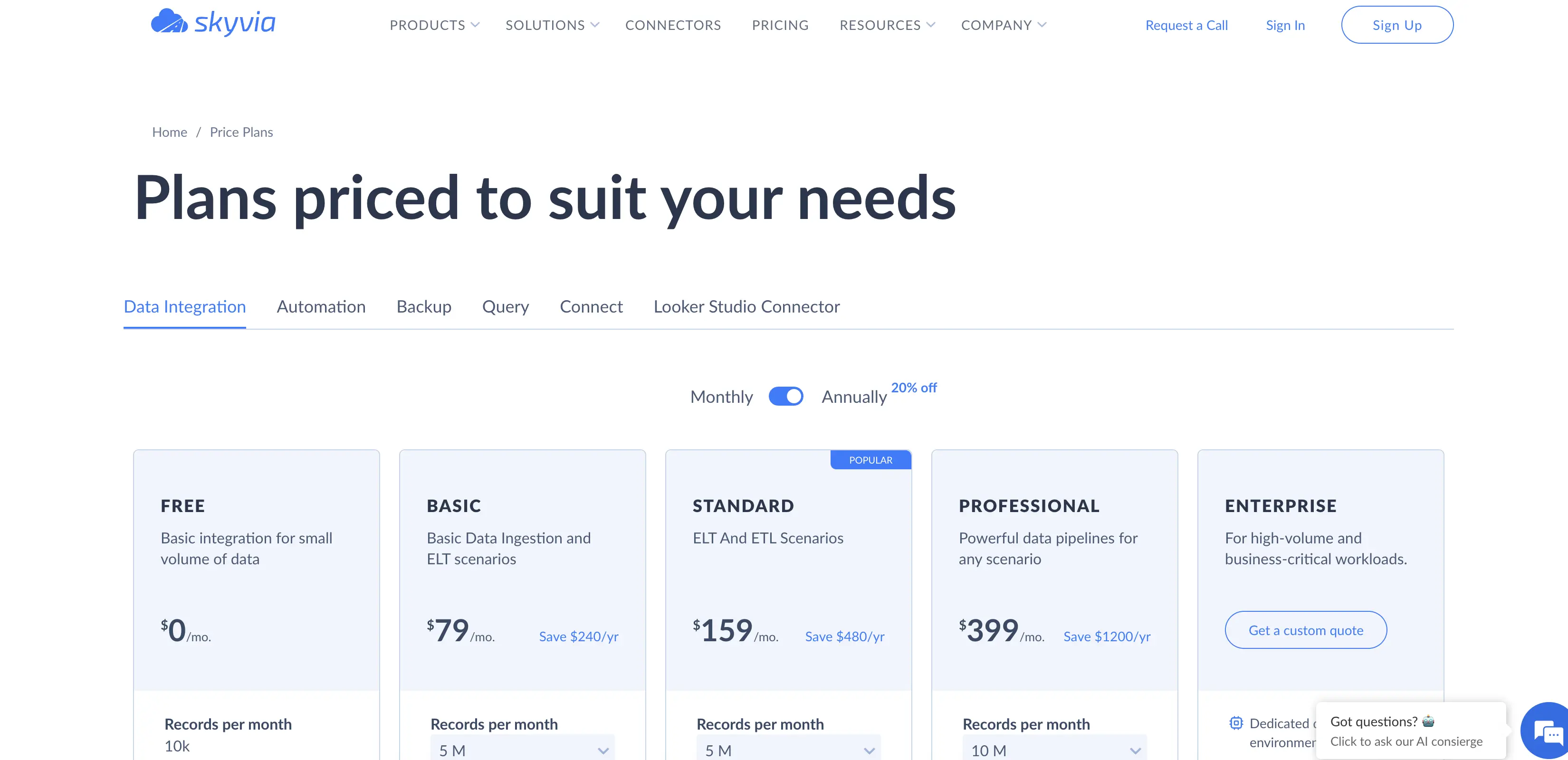
Data Integration Basic runs $79 a month billed annually. Automation Standard is a separate $99. Backup Standard is $7. Query and Connect are $15 each, and the Looker Studio connector is another $28 on its own line.
Add up the products a typical small team uses, integration plus backup plus automation, and you're closer to $185 a month than the $79 figure that shows up in most comparison charts. That's not a hidden fee, Skyvia lists every number on its own site.
The real reason people look for a Skyvia alternative
Skyvia is well liked for good reason. Reviewers on Capterra hold it at a 4.9 out of 5 average across 116 reviews, and ease of use comes up again and again. Duy T., a Senior Data Analyst who reviewed it on Capterra, called it "the easiest ELT ETL tool to use."
So people searching for an alternative usually aren't unhappy with it. They're hitting a limit, like the free plan's 10,000 records a month, or paying for a product, Backup or Automation, a cheaper standalone tool would cover alone.
That's the split this article follows: swap the whole platform, or replace just the one product you use.
Best Skyvia Backup alternative if you only need the backup piece
If Skyvia Backup is the only product you use, replacing the whole platform to fix a backup problem is overkill.
Boomi's pay as you go plan starts at $99 a month, no contract, and covers backup style scheduled jobs, a reasonable swap if you also want room for automation later. For a lower bill, compare Skyvia's own Backup Professional tier against a dedicated SaaS backup tool sized to the apps you actually run.
Skyvia's free Backup plan caps out at 1 GB of storage and three month snapshots. If a NetSuite or Salesforce backup is the entire reason you're on Skyvia, that's the number to watch, not the ETL pricing every other article quotes instead.
Best Skyvia Automation alternatives for trigger based workflows
Skyvia's Automation product handles scheduled, event driven tasks between apps, and its free plan caps out at 1,000 tasks a month with a one day minimum interval.
If your workflows need to fire the moment something happens, n8n is the closest open source match: Community is free and self hosted, with over 200,000 stars on GitHub, and Cloud Starter runs about 20 euros a month for 2,500 executions.
Zapier covers similar ground with a lower learning curve: Free includes 100 tasks a month, Professional starts at $19.99.
Neither bundles automation with a separate integration or backup product the way Skyvia does, so you'll likely still want a dedicated ETL tool alongside whichever one you pick.
General purpose ETL and ELT alternatives
Fivetran
Fivetran is a fully managed ELT platform for analytics teams who want data landing in a warehouse with minimal upkeep.
Free includes 500,000 monthly active rows, and Standard adds 700 plus connectors with 15 minute syncs. The pick if your team already lives in Snowflake or BigQuery.
Airbyte
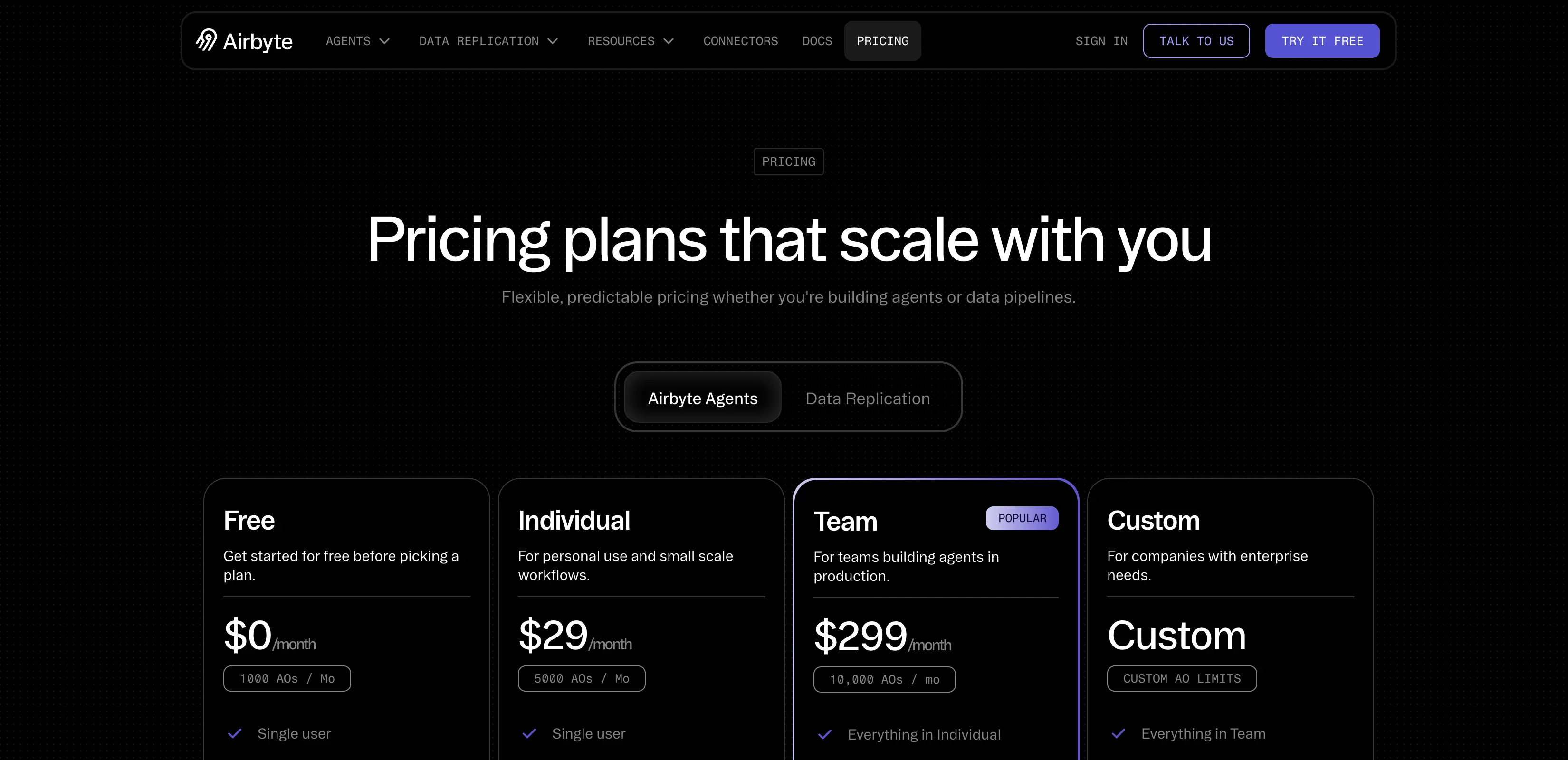
Airbyte is an open source data movement platform, and the option most Skyvia switchers land on first. Core is always free and self managed, with over 300 connectors, and Cloud Standard starts at $10 a month with volume based pricing above that.
Integrate.io
Integrate.io runs one published plan, Core, at $1,999 a month, with unlimited data volumes, unlimited pipelines, and a 60 second pipeline frequency.
It's a fixed fee rather than usage based, which some teams prefer specifically because it removes the surprise a credit based tool can produce.
Coupler.io
Coupler.io is the closest match to Skyvia's own price range and audience. Starter runs $24 a month billed annually for three accounts and one destination, and every plan, including Free, includes the same 400 plus data sources.
Talend
Talend, now sold as Qlik Talend Cloud, is an enterprise data integration and data quality platform. It publishes four tier names: Starter, Standard, Premium, Enterprise, but no public prices.
Usage is billed by data volume, job executions, and run duration, so an actual number means requesting a quote.
Skyvia vs MuleSoft: when you've outgrown no code ETL
Skyvia is a no code platform for small and mid sized teams. MuleSoft's Anypoint Platform is an enterprise integration platform built around API led connectivity, and its pricing reflects that: every tier reads "contact for pricing," with usage measured by Mule Flows and Mule Messages rather than a flat monthly number.
You move from Skyvia to MuleSoft when the problem stops being "connect these apps" and becomes "expose these systems as governed APIs across the company." A Senior Technical Lead reviewing MuleSoft on G2 in May 2026 described its licensing cost as "high enough that it becomes a difficult conversation with executives," which tracks next to Skyvia's $79 starting point.
Our separate MuleSoft alternatives comparison covers twelve enterprise grade options, several with pricing MuleSoft itself doesn't publish.
Enterprise iPaaS Skyvia alternatives
Boomi
Boomi is an enterprise iPaaS, short for integration platform as a service, connecting apps, data, and APIs. It publishes one real number: pay as you go at $99 a month plus usage, no contract. Every other plan, Professional, Professional Plus, Enterprise, needs a sales call. Boomi also acquired the DataOps platform Rivery in 2025, folding in Rivery's credit based pricing without a second vendor relationship.
Jitterbit
Jitterbit is another enterprise iPaaS, built around a visual integration designer and a low code app builder. It shows detailed feature comparisons across Standard, Professional, and Enterprise tiers, but keeps every dollar figure behind a "contact us" button.
SnapLogic
SnapLogic advertises "simple and transparent pricing" across three packages, Essential, Professional, Enterprise One, each covering unlimited pipelines and data movement.
The packages are named publicly; the prices are not, and the page still ends on a demo request. Our SnapLogic alternatives roundup goes deeper into which enterprise platforms actually show pricing upfront.
Skyvia vs CData: Querying live data instead of moving it
If you use Skyvia Query or Connect rather than the ETL side. Those two run live SQL queries or expose OData and ODBC endpoints without copying data anywhere, at $15 a month each.
CData does the same job through a large library of live connectivity drivers: Sync runs $7,999 a year for up to five connections and 100 million rows a month, or around $2.74 an hour on AWS and Azure for ten connections.
For a handful of live connections, Skyvia Query is the cheaper option by a wide margin. For a data heavy deployment across many databases, CData's per connection model can work out ahead.
Real time pipelines and DataOps alternatives
Hevo Data
Hevo Data runs a no code, real time pipeline model similar to Skyvia's own pitch. Free covers up to 1 million events a month, and Starter begins around $265 a month billed annually for higher volume tiers with 150 plus connectors.
Rivery
Rivery is a DataOps platform combining data movement with built in orchestration, now owned by Boomi after last year's acquisition. Its Base plan runs $0.90 per credit, with credits varying by source: 0.5 per API call, one per 100 MB from a database, two per 100 MB on log based change data capture. Worth knowing who backs a tool financially before you commit to it.
Skyvia Alternatives Compared
Tool | Best for | Starting price | Free plan or trial | Open source | Minimum sync interval |
|---|---|---|---|---|---|
Skyvia | Small teams wanting one no code platform | $79/mo (Data Integration) | Yes, 10,000 records/mo | No | 1 minute (Professional) |
Fivetran | Analytics teams on a warehouse | Usage based, free tier available | Yes, 500,000 rows/mo | No | 15 minutes (Standard) |
Airbyte | Open source, self managed pipelines | Free (Core), $10/mo (Standard) | Yes, always free tier | Yes | Depends on self hosting |
Integrate.io | Fixed fee, unlimited volume | $1,999/mo | No public free tier | No | 60 seconds |
Coupler.io | Budget conscious small teams | $24/mo (annual) | Yes, free forever plan | No | Daily (Starter) |
n8n | Open source automation | Free (Community), 20 euro/mo (Cloud Starter) | Yes, self hosted | Yes | Execution based |
Boomi | Entry level enterprise iPaaS | $99/mo (pay as you go) | 30 day free trial | No | Custom |
CData | Live query and connectivity | $7,999/yr (Sync Standard) | Trial available | No | Live, not scheduled |
Is Skyvia GDPR and HIPAA ready?
If you're moving healthcare or EU customer data. Skyvia's own security page states plainly that the platform is SOC 2 certified, PCI DSS compliant, complies with GDPR, and will sign a Business Associate Agreement for HIPAA data.
That's comparable to Fivetran's Business Critical tier, which adds customer managed encryption keys and PCI DSS Level 1 certification.
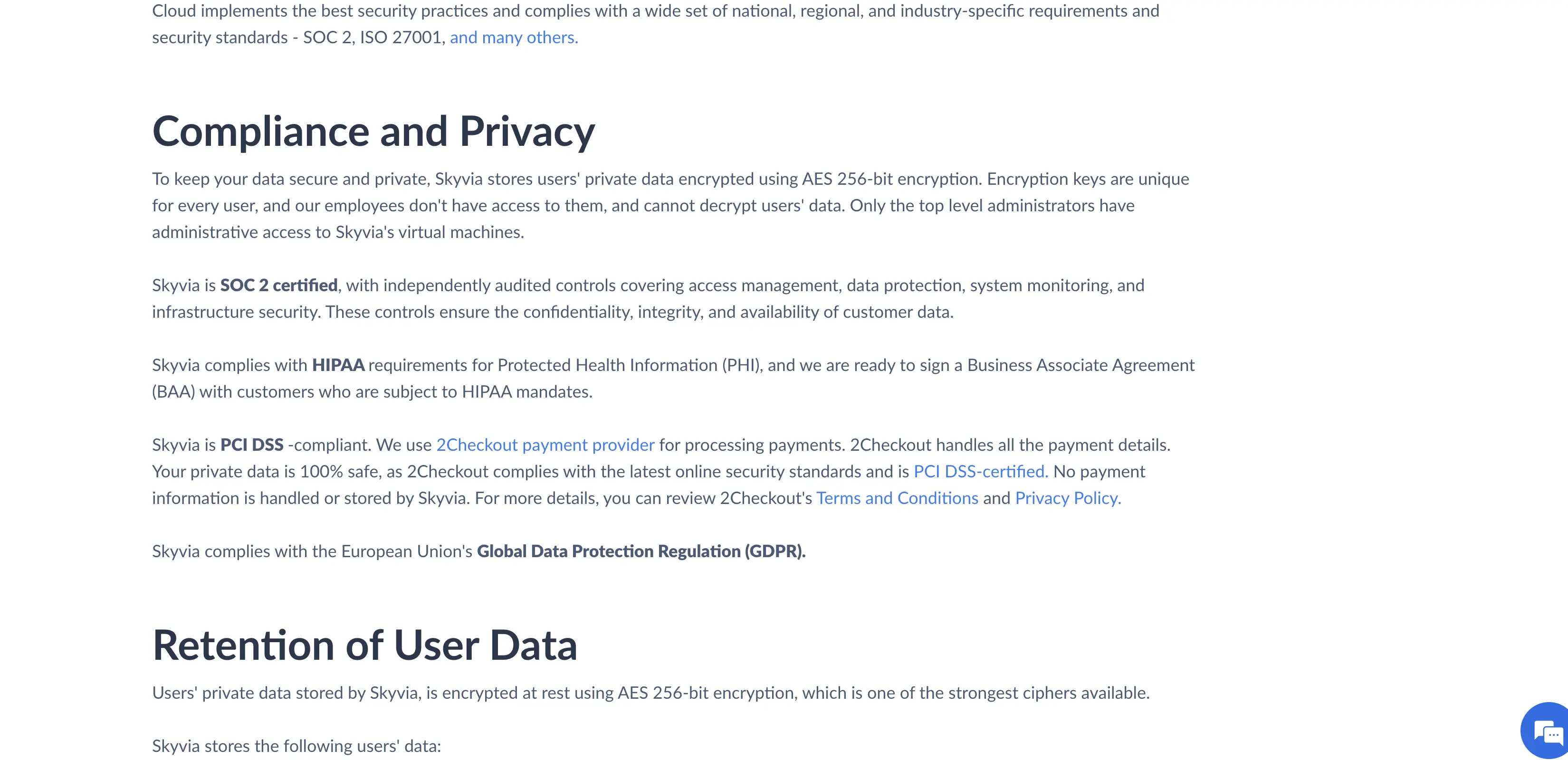
If compliance is your reason for switching, don't assume you're trading up. Ask any alternative for a signed BAA and a current SOC 2 report before assuming it clears a bar Skyvia already clears.
Is Skyvia down a lot? What I could actually confirm
What exists is a support portal at support.skyvia.com with a community forum and a troubleshooting section for backup jobs. Not a red flag by itself, plenty of platforms Skyvia's size handle status through support tickets, but if uptime matters, ask their support team directly.
Decision guide: which Skyvia Alternative fits your setup
If you're running NetSuite or Business Central for ERP: look at Boomi or Jitterbit first. Both show up repeatedly in ERP focused comparisons, and Boomi's $99 entry point keeps the switch affordable while you evaluate.
If HubSpot is your marketing system of record: Zapier or n8n covers most HubSpot to warehouse workflows without the enterprise contract MuleSoft or Boomi requires.
If Salesforce backup was your main use of Skyvia: compare its Backup Professional tier against a Salesforce specific backup tool before assuming a full switch is necessary.
If you're on Odoo and need it connected elsewhere: Airbyte's open connector library and Integrate.io's fixed fee model both support Odoo without per app surprises.
If you need on premise database access behind a firewall: Skyvia's own Agent already solves this without a static IP, and CData's driver based connectivity is the closest equivalent elsewhere.
If budget is the deciding factor: Coupler.io's $24 Starter plan or Airbyte's free Core edition covers a small team's data movement without a six product bill.
FAQs
Is Skyvia free?
Yes, for limited use. The free Data Integration plan allows 10,000 records a month and two scheduled integrations expiring after 30 days. Automation, Backup, Query, and Connect each have their own separate free tiers.
Who owns Skyvia, and is the company stable?
Skyvia is built and owned by Devart, a software company that also makes database tools and has operated for years. Skyvia states it serves over 2,000 customers and processes 30 billion records a month.
Does Skyvia support on premise or local databases behind a firewall?
Yes, through Skyvia Agent, a downloadable application creating a secure connection between your local data and Skyvia's cloud platform without a static IP address or major firewall changes.
Can I get just a Skyvia alternative for backup, without paying for full ETL?
Yes. Boomi's pay as you go plan and most dedicated SaaS backup tools let you replace only the backup function rather than committing to a full platform you don't use.
What is Skyvia used for?
Skyvia is a cloud platform for moving, backing up, automating, and querying data across apps and databases without writing code, for teams that want enterprise style connectors without an engineering team.
Which Skyvia alternative is best if I need GDPR or HIPAA compliance in writing?
Fivetran's Business Critical tier and Integrate.io's custom enterprise plan both explicitly support HIPAA readiness. Ask for a signed BAA and a current SOC 2 report from any vendor, Skyvia included, before treating compliance as a reason to switch.
If you're weighing data sync tools against the wider integration market, our best iPaaS platforms in 2026 guide groups all ten by who each one actually serves."
Where to start
Six products, six prices, and most alternatives above replace only one at a time.
Start with which Skyvia product you actually pay for today, not the platform as a whole, and the right swap gets easier to find.