
MuleSoft is the strongest pick for API led enterprise integration with real governance controls. Boomi is the only major enterprise player that shows you an actual number, $99 a month plus usage, before you talk to anyone. n8n is the one to pick if you want the whole platform open source and self hosted, with no sales call ever required.
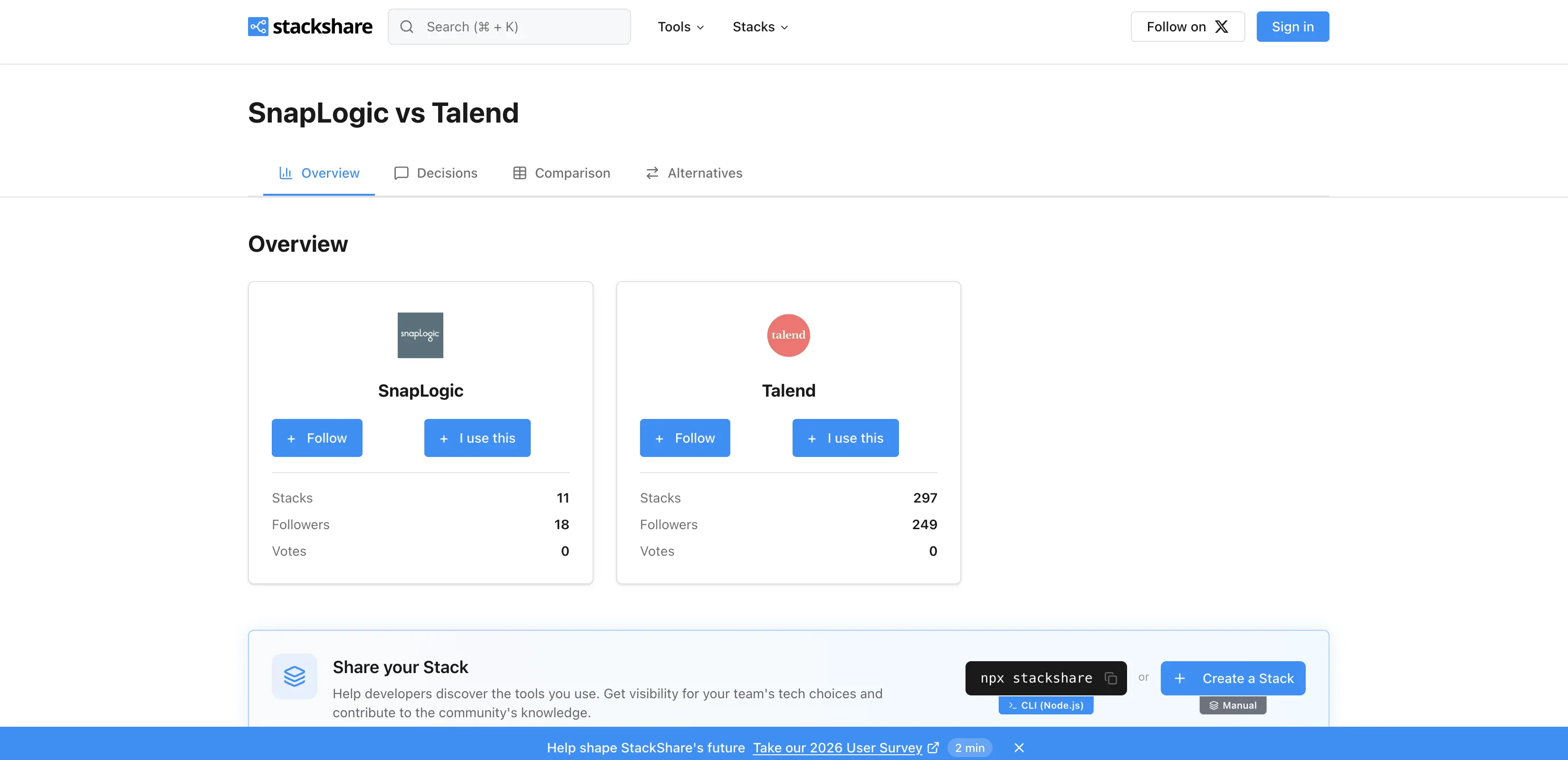
I kept seeing SnapLogic sit next to Talend on StackShare's SnapLogic vs Talend comparison page, where SnapLogic shows 18 followers against Talend's 249, an odd gap for an established iPaaS vendor. Around the same time, a client running ops for a 30 person logistics brokerage forwarded me a SnapLogic renewal quote and asked if the jump was normal.
I could not answer that without a number to compare it to, and SnapLogic will not give you one until you book a demo. So I spent two weeks pricing 13 alternatives against the same three pipelines that client already had running, using each vendor's own pricing page rather than a reseller's estimate.
Where SnapLogic runs into trouble
SnapLogic is a capable platform with real strengths. It has over 1,000 pre built connectors, it can run in the cloud, on premises, or in a hybrid setup through its Groundplex agent, and it has been pushing hard into AI agent tooling with AgentCreator and an Enterprise MCP layer that turns pipelines into tools an AI agent can call.
Where it gets harder is cost and clarity. SnapLogic sells three packages, Essential, Professional, and Enterprise One, and none of them carry a public number. You get "unlimited pipelines" and "no hidden fees" as promises, but you cannot check either claim against a price until sales gets involved. Teams that want a number today, or that want the option to self host and skip vendor pricing conversations entirely, usually start looking somewhere else.
The list of SnapLogic Alternatives, Ranked by strength
MuleSoft Anypoint Platform.
Pricing: contact sales for every package. Deployment: cloud, hybrid, or on premises. MuleSoft is the deepest option here for API led integration, with governance and API management built into the same platform rather than sold as an add on.
It is also the tool most SnapLogic evaluations get compared against directly, since both target the same enterprise integration budget.
If you already know MuleSoft is on your shortlist, our pricing breakdown of 12 MuleSoft ESB alternatives has the numbers for the tools around it.
Dell Boomi.
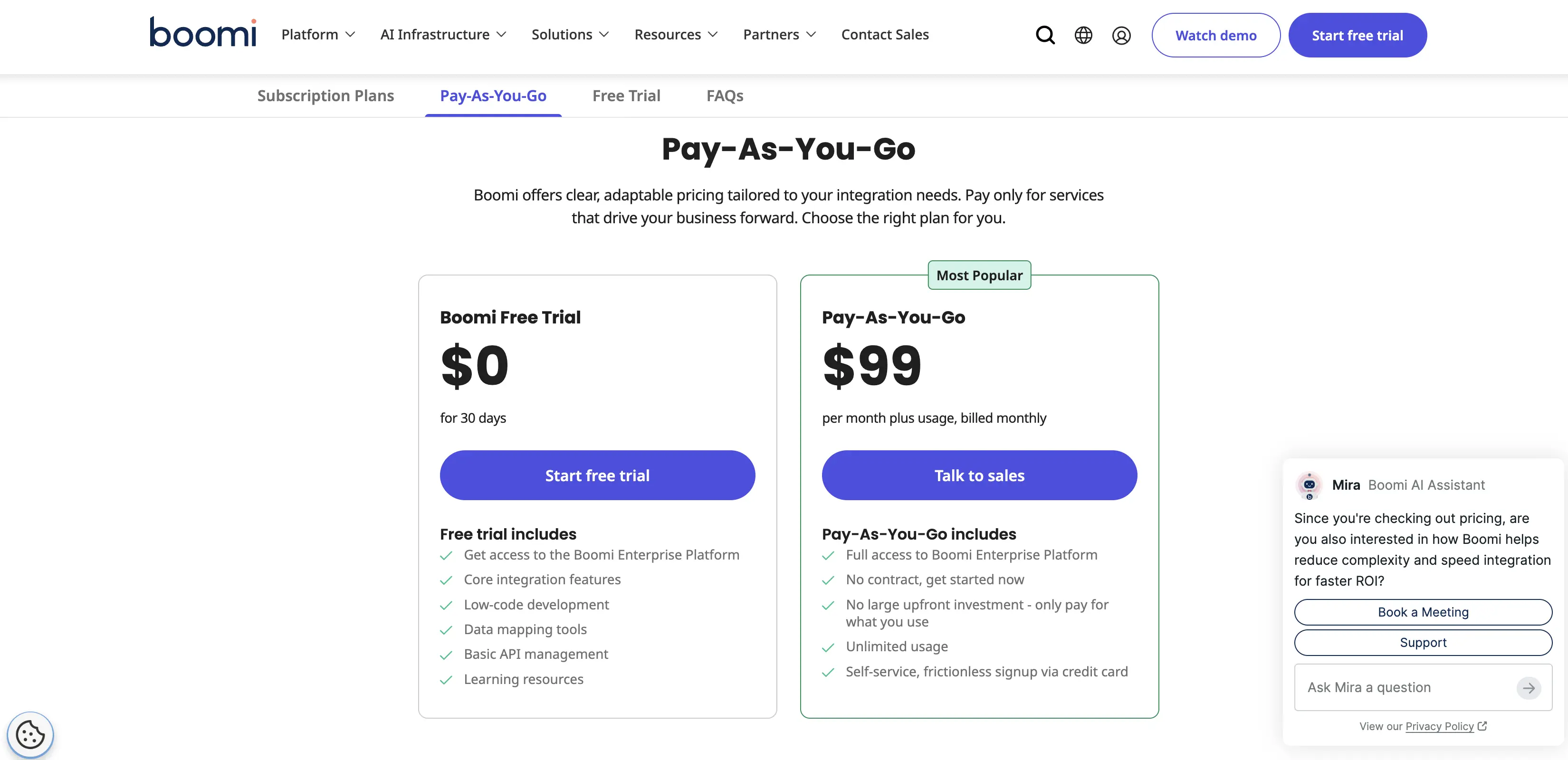
Pricing: free 30 day trial, then pay as you go from $99 a month plus usage. Every tier above that is sales gated. Deployment: cloud native with hybrid options.
Boomi is the fastest to get a real number out of, and it is built for mid market teams that want low code integration without a long implementation.
Workato.
Pricing: contact sales, no published tiers. Deployment: cloud only.
Workato leans hardest into cross department automation, the kind where a finance team and a support team both touch the same workflow without either one writing code.
Informatica IDMC.
Pricing: consumption based on Informatica Processing Units, rate available only after contact. Deployment: cloud.
Informatica's strength is metadata management and data quality at a scale most other tools on this list do not try to match, which is why large enterprises with governance requirements gravitate toward it.
Celigo.
Pricing: Standard, Professional, and Enterprise editions, all sales gated, with a 30 day free trial. Deployment: cloud.
Celigo prices by endpoints and flows rather than usage, and it is aimed at small to mid sized teams that want prebuilt flows instead of building integrations from scratch.
Jitterbit Harmony.
Pricing: Standard, Professional, and Enterprise tiers, contact sales, annual contracts required. Deployment: cloud or hybrid through private agents.
Jitterbit bundles integration and a low code app builder in one subscription, with enterprise license agreements for large deployments.
Qlik Talend Cloud.
Pricing: Starter, Standard, Premium, and Enterprise editions, all contact only, billed on data volume and job execution. Deployment: cloud or client managed.
This is the pick for teams that care as much about data quality and governance as they do about moving data from one place to another.
Fivetran.
Pricing: free up to 500,000 monthly active rows, then usage based from a $5 base charge per connection, with Enterprise and Business Critical tiers above that. Deployment: cloud.
Fivetran is built for moving data into a warehouse, not for general app to app automation, so it is the right swap only if that is actually your use case.
Azure Data Factory.
Pricing: consumption based on pipeline activity runs and compute hours, no flat published rate, calculated through Microsoft's pricing calculator. Deployment: cloud, tied to the Azure ecosystem.
It makes the most sense for teams already committed to Azure who want pipeline orchestration without adding a separate vendor relationship.
Tray.ai.
Pricing: Pro, Team, and Enterprise plans, all contact only. Deployment: cloud.
Tray leans into embedding AI agents directly inside automation workflows, which puts it closer to SnapLogic's newer AgentCreator positioning than most tools on this list.
n8n.
Pricing: Starter at 20 euro a month, Pro at 50 euro a month, Business at 667 euro a month, all billed annually, plus a free Community edition that is fully open source and self hosted. Deployment: cloud or self hosted, your choice.
It is the only tool here where you can read the entire source code before you commit to it.
Zapier.
Pricing: free for 100 tasks a month, Professional starting from $19.99 a month, Team starting from $69 a month. Deployment: cloud only.
Our full breakdown of Zapier's real task pricing covers how fast that task count adds up, but for simple app to app triggers it is still the fastest tool on this list to set up.
Make.
Pricing: free for 1,000 credits a month, Core at $12 a month, Pro at $21 a month, Teams at $38 a month. Deployment: cloud only.
Make is the visual workflow builder of this group, and its paid tiers stay cheaper than Zapier's at similar volume.
SnapLogic alternatives Compared
Tool | Deployment | Public self serve pricing | Best for |
|---|---|---|---|
MuleSoft Anypoint Platform | Cloud, hybrid, on premises | No | API led enterprise integration |
Dell Boomi | Cloud native, hybrid | Yes, entry tier only | Fast mid market deployment |
Workato | Cloud | No | Cross department automation |
Informatica IDMC | Cloud | No | Enterprise metadata and governance |
Celigo | Cloud | No | Small to mid size teams, prebuilt flows |
Jitterbit Harmony | Cloud, hybrid | No | Integration plus app building |
Qlik Talend Cloud | Cloud, client managed | No | Data quality and governance |
Fivetran | Cloud | Yes | Moving data into a warehouse |
Azure Data Factory | Cloud, Azure only | No, calculator required | Teams already on Azure |
Tray.ai | Cloud | No | Embedded AI agent workflows |
n8n | Cloud or self hosted | Yes | Open source, dev friendly |
Zapier | Cloud | Yes | Lightweight task automation |
Make | Cloud | Yes | Budget friendly visual automation |
How much does SnapLogic actually cost?
SnapLogic sells three packages, Essential, Professional, and Enterprise One. Its own pricing page promises "no surprises, no hidden fees," but it does not put a single dollar figure anywhere on that page. Every tier routes to "book a demo."
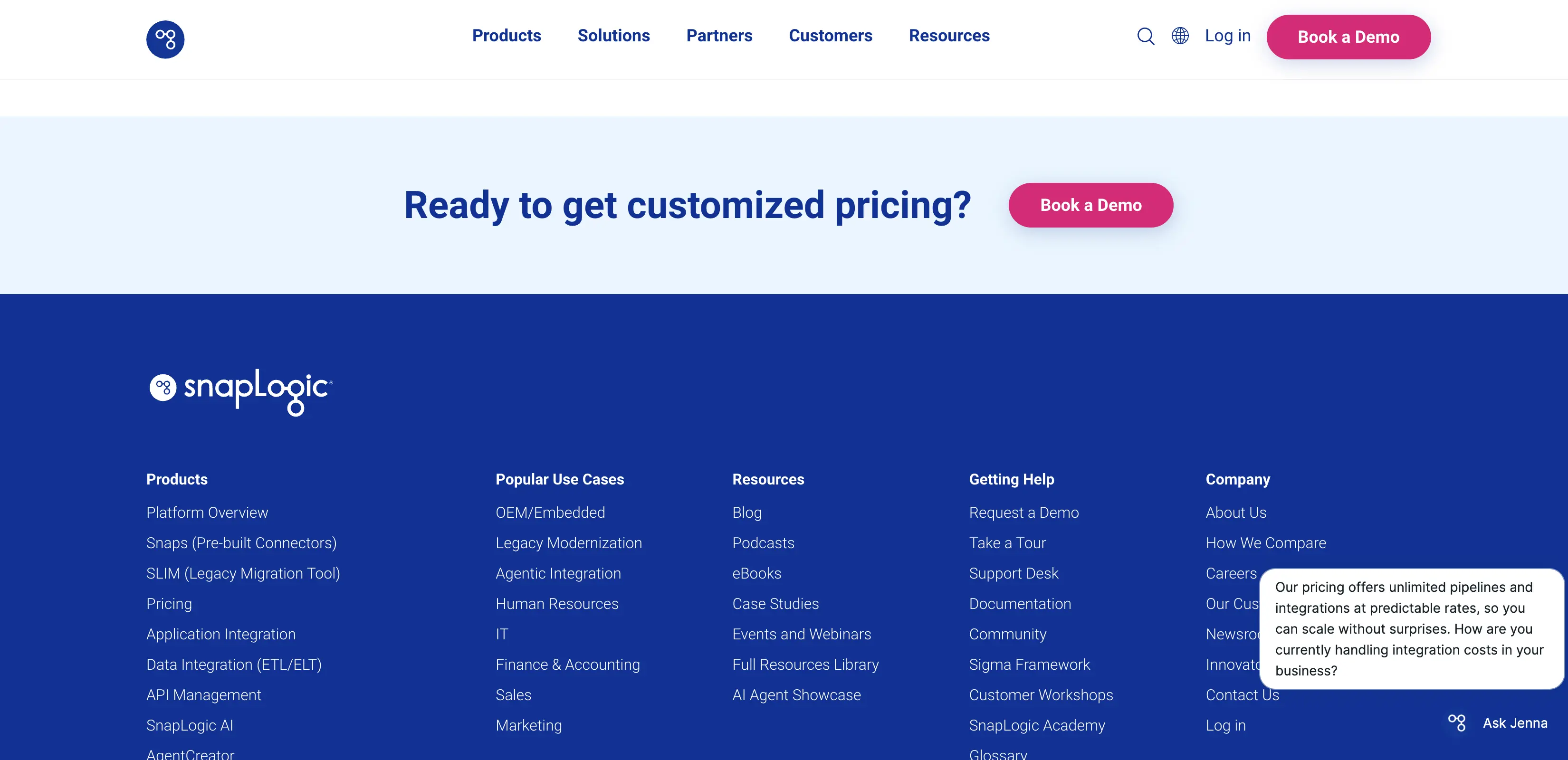
That is not unusual for this category. Nine of the 13 alternatives here are priced the same way, sales call first, number second, but reviewers rarely say so plainly.
If a fast, published number matters to you, Boomi's entry tier, Fivetran, n8n, Zapier, and Make are your realistic options. Everything else on this list requires the same conversation SnapLogic does.
Is SnapLogic an ETL tool, an iPaaS, or middleware?
Technically, it is closest to an iPaaS, an integration platform as a service that connects and moves data between applications. But SnapLogic also does the work people associate with ETL, extract, transform, load, when it moves and reshapes data for a warehouse, and it can sit in the middle of two systems the way older middleware products did.
The honest answer is that the category labels blur once a platform gets this broad. If your evaluation criteria are built around a single label, ETL only, or iPaaS only, you will end up cutting tools that could actually do the job. Judge SnapLogic and its alternatives on the specific pipelines you need to build, not on which category box they check.
SnapLogic vs MuleSoft vs Boomi: how the three actually differ
These three get compared as a set more than any other combination, and the differences are less about raw capability than about who each one is built for.
MuleSoft leans hardest into API management and governance, the controls a security team asks for before signing off.
Boomi leans into speed, it is the fastest of the three to get running and the only one with a public entry price.
SnapLogic sits in the middle, with a stronger AI and agent story than either of the other two right now, but the same opaque pricing as MuleSoft.
If governance is the deciding factor, MuleSoft wins. If time to first pipeline matters most, Boomi wins.
If you specifically want the newest agent tooling and are willing to accept unclear pricing to get it, SnapLogic still has an edge, at least until a competitor catches up on that front.
Which SnapLogic alternative is actually open source?
Only one tool in this list is actually open source: n8n. Its Community edition is free, self hosted, and the source code is public, which means you can read exactly what it does before a single workflow touches production data.
The paid cloud tiers exist for teams that want n8n's infrastructure managed for them, but the self hosted option never disappears behind a sales call.
Every other tool on this list, including SnapLogic, is closed source. Some are cheap or free to start, Zapier and Make both have real free tiers, but "free" and "open source" are not the same claim, and it is worth keeping them separate when you are actually comparing options.
SnapLogic vs Snowflake and Databricks: not the same fight
SnapLogic is not a substitute for Snowflake or Databricks, and neither of those is a substitute for SnapLogic. Snowflake and Databricks are where data lives and gets processed at scale. SnapLogic, like the other tools in this list, is what moves data into and out of those platforms in the first place.
Most teams running SnapLogic or an alternative like Fivetran are feeding a warehouse like Snowflake or Databricks, not replacing it. If your evaluation has these three names on the same shortlist, the real question is which integration tool feeds your warehouse best, not which one replaces it.
Does your alternative need to run on premises like SnapLogic's Groundplex?
SnapLogic's Groundplex lets it run inside your own network for data that cannot leave your infrastructure, alongside its cloud hosted CloudPlex option, at the same price.
That flexibility matters more than most roundups admit, and it rules out a chunk of this list immediately.
Zapier, Make, and Fivetran are cloud only, with no on premises option at all. If an on premises or hybrid requirement is non negotiable for you, your realistic alternatives narrow to MuleSoft, Boomi, Jitterbit, or n8n, since all four can run outside a vendor's cloud when you need them to.
SnapLogic's AI agent tools: does any alternative match Enterprise MCP and AgentCreator?
Of the 13 tools here, Tray.ai comes closest to matching SnapLogic's agent tooling, since it was built from the ground up around embedding agents inside automation workflows rather than adding the capability on top of an older platform.
Workato and Boomi have both added AI assisted building tools recently, but neither has published anything as specific as SnapLogic's MCP layer.
SnapLogic pushed hard into agentic AI over the past year, with AgentCreator for building AI agents visually and an Enterprise MCP layer that exposes existing pipelines as tools an AI agent can call directly.
Most of the alternatives fetched for this roundup were last updated before that push landed, so almost none of the coverage out there mentions it at all.
If agent tooling is the deciding factor rather than a nice to have, SnapLogic and Tray.ai are currently the two names worth a closer look, not the rest of this list.
Picking the right SnapLogic Alternatives
If you need API governance and multi cloud reach at enterprise scale, go with MuleSoft.
If you want the fastest path to a running pipeline with a real price you can check today, go with Boomi.
If your integrations sit across finance, support, and ops teams who cannot write code, go with Workato.
If you are moving data into a warehouse rather than syncing apps, go with Fivetran.
If you want to self host, read the source, and never see a sales call, go with n8n.
If you are a two person team automating a handful of everyday tasks, go with Zapier or Make, whichever fits your budget.
FAQs
What are the key differences between SnapLogic and MuleSoft?
MuleSoft focuses more on API management and governance controls, while SnapLogic leans harder into AI agent tooling through AgentCreator and Enterprise MCP. Both keep pricing behind a sales call, and both support cloud, hybrid, and on premises deployment.
Is SnapLogic easy to learn?
It depends on your background. The visual pipeline builder is approachable for non technical users on simple flows, but building anything with error handling, parameters, or child pipelines assumes some integration experience. Budget real onboarding time either way.
Is there a free SnapLogic alternative?
Yes. n8n's Community edition is free and self hosted, and Zapier and Make both offer free tiers for a limited number of tasks or credits a month. None of those free tiers replace an enterprise SnapLogic deployment, but they cover a real slice of use cases.
Is SnapLogic the same as Kafka or Kong?
No. Kafka is a streaming platform for moving high volume event data in real time, and Kong is an API gateway focused on routing and securing API traffic. SnapLogic and its alternatives in this list connect applications and move data between them, which is a related but different job.
Does SnapLogic offer a free trial?
SnapLogic does not publish a self serve free trial on its pricing page. Access requires booking a demo first, unlike Boomi and Celigo, which both offer a 30 day free trial without a sales call.
If you want to see which integration platforms publish a real price and which hide every tier behind a sales call, our best iPaaS platforms in 2026 guide checks all ten.
Bottom line
SnapLogic is not a bad platform. It has the connector breadth and the AI agent tooling to back up its reputation.
What it does not have is a number you can check without picking up the phone, and for most of this list, neither do its competitors.
Start with MuleSoft if governance is non negotiable, Boomi if you want a real price today, and n8n if you would rather never make that sales call at all.