
Make's pricing page lists Core at $9 a month for 10,000 credits when you pay for the whole year. Add the US country setting to the address, and the same plan reads $12.
Both numbers are real. Make pricing follows a separate list for each country, and third-party guides print $9, $11, or $12 for the same plan, so a reader who compares two guides ends up unsure which figure to budget.
This guide covers Make, the automation tool at Make.com that used to be called Integromat.
Figma Make is not covered.
Short answer
Free costs $0 and includes 1,000 credits a month. Paid prices depend on the credits you pick and on which list you see, so check the list for your country before you compare any plan with another tool.
At 10,000 credits on yearly billing, Core is $9 or $12, Pro is $16 or $21, and Teams is $29 or $38 a month.
Free: a place to test.
Core: the first paid step, because it lifts the cap on active scenarios.
Pro: the pick when your runs must start first in line, or when you need custom variables.
Teams: the pick when several people share scenarios and need roles.
Why does Make cost $9 on one site and $12 on another?
Make shows different price lists by country, and at 10,000 credits a month, Core costs $9 on the default list and $12 on the US list when you pay for the whole year.
Pro costs $16 or $21, and Teams costs $29 or $38. Monthly billing costs more.
Plan | Default list, yearly | Default list, monthly | US list, yearly | US list, monthly |
|---|---|---|---|---|
Core | $9 | $10.59 | $12 | $16 |
Pro | $16 | $18.82 | $21 | $28 |
Teams | $29 | $34.12 | $38 | $51 |
All prices in that table are per month at 10,000 credits. Both lists were read from Make's own pricing page on 16 November 2026.
Here is the default page as it looked that day.
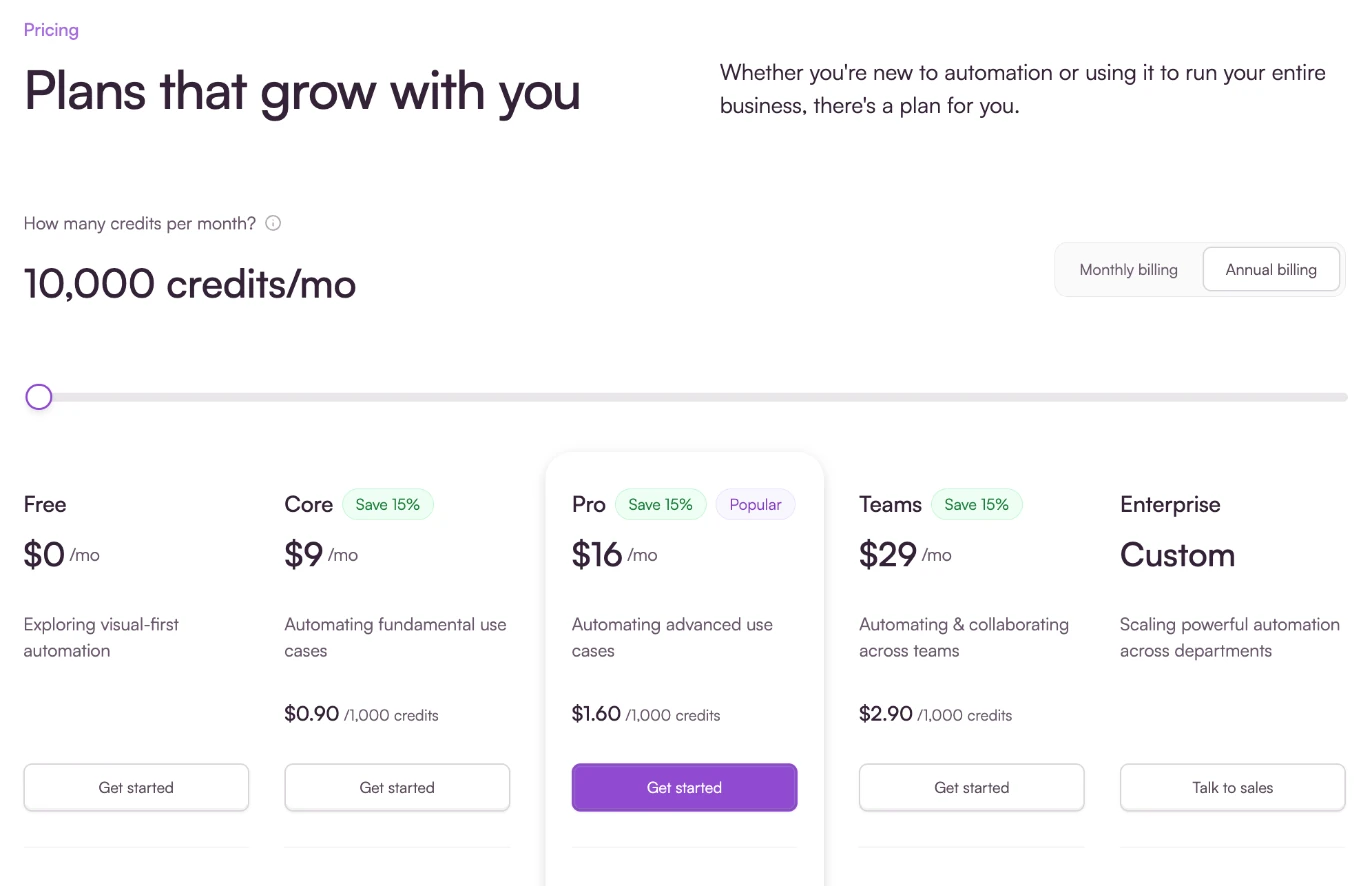
The yearly savings differ too. The default list says Save 15%, and the US list says Save 25%, and Make does not say on its page whether the two lists are permanent or how long each one will stay.
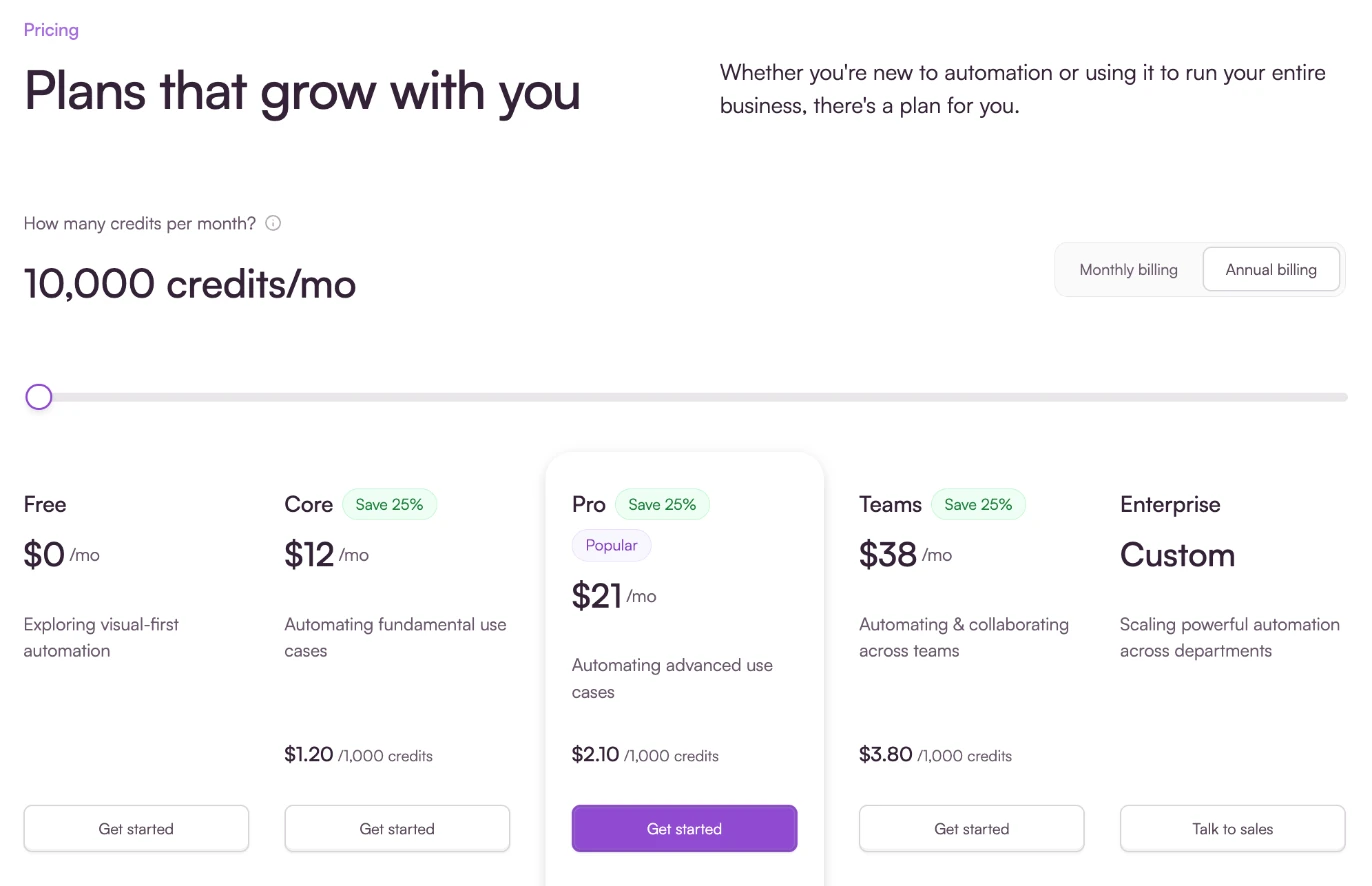
Core on the default list costs $9 a month on yearly billing. A full year costs $108.
Core on the US list costs $12 a month on yearly billing. A full year costs $144.
The US list costs $36 more over the year, which is 33% more.
Make.com pricing in India has a third layout. It loads at https://www.make.com/en/pricing?pricing-country=IN and shows Free, one paid plan called Make Plan, and Enterprise at a custom price.
At the starting slider position of 5,000 credits, Make Plan costs $9 a month on yearly billing, which is $1.80 for every 1,000 credits, and $10.59 a month on monthly billing. Other sizes are not listed.
Weigh a year of upfront payment against month-by-month cost with our annual vs monthly calculator.
Make plans and pricing: what 10,000 credits cover
Most steps cost 1 credit, so 10,000 credits cover about 10,000 steps a month. Make's pricing page says that each time a step in a scenario acts, it uses credits.
Reading a record from Pipedrive and writing a row into a Google Sheet count as 1 credit each, while some advanced features that use Make's AI Provider may use more.
Take one scenario with 4 steps that runs 300 times in a month. Each step costs 1 credit, so one run costs 4 credits. 300 runs cost 1,200 credits.
Free includes 1,000 credits, so that scenario is already 200 credits over, while Core includes 10,000 credits and leaves 8,800 after the 1,200 are used.
Free allows 2 active scenarios and starts a run no more often than every 15 minutes. Core lifts the cap on active scenarios, lets you schedule down to the minute, and adds access to the Make API.
Pro lists priority scenario execution, custom variables, and full text search of execution logs, and Teams lists team roles and shared scenario templates, with Enterprise at a custom price.
How much do Make extra credits cost?
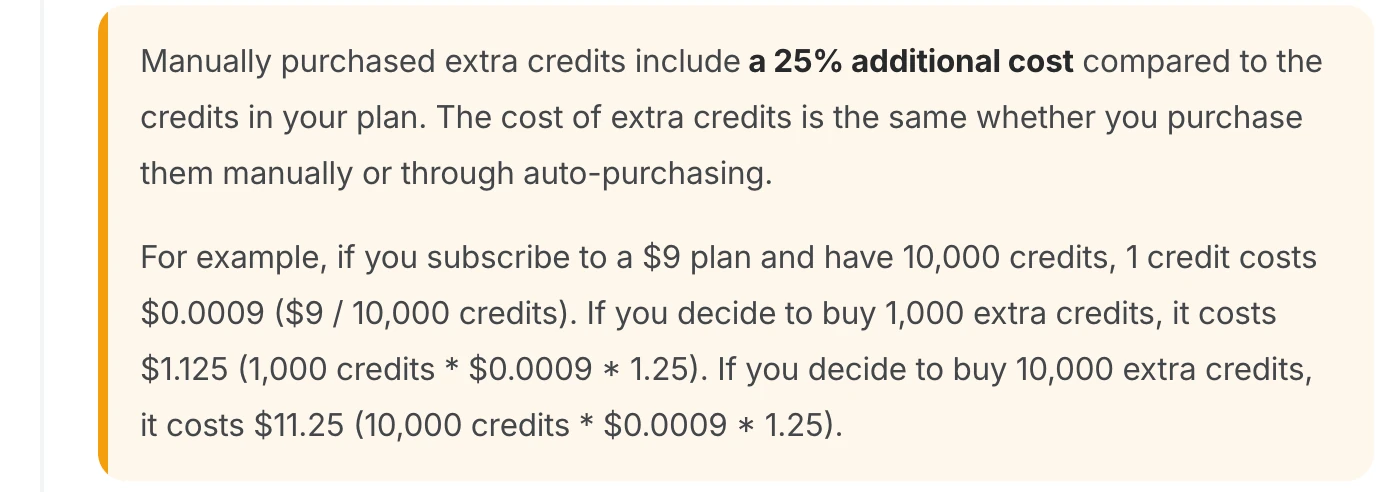
Extra credits cost your plan's own rate plus 25%, so on Core at 10,000 credits, 1,000 extra credits cost $1.125 on the default list and $1.50 on the US list.
Start with the default list. Core costs $9 a month for 10,000 credits, which is $0.90 for 1,000 credits. Add 25%, and 1,000 extra credits cost $1.125. 10,000 extra credits cost $11.25.
On the US list, Core costs $12 a month for 10,000 credits, which is $1.20 for 1,000 credits. Add 25%, and 10,000 extra credits cost $15.00.
The Make Help Center gives the 25% rule with a $9 plan as its example.
The table below applies the same rule to each plan at 10,000 credits on yearly billing.
Plan | Default list, per 1,000 extra credits | US list, per 1,000 extra credits |
|---|---|---|
Core | $1.125 | $1.50 |
Pro | $2.00 | $2.625 |
Teams | $3.625 | $4.75 |
Manual purchases start at 1,000 credits, in multiples of 1,000. Auto purchase buys 10,000 credits at a time, takes cards only, and works on Core, Pro, and Teams.
Make limits it to the number of credits in your plan, so an 80,000-credit plan can auto-purchase 8 times at most, and using up your data transfer can also trigger an auto-purchase while credits remain. Free users cannot buy extra credits.
Reviews ask for credit alerts. G2 rates Make 4.6 out of 5 across 493 reviews. One reviewer asks for a WhatsApp alert when credits run out, and another wishes the app showed the estimated credit use for the next 24 hours of a scheduled scenario.
Make AI pricing: what AI steps and Maia cost
AI steps and Maia chats draw from the same credits as ordinary steps, but Make changed how its AI Provider counts them on 25 August 2026, and one Maia reply can cost more than 100 credits.
The Make Help Center shows the new rates. Before that date, Make counted input and output tokens together, so Small gave 5,000 tokens for each credit, Medium gave 3,500 tokens, and Large gave 1,500 tokens. Now they have separate rates.
Small and Medium each give 18,080 input tokens or 2,260 output tokens for each credit. Large gives 3,616 input tokens or 452 output tokens.
Make's own example uses a data extraction step on Medium with 2,000 input tokens and 100 output tokens.
It cost about 0.6 credits before and costs about 0.16 credits now, a 73% cut. A step that writes long text from a short prompt may cost more than it did. Own API keys are unaffected.
Maia chats are still in public beta, and they "draw from the same credit pool that you use for scenarios," says Maia by Make. Paid plans get unlimited access and pay in credits.
The first 70 messages are free for 30 days as a temporary promotion. The Free plan gets a 30-day trial with 45 free messages.
The same help page shows one reply that used 140.04 credits and another that used 160.18, so a single reply can cost more than 100 credits.
Use 140.04 as the guide. That buys about 71 replies from 10,000 credits. Divide 10,000 by 140.04, and you get 71.4.
Make says each reply costs more or less with the task; the cost is the same on every plan, and the page may change during the beta.
Core caps at 300,000 credits, and credits expire
Core stops at 300,000 credits a month. Above that, Pro goes up to 8 million credits.
Core subscribers with more than 300,000 credits were moved to Pro at the same price, and the Make Help Center gives the example of 500,000 credits at $338.13 a month, a price that stayed the same.
Unused credits expire. Plan credits end with the term, and extra credits expire after one month on monthly billing, or at the end of one year on an annual Pro or Teams plan, so buy only what you expect to use.
Make startup program and nonprofit offers
Make's pages describe three startup offers. They disagree. For nonprofits, the pricing page lists no discount and asks NGOs and NPOs to contact Make.
The Make Startup Program page offers the Teams plan free for up to 6 months, with nearly 500,000 credits, then 50% off any plan for 3 months. It asks for funding of up to $5 million and no automation as a service.
The Make startup application says something else. A startup with an investor in Make's network gets 6 months and 50% off Pro or Teams with 480,000 credits.
A bootstrapped team gets 3 months and 50% off with 240,000 credits, and the form asks for a company under 5 years old, under 50 people, not yet a paying customer, and not selling AI automation services.
The pricing page adds a third version. It offers 50% off to teams under 20 employees and calls the discounted plan Business. Ask Make first.
Make vs Zapier vs n8n pricing
Make counts credits for each action a step performs. Zapier prices by tasks, and n8n prices by runs. Count the steps first.
Read Zapier pricing in 2026 and n8n pricing at your number of runs to see how the same work is counted on each tool, because a lower sticker price can turn into a higher bill.
If your credits run out early and you want another tool, our Make alternatives guide covers the options.
For a wider list with real prices, see the best iPaaS platforms.
Who should pick which plan?
To test, stay on Free.
If you build for yourself and need more than 2 active scenarios, pick Core.
If you run client automations as an agency, add up credits across every client first, then compare Core and Pro by the cost of 1,000 credits.
If you build with AI steps or Maia, budget more credits than your step count suggests.
If you run a startup, check which of the three offers your page shows before you pay.
If you run a nonprofit, contact Make about the NGO and NPO route first.
If a team shares scenarios, pick Teams for roles and shared templates.
Make pricing FAQ
Is Make free?
Yes. Make has a Free plan with 1,000 credits a month, 2 active scenarios and a 15 minute minimum interval between runs, and it stops when the credits are used up, since Free cannot buy extra credits.
What happens when my Make credits run out?
Your scenarios stop running. Incoming webhooks wait in a queue up to your queue storage and run once credits return, and scenarios that poll for data search for records since the last time they ran.
You can upgrade, buy extra credits, or turn on auto purchase.
Does Make have a Black Friday deal?
No Black Friday offer appeared on Make's pricing page on 16 November 2026. Startups and nonprofits have their own routes, covered above.
Is Make Enterprise pricing public?
No. The pricing page shows Enterprise as a custom price, so you ask Make for a quote, and Enterprise adds custom functions support, enterprise app integrations, 24/7 Enterprise support, overage protection, and advanced security features.
What happens if I downgrade Make?
Active scenarios that use features of the higher plan stop, and Make warns you first; your card is charged right away, the downgrade date starts a new billing cycle, and unused credits move to the new plan.
Before you pay
Open Make's pricing page and check which list you see for your country. Count the steps in your busiest scenario, then add up the runs you expect in a month.
Past 1,000 credits, Free stops. Pick the cheapest plan that holds the total with room to spare, and check the page again on the day you pay, since Make can change either list.